
Tags
Edward Lear, Jabberwocky, John Hoskyns, Lewis Carroll, narrative, neologisms, Nonsense, The Jumblies, Tony Maude
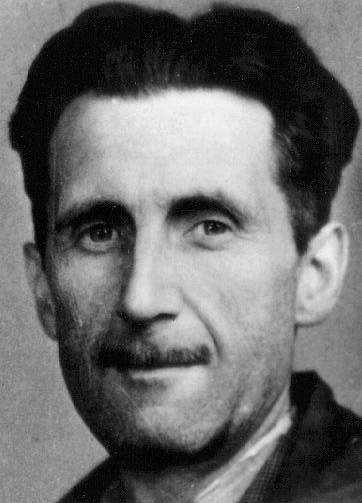
In many languages, it is said, there is no nonsense poetry, and there is not a great deal of it even in English. (George Orwell, pictured above)
Hello poets everywhere. My name is Tony Maude and it is my pleasure to once more take up the towel, set up the glasses and welcome you to the pub. Today I’d like you to try your hand at writing some nonsense of your own … smiles. But first some history …
The Origins of Nonsense Poetry
Although nonsense poetry is inextricably connected with the names of Lewis Carroll and Edward Lear, historians of the genre generally hold that the earliest example of nonsense verse is Cabalistical Verses by the 17th century wit John Hoskyns. Here it is:
Even as the waves of brainless butter’d fish,
With bugle horne writ in the Hebrew tongue,
Fuming up flounders like a chafing-dish,
That looks asquint upon a Three-mans song:
Or as your equinoctiall pasticrust
Projecting out a purple chariot wheele,
Doth squeeze the spheares, and intimate the dust,
The dust which force of argument doth feele:
Even so this Author, this Gymnosophist,
Whom no delight of travels toyle dismaies,
Shall sympathize (thinke reader what thou list)
Crownd with a quinsill tipt with marble praise.
Hoskyns example was taken up by his contemporary John Taylor – the self-styled Water-poet. Although his early work could be categorised as gibberish, Taylor quickly discovered the comedic value of animated food and his later works contain all manner of foodstuffs (especially seafood for some reason) leaving the plate and performing all manner of strange activities.
Taylor died in 1653 and, by and large, nonsense poetry then disappeared until it was re-invented by Lear and Carroll in the 19th Century.
Why Write Nonsense Verse?
The 17th century in Britain was a time of great political and religious tension. The century began with the death of England’s Queen Elizabeth in 1603. She left no direct heir and so James VI of Scotland inherited the throne, becoming James I of the newly united kingdoms of Scotland and England. He was succeeded in turn by his son Charles I. Tensions between the Crown and Parliament erupted during his reign, leading to the Civil War and ultimately to the execution of the King and the installation of Oliver Cromwell as Lord Protector of the Commonwealth of England, Scotland and Ireland.
Against such a turbulent and violent background simply saying the wrong thing to the wrong person could result in imprisonment or worse, and publishing your views was a very risky business indeed. Step forward nonsense as a form of political writing in which you could say whatever you wanted while being able to claim that any meanings other people might choose to read into your words were not necessarily what you intended. Nonsense writing was a way to make a stand for what you believed in and against those whose political and religious views (and actions) you opposed. It seems probable to me that the Restoration of the Monarchy in 1660 and the increase in religious tolerance in Britain over the following century were at least as significant factors in the virtual disappearance of nonsense verse as the death of John Taylor.
Nonsense resurfaced in the 19th Century in the works of Lewis Carroll (Rev Charles Dodgson) and Edward Lear, both of whom were writing for children. Carroll wrote his Alice books for Alice Liddell while Lear composed his verse – and illustrated it – to entertain the children of Edward Stanley, 13th Earl of Derby.
Narrative
Setting aside limericks, most nonsense verse is narrative in style – it tells a story. Both Carroll and Lear wrote nonsense narratives describing fantastical adventures undertaken in fantasy worlds, sometimes by imaginary creatures, sometimes by animals and people behaving in the most unexpected ways. Edward Lear gave us The Jumblies, The Courtship of the Yonghy Bonghy Bo, and The Owl and the Pussycat, while Lewis Carroll’s most famous poems are Jabberwocky (see below) and The Hunting of the Snark. But, although there are obvious similarities between Carroll and Lear’s work, the two writers generally took differing approaches to the creation of their imaginary worlds – and it is to these we turn now.
Putting the Ordinary to Extraordinary Uses
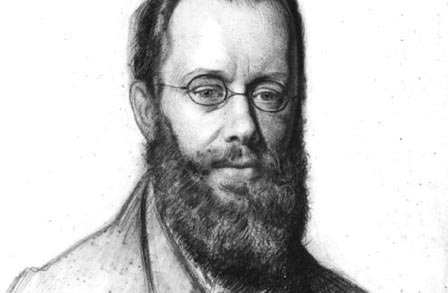 Edward Lear
Edward Lear’s nonsense poems are full of ordinary, everyday objects being put to extraordinary uses. The Jumblies serves to illustrate the point:
The Jumblies
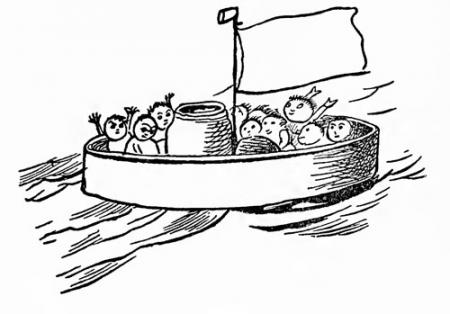
They went to sea in a Sieve, they did,
In a Sieve they went to sea:
In spite of all their friends could say,
On a winter’s morn, on a stormy day,
In a Sieve they went to sea!
And when the Sieve turned round and round,
And every one cried, “You’ll all be drowned!”
They called aloud, “Our Sieve ain’t big,
But we don’t care a button! we don’t care a fig!
In a Sieve we’ll go to sea!”
Far and few, far and few,
Are the lands where the Jumblies live;
Their heads are green, and their hands are blue,
And they went to sea in a Sieve.
They sailed in a Sieve, they did,
In a Sieve they sailed so fast,
With only a beautiful pea-green veil
Tied with a riband by way of a sail,
To a small tobacco-pipe mast;
And every one said, who saw them go,
“O won’t they be soon upset, you know!
For the sky is dark, and the voyage is long,
And happen what may, it’s extremely wrong
In a Sieve to sail so fast!”
Far and few, far and few,
Are the lands where the Jumblies live;
Their heads are green, and their hands are blue,
And they went to sea in a Sieve.
The water it soon came in, it did,
The water it soon came in;
So to keep them dry, they wrapped their feet
In a pinky paper all folded neat,
And they fastened it down with a pin.
And they passed the night in a crockery-jar,
And each of them said, “How wise we are!
Though the sky be dark, and the voyage be long,
Yet we never can think we were rash or wrong,
While round in our Sieve we spin!”
Far and few, far and few,
Are the lands where the Jumblies live;
Their heads are green, and their hands are blue,
And they went to sea in a Sieve.
So one approach to writing nonsense is to take the ordinary and make it extraordinary; to put everyday objects to unusual – even insane – uses.
Another approach is to use invented words – neologisms – which Lewis Carroll was brilliant at.
Neologisms
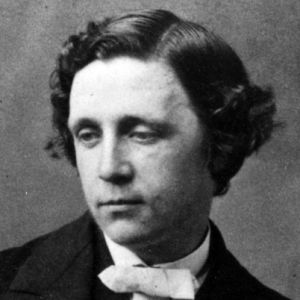 Lewis Carroll
Jabberwocky
’Twas brillig, and the slithy toves
Did gyre and gimble in the wabe:
All mimsy were the borogoves,
And the mome raths outgrabe.
“Beware the Jabberwock, my son!
The jaws that bite, the claws that catch!
Beware the Jubjub bird, and shun
The frumious Bandersnatch!”
He took his vorpal sword in hand;
Long time the manxome foe he sought—
So rested he by the Tumtum tree
And stood awhile in thought.
And, as in uffish thought he stood,
The Jabberwock, with eyes of flame,
Came whiffling through the tulgey wood,
And burbled as it came!
One, two! One, two! And through and through
The vorpal blade went snicker-snack!
He left it dead, and with its head
He went galumphing back.
“And hast thou slain the Jabberwock?
Come to my arms, my beamish boy!
O frabjous day! Callooh! Callay!”
He chortled in his joy.
’Twas brillig, and the slithy toves
Did gyre and gimble in the wabe:
All mimsy were the borogoves,
And the mome raths outgrabe.
What an absolute feast of invented words! But how do you invent a new word? One of Carroll’s techniques was to condense two existing words into one new one. For example, slithy is the result of combining slimy with lithe – and it manages to convey a sense of both as it describes the gyring and gimbling motions of the toves. Something else Carroll was good at was making it clear what type of word – noun, verb, or adjective – his neologisms are; of all the strange new words in Jabberwocky, only brillig is difficult to classify; is it a noun or an adjective?
A Call to Order
I’ll close with a couple of notes on style.
First, although the three poems I have included in this article are clearly nonsense, they are neither anti-sense nor gibberish. Hoskyns’ poem has the appearance of a eulogy for another writer; Lear and Carroll have both told stories which have a coherent internal logic.
Second (Brian, you’ve been waiting for this … smiles) all three poems use standard poetical devices like meter, rhyme, alliteration, repetition and refrains etc. I think this is something worth aiming for in your own nonsense verse because it gives your readers a small sense of security in the midst of all the strangeness.
And that’s it. Have at it poets; let’s write nonsense!
Here’s what to do now:
• Write your poem and post it to your blog.
• Add a link to your poem via the ‘Mr Linky’ below.
• This opens a new screen where you’ll enter your information. This is also where you choose links to read. Once you have pasted your poem’s blog URL and entered your name, click Submit. Don’t worry if you don’t see your name right away.
• Read and comment on other people’s work to let them know it’s being read.
• Share your work and that of your fellow poets via your favourite social media platforms.
• Above all – have fun!
 dVerse
Hi poets and welcome to the pub. It’s been a wee while since I was here behind the bar. I’m glad to be back.
On this important day in my homeland, help me to while away the hours between now and the result by setting my mind on nonsensical things … you know you want to … smiles.
Ah.. yes .. you are all over the news.. I have not quite recovered from the election on Sunday here..
hey tony…. good to see you behind the bar again…
and def. an exciting day for scotland… so curious about the results…
nonsense poetry is def. not easy… for me it was a big, big challenge to come up with something…
Ha – I’m still working on mine. Remind me to ask for something easy next time I’m hosting … smiles
Thank God and common sense it’s No, Tony. I hope you agree it would have been a catastrophe. Jock would have resigned his Scottishness.
PS I write a lot of nonsense…
It would certainly have been risky … but putting faith in almost any politician’s promises is a fool’s errand. Whatever the rights and wrongs of it, Alex Salmond was elected on a promise that there would be a referendum … and he delivered on that promise. He also promised that if he lost he would step down … and he’s delivered on that too. We could do with more politicians who keep their promises like that.
Oh so true. Are there any honest statesmen left in the world?
Tony,, so nice to have your excellent prompts here .. at first I thought it would be easy,, but really it’s very hard to write nonsense with sense… The easy part was to select a form… ha!! .. but once you started writing it kind of made sense to use the rhymes to push a fantasy tale along… My internet is kind of slow today as the fibre is broken .. so I use a mobile connection instead…
It’s definitely not as easy as it looks … my hat is well and truly off to Carroll, Lear, Milligan and others who have managed to make nonsense look easy.
definitely… and lewis carroll was one smart guy… when i visited oxford a few weeks ago i learned that he was a math prof in christ church college there..
Are you smart if you know math… hmm. 🙂 that’s great news..
ha
new words come out of the young often – perhaps thinking this way helps to rejuvenate our minds – thanks again Tony, I enjoy expanding my poeticalpocketisms and tools of the trade.
Most of my recent prompts have been about poetry as a spoken/heard art form; nonsense gives you more scope to find exactly the right combination of sounds for your verse.
yes, I find it easiest to write in iambic notameter.
Bless you, Tony, what a wonderful subject – I am very fond of nonsense verse indeed! (Any association with current referendum situations are of course entirely coincidental, I presume?) I’m afraid I may link to something I wrote a couple of weeks ago, as it was spot on for this prompt – and related to the Jabberwocky. Hope that’s OK?
Of course that’s OK. And honestly, I need a break from all the referendum stuff; it’s been pretty intense. And it won’t stop when the voting is over either; then there’ll be the speculating about the result and what it might mean etc etc.
It’s a great subject and I really wanted to join in. However, my mind is not co-operating. Thought about joining Texas and Scottish secession but the images kept being less than nonsense and not even satirical. sigh…..I’ll think some more and if I fail, just realize I can’t go into gear as easily as I used to be able to do, sad as that is to say.
Nonsense is deceptive; it’s much harder to write than it looks.
smiles.. maybe you dream up something tonite and only have to write it down in the morning…
I hope. I am not very funny any more…can’t understand why. I think I used to be.
Not all nonsense is funny, Gay. Jabberwocky is quite sad – certainly that’s Alices reaction when the Mad Hatter recites it for her.
I do recall..although my Alice Books have gone missing and I ache for them. Somewhere in the move back from the beach house. I just never have wrapped my head around poetry this last 10 days although I have several ideas going. I host next week and will be challenging with my “falling diamonds” / Quarrel form that I devised. I will pre-post soon. I finished writing it today.
i enjoy neologisms and writing cryptic poetry at times.. just for the mental exercise.. and in general enjoy solving puzzles so i will read another person’s cryptic poetry to find my own meaning and attempt find the other person’s meaning too…
I think creating like this in general..is an excellent exercise to keep new connections growing in the mind.. to expand one’s horizons…
Interestingly some folks who stay in a mechanical cognition type of way of thinking in the sciences..engineering..technology and math fields may have difficulty reading emotion into poetry and the deeper meanings therein.. seeing almost all of poetry as gibberish…
And then there are those who find an emptiness in theses fields that pursue the arts..whether poetry..painting..sculpture.. or other ways of expressing heart to balance a mind that has become unbalanced…
As an administrator for the government behind a computer for much too long.. i found this in creating piano music..and then finally a cryptic way of writing poetry too….
Now i go in all directions… to continue to expand my horizons of both creativity and science too..
Emotion is required for effective learning…
Scientists.. in general.. could learn more from poetic expression to get folks more interested in science too.. 🙂
Just stopping by today.. to say i appreciate the research that went into this prompt..
I am a little under the weather in the illness category this week with a nasty intestinal bug and some respiratory virus added in.. that has expanded my emotional content a little in my writing this week as it reminds me of darker days.. so I am currently out of the more abstract ways of writing… and my mind is a little too soft now.. to solve puzzles… if you will.. but again just stopping by to thank you for all this great information on a category of poetry i do enjoy writing.. from time to time.. when the mood strikes me…:)
Thanks for dropping by … and we all hope you’re feeling well again soon.
Well folks, it’s time for me to head off to sleep; I’ve got an early start tomorrow. I will visit everyone who links – although it might take me until Saturday depending on how many of you join in.
Made me think of Dr. Seuss and t.s. elliot (CATS anyone?) may have to give this one a go after I take suppers to the harvest and baling crews tonight. 🙂 Great to see everyone here!
There’s certainly a nonsense element to Dr Seuss;
I wish that I had duck feet
and I shall tell you why,
You can splash around in duck feet,
you don’t have to keep them dry.
Smiles
Nonsense? This is right up my ally.
I will be posting something in a bit. This prompt is all me. hahahaha!!! I am just so full of nonsense today. 🙂
My new poem is up and read to read…I’m so fully of joy with Nonsense. 🙂
There were certainly some interesting flights of ideas in your poem, Charlie.
I was going to bow out of today’s prompt, because I have things I really need to do, but with a prompt like that, how could I resist procrastinating just a bit more?? I will admit that I cheated a bit…I took one of my existing poems and “nonsensesized” it (and perhaps that may be another technique that the likes of Carroll used). I was surprised at how hard this actually was!! But it was also a lot of fun!
I thought about what you would do on it Bryan.. this prompt was written for you..
That sounds like a method that could work; I found the hardest part was trying not to make too much sense, while still retaining some semblance of meaning. It’s a subtle balance and hard to get right.
This sounds really fun and you guided us through well on how to write a nonsense poem and the background stories are really interesting. I am going to put an effort in writing a poem this morning.
Thanks Lisa. It’s both fun and diffficult to do well. I’ll be looking out for your poem … smiles
Tony–what a great prompt. I do not know if I can get to it, today–may be belated–but it is really interesting and helpful. I particularly enjoyed the parts about Carroll as I’d never focused on the neologisms so much. Thanks. k.
Carroll was really, really good at neologisms; inventing words is actually quite tricky. On morethan one occcasion I’ve invented a word only to discover that it already exists!
Ha. I tend to invent them by accident! Poor usage some call it. K.
good morning… making my rounds with a cup of coffee in hand…
Where is Brian? Is he OK?
yes he’s ok – he just has loads of work at the moment and needs a little break… hopefully he’ll be back next week…
After reading through I added a second one with neologisms .. too much fun to pass ..
loved your invented words..
I will reach the end of the trail … so another stop at your place is on my agenda. I’d ask you to pour me a drink, but in Sweden that’d be really expensive … smiles
I have some special import especially for you Tony.. maybe a little single malt 🙂
With just a splash of water to let the aroma and flavour out 🙂
tony this was no nonsense..what ever i wrote it made more sense that anything else..well tried my best with the limited time,,i am preparing for my music concert and all my time is going in the rehearsals..thanks alot for this prompt..
hey very cool… what kind of concert is it and which instrument are you playing…? have fun practicing..
It’s tougher than it looks – making too little sense can be as bad as making too much though. But one way round it is to write your poem and if it makes too much sense with one object – say a spoon – then change it for another – maybe a gnu. The sound is very similar, but the meaning is totally different.
Hi everyone. Later than expected back to the bar; it’s been a really interesting, exhilarating, exciting and, for some people, sad day here in Scotland following the referendum. The analysis of what the result means will go on for some time.
One thing is for sure; democracy won. We, the people of Scotland, had the opportunity to make a decision that really mattered. We grasped that chance with both hands – 85% of the electorate voted, which is amazing in a country where voting is not compulsory and turnout is usually in the region of 45-55%. And perhaps we’ve changed UK politics forever, to the benefit of everyone who lives here.
But enough of that … back to the nonsense. I see lots of you have joined in, so I’m going to hit the trail … smiles.
Time to sleep; I’ll be round to finish the trail tomorrow … and that’s not a politician’s promise.
So much fun!
Mine is up at: http://purplepeninportland.wordpress.com/2014/09/19/the-conversation-of-the-purple-spotted-cow-and-the-ten-o-pus/
Been round and visited; I really enjoyed your poem.
Thanks, Tony!