
Tags
Bill Holm, Craig Arnold, creative writing challenge, dVerse poetics, food poetry, Halfway through August, how to rejuvenate your writing, Li Young Lee, Pablo Neruda, Sanaa Rizvi, Wallace Stevens
Good evening, Poets!
Sanaa here (aka adashofsunny) to accompany you to the world of food poetry. There is just something about a good food poem that gets me going especially when Li Young Lee writes about Persimmons.
Which brings me to question, what are some of your favorite foods, and why? Have you ever had a particularly memorable meal, either for good or bad reasons? What are some of the cultural or family traditions that revolve around food for you? Do let me know in the comment section.
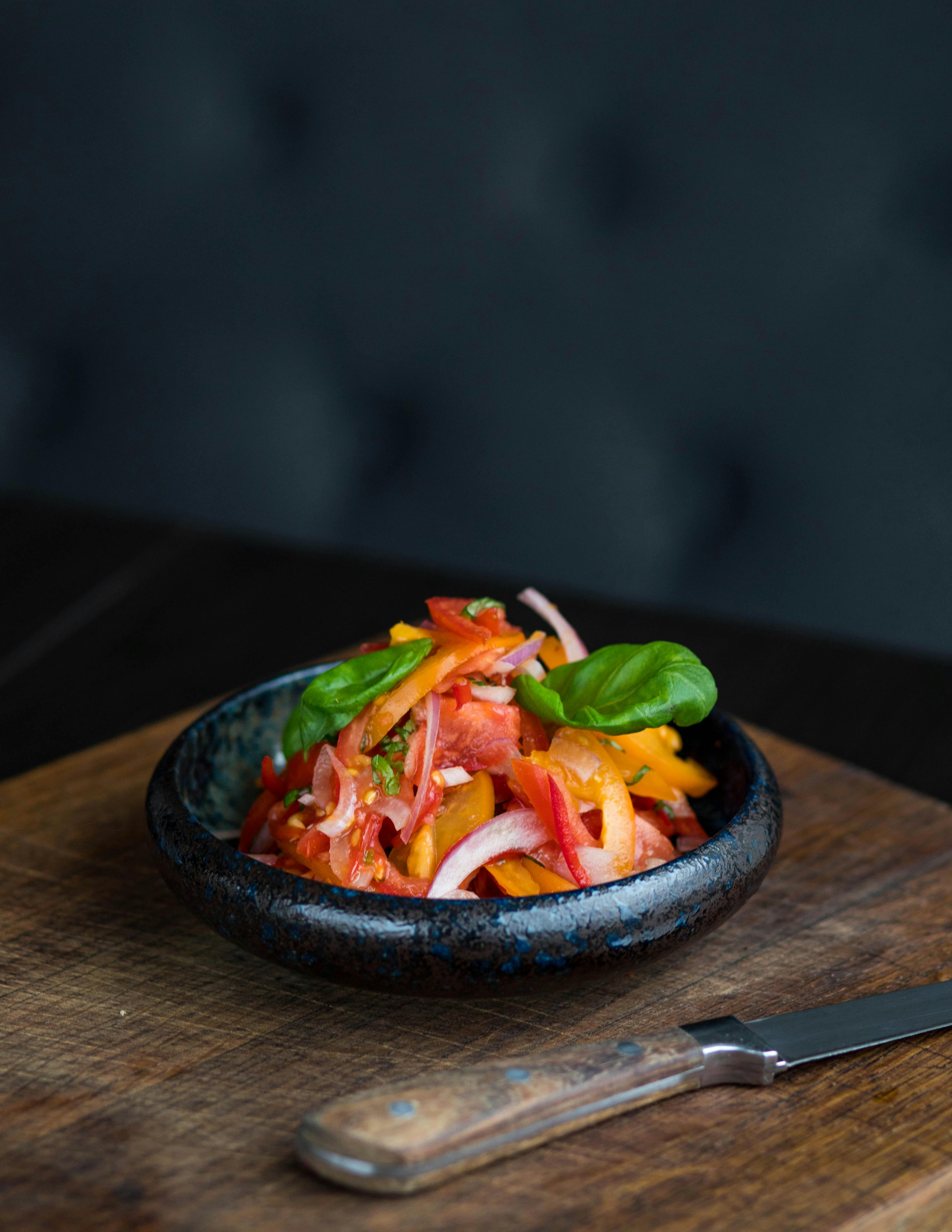
Picture courtesy: Sliced Tomato with Green Vegetables in Brown Saucer by Valeria Boltneva, Pexels.
Writing about food can be a sensory experience that engages all five senses. By exploring various aspects of food, writers can create vivid descriptions that transport readers to the world of the dish.
Bread Soup: An Old Icelandic Recipe
by Bill Holm
Start with the square heavy loaf
steamed a whole day in a hot spring
until the coarse rye, sugar, yeast
grow dense as a black hole of bread.
Let it age and dry a little,
then soak the old loaf for a day
in warm water flavored
with raisins and lemon slices.
Boil it until it is thick as molasses.
Pour it in a flat white bowl.
Ladle a good dollop of whipped cream
to melt in its brown belly.
This soup is alive as any animal,
and the yeast and cream and rye
will sing inside you after eating
or a long time.
By Pablo Neruda
Onion,
luminous flask,
your beauty formed
petal by petal,
crystal scales expanded you
and in the secrecy of the dark earth
your belly grew round with dew.
Under the earth
the miracle
happened
and when your clumsy
green stem appeared,
and your leaves were born
like swords
in the garden,
the earth heaped up her power
showing your naked transparency,
and as the remote sea
in lifting the breasts of Aphrodite
duplicating the magnolia,
so did the earth
make you,
onion
clear as a planet
and destined
to shine,
constant constellation,
round rose of water,
upon
the table
of the poor.
You make us cry without hurting us.
I have praised everything that exists,
but to me, onion, you are
more beautiful than a bird
of dazzling feathers,
heavenly globe, platinum goblet,
unmoving dance
of the snowy anemone
and the fragrance of the earth lives
in your crystalline nature.
Taste is fundamentally the first aspect which is connected with food, followed by memory. The flavor of the dish can be described in detail to bring it to life. Consider the choice of words in Wallace Steven’s “A Dish of Peaches in Russia.”
‘I absorb them as the Angevine absorbs Anjou. As a young lover sees the first buds of Spring.”
Or one can also opt to engage the reader by including shape, color and texture of the ingredients. In food writing, it is important to use vivid language to describe the visual aspects of a dish. Consider the descriptions used in “Meditation on a Grapefruit” by Craig Arnold:
“To ease each pale pink section out of its case so carefully without breaking a single pearly cell.”
The sounds of cooking can also be a vital aspect of food writing. The sizzling of a pan, the bubbling of a pot, and the clanging of utensils can all be described in detail to create a sensory experience for readers.
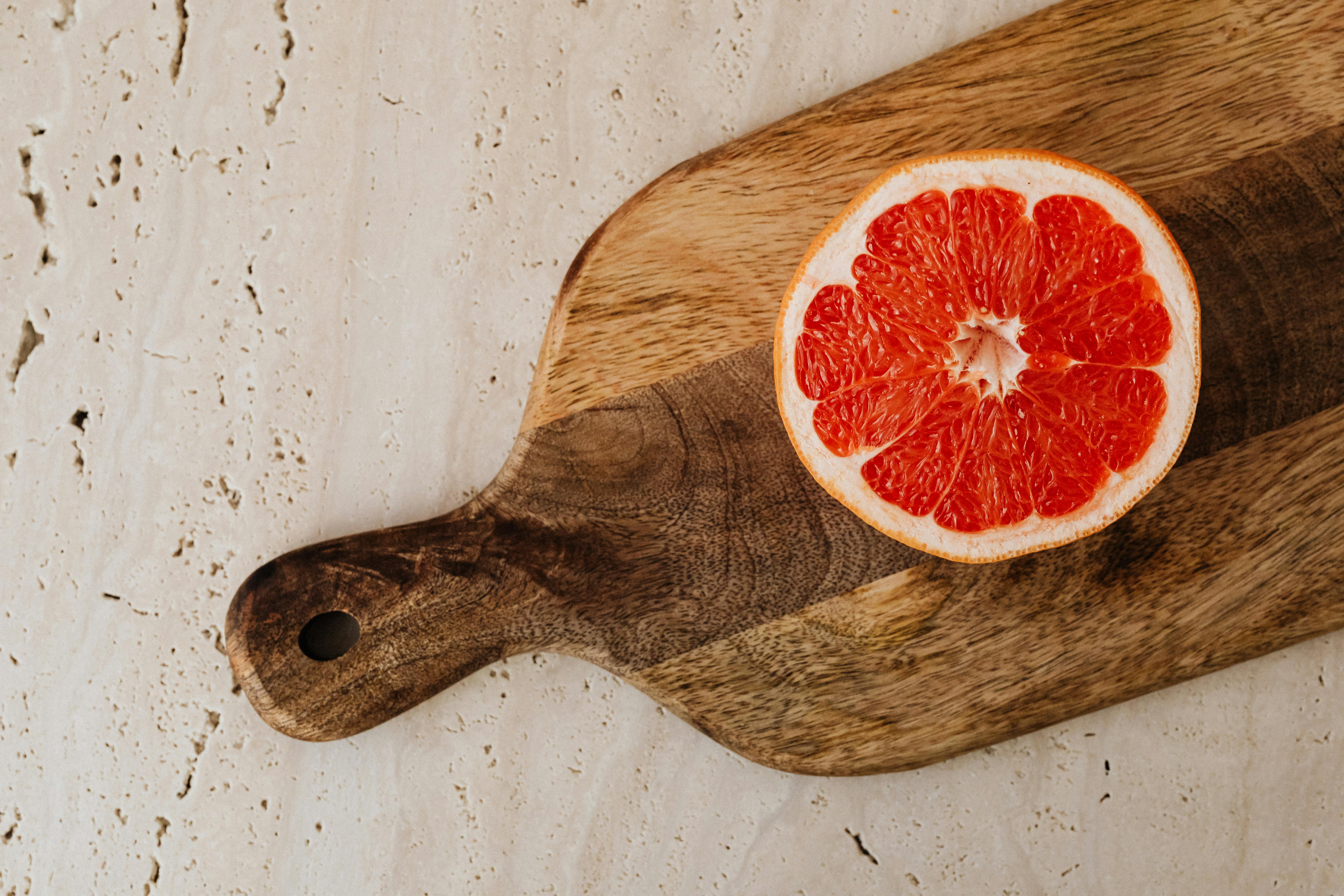
Picture courtesy: Grapefruit on Cutting Board by Karolina Kaboompics, Pexels.
For Today’s Poetics, I’d like you to explore atleast ONE of the five senses in food poetry. It can be the taste, the texture of a dish or its aroma that fills the kitchen. It can be an experience you had while cooking for the first time. The choice is yours! Just be sure to let the reader feel something when reading the poem.
New to dVerse? Here’s how to join in:
- Write a poem in response to the challenge.
- Enter a link directly to your poem and your name by clicking Mr. Linky below
and remember to check the little box to accept the use/privacy policy. - You will find links to other poets and more will join so please do check
back later in order to read their poems. - Read and comment on other poets’ work– we all come here to have our poems read.
 dVerse
Welcome to Poetics, everyone!
On the menu, we have smoked gouda mushroom quesadillas with rotari rose, peach cobbler with vanilla icecream or if you prefer we also have butter croissants with coffee/tea of your choice.
Let me know if I can get you anything else ☺️ See you on the poetry trail! 💝💝
Good evening poets, and what a great prompt, Sanaa! You’re an expert at weaving food and the senses into your poems, so I hope my poem comes up to scratch. I could do with a mango smoothie, if you have one tonight, please.
Mango smoothie coming right up! So good to see you, Kim 🩷🩷
You too, Sanaa.
🥰🥰
Ooooh this is so much up my alley!
Do tell, are we allowed to explore more than one sense? 😉
While I get my creative juices flowing, the menu tonight sounds divine…
Hi Dale 🥰 yes we are definitely allowed.. if you like to.. you may.. do join me for peach cobbler with vanilla ice cream!
So pleased you liked the prompt! Happy Tuesday 🩷🩷
Oh, I will!
Happy Tuesday to you!
🥰🥰
There is passion for good food in your words!
Thank you for presenting with such clearly heartfelt joy..
Thank you! I look forward to seeing what you come up with 🩷🩷
Hi Sanaa! Thank you for hosting!
Since it’s peach season, I’ll have a small dish of peach cobbler, with just a dollop of ice cream. 😊
I so loved your poem, Merril! I will join you for some peach cobbler with vanilla ice cream 🍨
Happy Tuesday! 🩷🩷
Thank you, Sanaa! Now it’s Happy Wednesday! 💙
As usual, I’m incapable of taking food seriously. Or much of anything seriously.
If you can’t access Substack, I also posted it on my blog:
https://nolchafox2.wixsite.com/nolcha-s-written-wor/post/anxiety-milkshake
Heading over to read you! Happy Tuesday 🩷🩷
And to you, Sanaa!
🥰🥰
Thank you for hosting, Sanaa and . . . ooooh yum!!! I would love a piece of peach cobbler with vanilla ice cream, please….and perhaps a decaf coffee as well. A fabulous prompt. I suspect when I return to read tomorrow, my mouth will be salivating! The good thing is food poetry has no calories 🙂
Peach cobbler with vanilla ice cream and decaf coffee coming right up! 🥰 Happy Tuesday 🩷🩷
Good afternoon, Poets!
Thanks for the delicious prompt, Sanaa! How about my usual? 😉
So good to see you, Frank! The usual coming right up! 🥰 Happy Tuesday 🩷🩷
Pingback: Poetics: Exploring the senses in Food Poetry – Liver and Onions – Stine Writing
Pingback: the honey tomb – the ren club
i went with honey! thanks for hosting, Sanaa!
That sounds divine! Heading over to read you 🩷🩷
Pingback: Eating the Moon – Re-entry
Pingback: A Lifetime Love - How would you know...
Good morning Sanaa – I hope to goodness “smoked gouda mushroom quesadillas with rotari rose” are still available for the breakfast shift at the pub – thanks for a great prompt about My Lifetime Love…
Ofcourse! Smoked gouda mushroom quesadillas with rotari rose for the gentleman! Good to see you, Andrew! 🩷🩷
Thank you for hosting Sanaa. Fascinating prompt, quite delicious. I’ve done an expanded edit on a poem I wrote 4 years ago. It had good bones for your prompt. 🙂✌🏼🫶🏼
I am intrigued 🥰 Heading over to read you, Rob! 🩷🩷
Thank you for this delightful prompt Sanaa, a slice of heaven.
And thank you for the amazing poem! 🥰🥰
Thank you for the kind words of encouragement Sanaa ❤️
Thank you for an amazing prompt, Sanaa. 🙂
You’re most welcome, Kitty! 🩷🩷
I loved your poem!
I’m so loving all these food poems!
I love this prompt, Sanaa. I’m too late for the link, but here’s mine:
http://www.poetlaundry.com/2024/08/night-in.html