Tags
David Gascoyne, Edna St. Vincent Millay, endings, Nichita Stanescu, Robert Frost, T. S. Eliot, The end of something
It’s Tuesday, and the dVerse Poets Pub is open with snacks and beverages of your choice, as well as a selection of delicious poetry. I’m Kim from writinginnorthnorfolk.com, your host for this week’s Poetics.
Back in May, I received an email from the Literary Hub, in which Emily Skaja suggests 50 ways to end a poem. I have selected eight of those endings, some with examples, with which I would like you to end your poems.
- End with a question, like Robert Frost in his poem ‘Reluctance’, about the end of a season.
- End on an image (the classic choice) as in ‘Season’s end’ by Nichita Stanescu.
- If the poem has been primarily narrative in mode (scene, character, plot, dialogue), end with a lyric strategy (repetition, music, imagery, figurative language) as in ‘Ebb’ by Edna St. Vincent Millay, a poem about the end of a relationship.
- End by going back to the beginning (circle back to an image, replicate your syntax, repeat a thesis, return to the start of the story) similar to Robert Frost in ‘Fire and Ice’, about the end of the world, which it is said was the inspiration for the title of George R. R. Martin’s A Song of Ice and Fire.
- End with a punchline like T.S. Eliot in ‘The Hollow Men’, which famously ends by telling us that the ‘world ends’ with ‘a whimper’ rather than a bang.
- Change your tone; for example, by making fun of something you may have taken very seriously until now, as in the surprising ending of David Gascoyne’s poem, ‘The End Is Near the Beginning’, in which he writes about an ageing woman; ‘the end’ is presumably death.
- End with an erasure of your own words.
- Distil your imagery into its essential parts and close your poem in the compressed style of haiku.
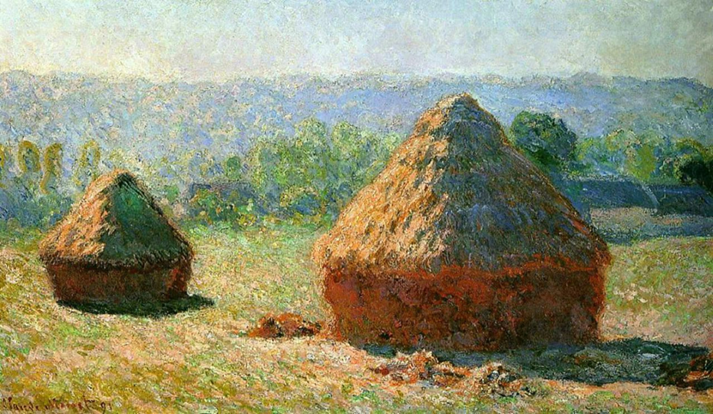
Stack. The end of summer. Morning, 1891, by Claude Monet
The poem I would like you write is about the end of something: the end of a season, a relationship, a story, a letter, a journey, a dream, a life, the world, etc. You can write in any form, rhyming or not; just make sure it ends in one of the ways described above – and let us know which you chose and why.
If you are new to dVerse and/or Poetics, here’s how to join in:
- Write a poem in response to the challenge;
- Enter a link directly to your poem and your name by clicking Mr Linky below;
- There you will find links to other poets, and more will join, so check back for their poems;
- Read and comment on other poets’ work – we all come here to have our poems appreciated;
- Please link back to dVerse from your site/blog;
- Comment and participate in our discussion below, if you like. We are a friendly bunch of poets.
- Have fun.
 dVerse
Good evening… a poem with a good ending, I like that. I hope mine made sense (even if it’s dark)
I’ll be over shortly to read and comment, Björn.
Good evening poets and welcome to Poetics. I look forward to reading your poems about endings and am interested to see which endings you choose from the list with which to end your poems. To keep your strength up until the bitter end, how about some sweet cakes and pastries and fruity cocktails of your choice?
Hi Kim. Thank you for hosting this interesting poetics. Love all the ways to handling endings. A hot chocolate and a peach pie please!
I’m so glad you like it, Grace. A hot chocolate and peach pie coming up!
Thank you!
Pingback: Deconstruction – Dreams from a Pilgrimage
Hi Kim, Thanks for hosting. Love this prompt which had me thinking ahead to the end from the beginning which is a fine exercise in writing. A coffee and a slice of pecan pie for me, thanks!
Happy you enjoyed the prompt, Dora. A coffee and a slice of pecan pie coming up!
Many thanks!
My pleasure, Dora!
After a long day, I’m heading off to bed, but I will be back tomorrow to read and comment on more poems about the end of some thing and their chosen endings, Goodnight poets. ‘🥱
I’ve come to the end. Wine is in order.
It’s too early for wine here, so I won’t join you in a glass. But I will say cheers, Nolcha!
It’s always time for wine somewhere in the world! We’ll grab a virtual glass together eventually.
hi all
back in the morning, if I don’t oversleep
rog
I’m up early and checking in before I go to the leisure centre for aqua aerobics, I ‘ll catch you later, Rog.
This should be fun. Just beginning I mean ending, or is it beginning to end? Either way I’ll get something in there to end with. haha :^)
Good morning, Stew! I look forward to reading your poem.
Hey Kim, I dusted off an older piece that somewhat fits. I suppose it follows the ‘punchline’ motif. An espresso – or perhaps an apertif – for me, with a bit of hard cheese and good bread. Thanks for hosting ~ M
Good morning , Michael. I’ve just got up and am preparing to read and comment on a few poems before I head off to aqua aerobics. I shall be looking out for your punchline – with an espresso and some bread and cheese.
Hi Kim, Thanks for hosting this evening. I like your choice of a challenge. It is good to leave readers with a question. It extends the thinking beyond the poem itself.
Pastries and coffee sounds like a great combination for me.
I’m glad you like the challenge, Dwight, and I agree about ending with a question, which also depends on the poem and theme, Pastries and coffee coming up!
Thank you, Kim.
You’re most welcome, Dwight.
Thank you for hosting, Kim. This is an interesting prompt and I enjoyed it. 🙂
I’m so glad you enjoyed it, Kitty. I’m not long up and will be reading and commenting shortly.
Pingback: Nature’s Symphony – Reena Saxena
Pingback: The shortness of life – erbiage
Pingback: Dew Droplets – JJJ Interactive Books
Pingback: Locked Hearts – Where Stories Can Spark Their Magic
Interesting prompt so I decided to give it a try. Thanks for hosting
Thanks for joining us, Truedessa.
Pingback: After a long hiatus, Raven reappears at the end of the line – K.
Pingback: Cicatrix, For dVerse Poets: Endings | lifelessons – a blog by Judy Dykstra-Brown
Love this prompt. https://judydykstrabrown.com/2024/09/18/cicatrix-for-dverse-poets-endings/
Thank you, Judy!
Thank you for hosting Kim, a nice range of options here 🙂
Thanks Paul!
Pingback: dVerse — Poetics — Traversing the Hexagrams – Tao Talk
Kim, I appreciate the time you took putting this prompt together. Just linked up. I have to admit Chris’ video at the end tore me up. Even way back then he could see the writing on the wall for himself. Adding drugs to the mix of his mindset, I don’t see how there was any escape for him. I hope he’s found peace, wherever he is.
There were two voice in Grunge that really got my heart pumping, Chris Cornell and Layne Staley, and they both ended far too young.
I’m late to the party, Kim but thanks for leaving the pub lights on. I was intrigued by the Chris Cornell video…which led me to watch more. I’m adding my “conundrum” to the poetics mix!
Not late, Lynn. Mr Linky is open until Saturday. I’ll be over to read in a bit.
Pingback: My Life – The Phoenix Tree Writes
Pingback: The journey ends – Keep it alive
Pingback: Autumn for a moment – Mom With a Blog
Pingback: Mansplaining
Pingback: Tuesday Poetics: Endings | Sharing Thoughts