Of mantras, one could say as the Latins did, ‘Repetita juvant,’ that is, ‘It’s useful to repeat things’.
Welcome, my friends and poets! Dora here from “Dreams from a Pilgrimage,” your host as we embark yet again on the poetry trail.
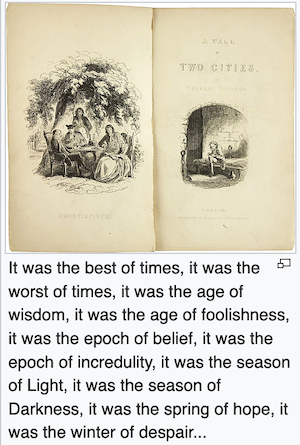
Writers of all sorts have found repetition of phrases or lines like a mantra to be a useful rhetorical tool. We all know Dickens’ famous repetition of “It was ….” to characterize the paradox of the revolutionary times at the opening of his “Tale of Two Cities.”
Mantras are also useful as motivational slogans (e.g., Nike’s 1988 slogan, “Just Do It,”) or mottos (guiding principles or received wisdom) that get us through hard times. The widow of a Christian missionary who was killed by cannibals tells of how she endured the following days, weeks, and months by repeatedly telling herself to “Do the next thing” that required her attention: the medical needs of that indigenous people group, the teaching, the mending, the cooking, the caring of her child.
Both these instances of mantras being used as a rhetorical tool and/or as a motto show up in poetry from the earliest times because of their strong lyrical appeal.
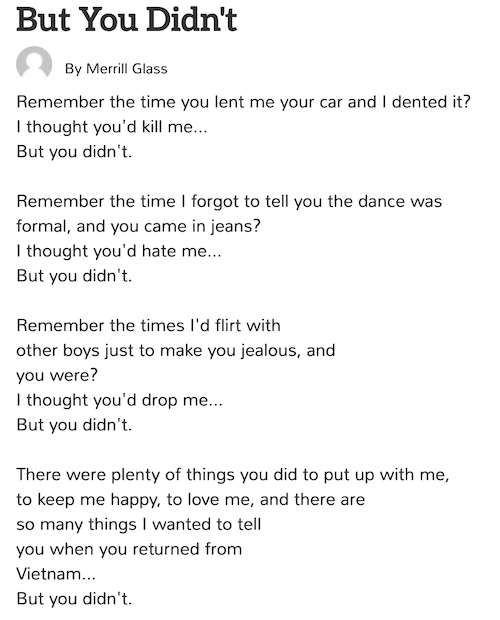
A more modern poet, Merrill Glass, repeats the line of her title, “But You Didn’t”.
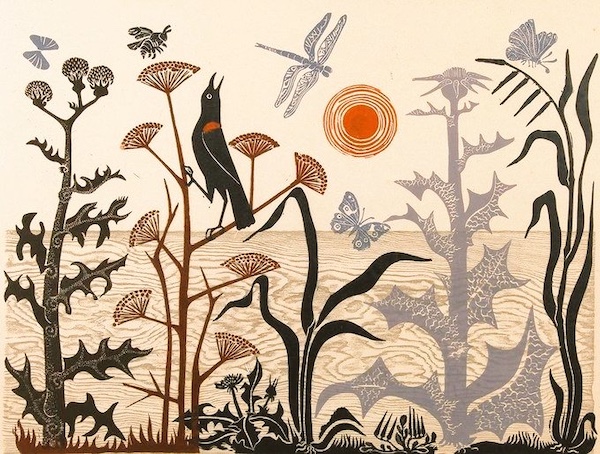
“Californian Morning” by US artist and printmaker Emmy Lou Packard (1914-1998)
Joy Harjo, a member of the Mvskoke/Creek Nation and 2019 U.S. poet laureate, also begins each line of her poem with its title, “Remember.”
Remember the sky that you were born under, know each of the star’s stories. Remember the moon, know who she is. Remember the sun’s birth at dawn, that is the strongest point of time.
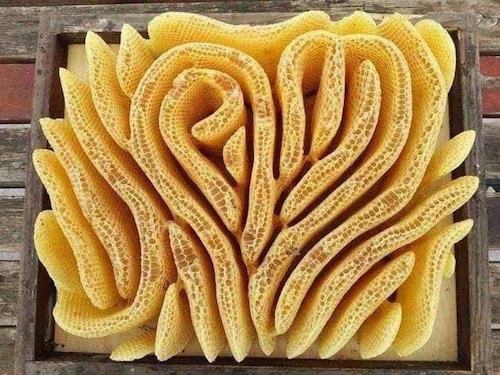
A French bee keeper who didn’t put the frames in his hive found this patterned sculptural magic the bees created by themselves.
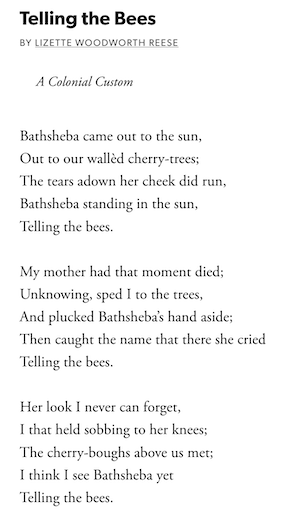
Maryland poet Lizette Woodward Reese’s “Telling the Bees” written in the nineteenth-century repeats that titular phrase to drive home the immediate and lasting effect of seeing it done. The belief is that if the bees are not told of momentous events, they will swarm and leave the hive. (This custom is still practiced in England where the royal bee keeper, for example, announced the death of Elizabeth II to the royal hives.)
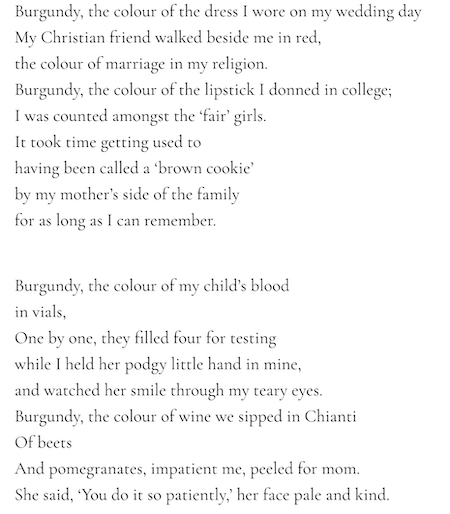
Indian author and poet Smitha Vishwanath repeats the titular “Burgundy,” the color becoming more than itself as it reflects her life. The following are the first two stanzas:
excerpt from “Burgundy” in The Thieving Magpie (Summer 2024)
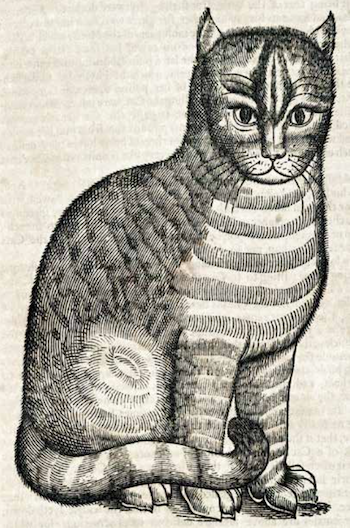
An illustration from Topsell’s The History of Four-footed Beasts and Serpents, 1658 via The Paris Review
And once read, who can forget the 74-line excerpt from the eighteenth-century poet Christopher Smart’s “Jubilate Agno” (“Rejoice in the Lamb”) which begins “For I will consider my Cat Jeoffry”? Each of the next seventy-three subsequent lines begin their consideration with “For . . . .”
For I will consider my Cat Jeoffry. For he is the servant of the Living God duly and daily serving him. For at the first glance of the glory of God in the East he worships in his way. For this is done by wreathing his body seven times round with elegant quickness. For then he leaps up to catch the musk, which is the blessing of God upon his prayer. For he rolls upon prank to work it in. For having done duty and received blessing he begins to consider himself. For this he performs in ten degrees. For first he looks upon his forepaws to see if they are clean.
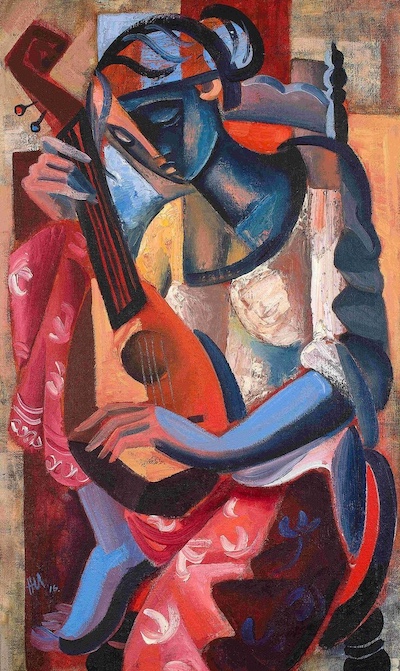
Hennie Niemann jnr, The Musician (Oil on Belgian linen, 2016)
Nasser Rabah, a Palestinian poet living in Gaza, begins each line with “And a day goes by” in his poem, “Untitled,” (translated from the Arabic) about the death and devastation from ongoing attacks by Israel.
It’s going to be critically acclaimed and win none of the awards.
It’s going to start as an argument over what’s buried inside the tomb but end in silence over what’s discovered beneath it.
It’s going to happen on your birthday in front of the mailman, while you’re receiving the letter for your sister sent by her murderer.
excerpt from “This Living” from The New Yorker (June 3, 2024)
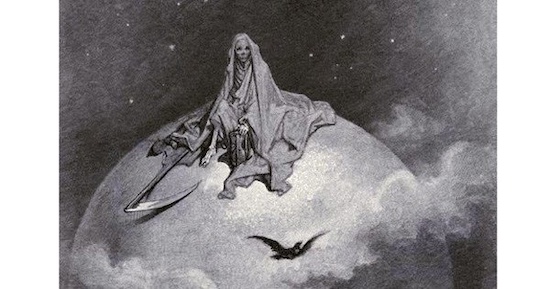
Illustration for Poe’s “The Raven” by Gustave Doré; to view more click here.
It being the spooky season, we can’t forget Edgar Allan Poe’s famous repetition of “nothing more” in “The Raven,” which eventually turns to “Quoth the Raven ‘Nevermore.’”
A Mantra as a Life Motto
It’s not only as a rhetorical device but as a life motto that a mantra can be useful.
This I can say for myself: that for awhile I was the Heodeninga’s scop, dear to my lord. My name was Deor. For many winters I held a fine office, faithfully serving a just king. But now Heorrenda a man skilful in songs, has received the estate the protector of warriors had promised me. That passed away; this also may.
excerpt from Deor’s Lament; translation by Michael R. Burch
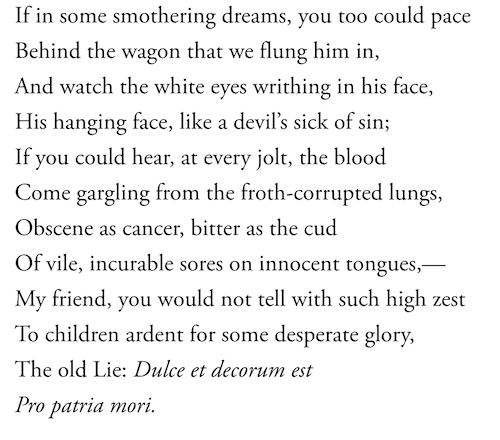
Wilfred Owen’s “Dulce et Decorum Est” (“It is sweet and fitting”) plays off culturally received wisdom, an aphorism upheld as a valuable dictum passed down from the Roman poet Horace who wrote, Dulce et decorum est pro patria mori” (“It is sweet and fitting to die for one’s country”). Owen, writing during World War I, turns this motto on its head in the last stanza:
In “Find Work,” Rhina P. Espaillat, born in the Dominican Republic, tells of her grandmother’s use of that phrase to endure her hard life.
So her kind was taught to do— ‘Find work,’ she would reply to every grief— and her one dictum, whether false or true, tolled heavy with her passionate belief.
Max Ginsburg (American) “Susan with Jewelry.” (1997, oil on canvas, 10 x 7 in)
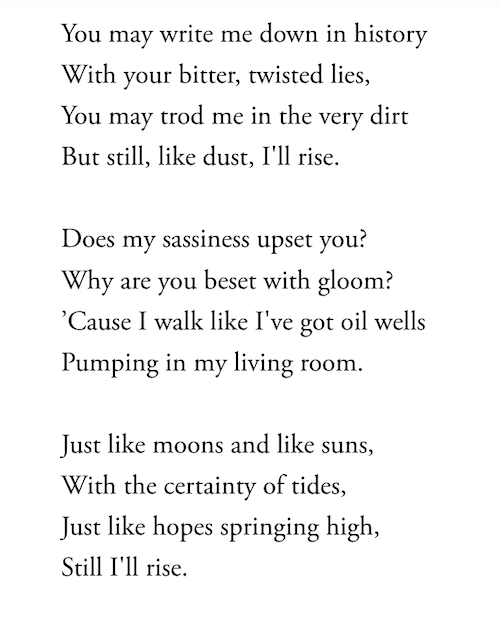
American poet Maya Angelou’s “Still I Rise” is a masterpiece of passionate resolve and resilience energized through that titular repetition of an irrepressible will to rise above the past. It begins:
Each of these poems show the intrinsic connection between mantras and refrains in song and poetry. We use them to get through life, to explain, connect, and manage our experiences. We use them as musical refrains that play on our tongue and mind, and linger in our memory.
So your challenge is to either use repetition as a rhetorical device (repetition of a word or phrase or line) in constructing your poem; or to write a poem that centers around a motto, your own or perhaps passed down in your family or in your culture, showing how it’s been used or misused. Or, if you’re ambitious, see if you can do a combination of the two (as in “Deor’s Lament” & Angelou’s “Still I Rise”).
New to dVerse? Here’s how to join in:
Write a poem in response to the challenge.
Post your poem on your blog and link back to this post.
Enter your name and the link to your post by clicking Mr. Linky below (remember to check the little box to accept the use/privacy policy).
Read and comment on your fellow poets’ work –- there’s so much to derive from reading each other’s writing: new inspiration, new ideas, new friends. Enjoy!
N.B. Poetics prompt stays open until Thursday, 3 P.M. (EST).
Can’t get into the post to add this but it needs to be repeated:
New to dVerse? Here’s how to join in:
Write a poem in response to the challenge.
Post your poem on your blog and link back to this post.
Enter your name and the link to your post by clicking Mr. Linky below (remember to check the little box to accept the use/privacy policy).
Read and comment on your fellow poets’ work –- there’s so much to derive from reading each other’s writing: new inspiration, new ideas, new friends. Enjoy!
Welcome everyone and once again, an open invitation to all to join us on the poetry trail!
I thought we might have a repast laid out such as Deor the minstrel may have enjoyed in the mead hall of his king! To start with, mead-infused slow-roasted beef, accompanied by barley, leek, and mushroom risotto, a variety of breads and late autumn fruits, and every manner of grog.
As always, the pub is ready to serve whatever you desire.
Hello Dora. I love reading the links to the poems as examples, and images as well. Wonderful tool to use again and again, smiles. Thank you for hosting.
Good evening all. Am finding it difficult to type as I have my ankle elevated with an ice pack on it, and I need it to mend quickly before I go down to my daughter’s for Louie’s second birthday next week.
Oh no, Kim! I’m so sorry to hear you’ve injured your ankle. Hope the ice pack is helping with the pain. Sending prayers for quick healing so you don’t miss Louie’s b’day!
Thank you so much, Dora. It was the skipping. I had x-rays at the hospital today and it’s not fractured or sprained, but I have arthritis in both ankles and the repeated jumps have caused one ankle to become inflamed. It is very painful, but rest, elevation, paracetamol and ice packs should do the trick.
Ah, Kim! You’ve gone above and beyond anything I’ve taken on for charity’s sake. Take good care and keep resting and elevating and everything it takes to not disappoint a little boy who’s guaranteed to be looking for his grandma at his party. 💖
Your husband’s mantra, huh? As a matter of fact, I have both aspirin and a drink to offer you, and my curiosity as to why they’re so needed, well and truly inflamed! 😀
That particular poem of his has stayed with me over the decades: it packs a real punch, especially for those of us who grew up fed on idealizing “great men” and “momentous wars.” Like the movie “Apocalypse Now,” it wakes you up to the hard edge of reality. (Glad you liked the prompt.)
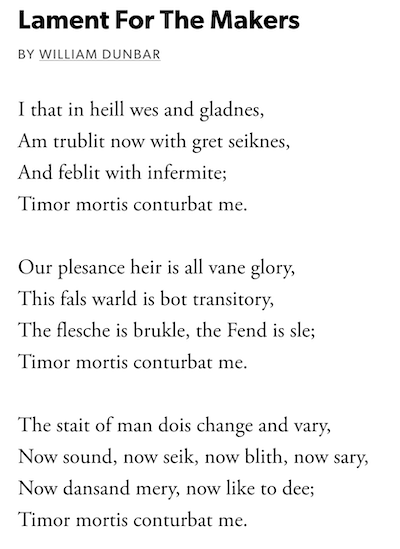
A deeply conceived and wide-ranging challenge Dora, five golden trumpets playing “Flight Of The Bumblebee” to goose us sleepy poets into fervor. I didn’t know there was a medieval Scots “Lament for the Makers.” Merwin turned that into a contemporary oompa-tuba lament for voices which grow bright in darkness. My contribution works toward a driving theme begging for Latin formulation — somewhat akin to Merwin, I suppose.
You stir me to the core, Brendan: “five golden trumpets playing “Flight Of The Bumblebee” to goose us sleepy poets into fervor” indeed! I confess that would have been a great accompaniment as I wrote the post and gathered the art! I’m going to look up Merwin’s poem by the same name. He’s someone I’ve only read anthologized. (Heading over to your poem now, latinized or not.)
Yours is a brilliantly conceived poem, Brendan, full of the star-shine of Merwin’s which I just read. For those interested, here’s the link to Merwin’s “Lament for the Makers.”
What a sumptuous introduction and embodiment-in-poetry of Repeetite Juvant, Dora! I have yet to follow all your links and examples, let aloe the writings of other dVersifiers, but had great fun penning a few stanzas to the accompaniment of a random track on Spotify.
I’ll pass on the beef and grog, but delight in the bread and autumn fruits, before I hit the pillow (it’s late here in northern Scotland) and sleep to the mantra of “mm-mmm”, my going-to sleep-cosy sound as a child.
Kathy, You’ll be in dreamland now as the mantra “mm-mmm” must have worked its charm. Thank you for dropping by and enjoying the bread and fruits while I (five hours behind you) head over to your dVersifying treat of a poem. 🤗💖
A wonderful prompt, Dora. It should prove quite interesting to read across the blog. I enjoyed reading all of your great examples. Seems we all have our mantras. Cherry Pie and Ice Cream would make me smile! Thank you for hosting!
I’m so glad you enjoyed the prompt. I’m so glad that you took the time to read each of the examples (hats off to you, Dwight!) and didn’t hopefully tax your patience. I think I’ll join you in that slice of cherry pie and a heaping scoop or two of ice cream. Sounds yummy. 😊
This is a humdinger of an Intro, Dora! “Lament For the Makers” reminds me of a favorite of mine from the same period, called “Worldes Blis” which opines that earthly joys do not last long. I am so pleased that you mentioned Amber Tamblyn, daughter of actor Russ. I have her collection “Bang Ditto” and like it a lot.
All right, let me totter off and begin repeating myself. It shouldn’t be too hard! 😛 All I gotta do is act naturally.
Re: your verse, am I really that hard to pin down?! Also, I want to look up “Worldes Blis.” As far as the Tamblyns are concerned, what a talented family! And you never repeat yourself (except on purpose) and certainly never miss a beat poetically, quite naturally.
Just listened — how did I ever miss this song?! It’s a keeper for me too.
“How slowly goes the dark night of the soul
But before the earth’s foundations were laid
You were loved, child, don’t give up, child ….”
We can’t sing, shout, cry this enough, my sister!
Thank you so much for hosting Dora. I love repetition to generate impact, it’s very effective. I have used it often over the years. It is a staple in pop and rock music lyrics. 🙂✌🏼🫶🏼🎼
Hi Dora! Thank you for the prompt. I couldn’t get anything together yesterday, but I wrote one this morning and added it. I’ll catch up with reading in a bit. 😊
Oh I’m so glad to hear it and I’m looking forward to reading! I’m running a bit late on the poetry trail myself so we’ll probably run into each other … kinda sorta. 😂
dorahak! … thank you, thank you, thank you. anyone that knows me, knows that i adore repetition in poetry. which is to say, i loved, loved, loved this challenge. ❤ ❤ ❤
❤❤❤ What a lovely acclamation to see this morning, Ren! Repetita juvant indeed and I can’t wait, can’t wait, CAN’T WAIT to read your offering!! Thank you, Ren.
Thanks for hosting this prompt, Dora! Strangely, I’m not a fan of repetition in life but don’t mind it in poetry. Hopefully my poem rises to this challenge!
Same here, Chris! Unfortunately, I’m at that age where i need to have things repeated as one thing pushes out another in my mind. I know you’ll have more than risen to this poetic challenge. Headed over to read! 💖
Dear Dora, wonderful prompt! Loved the selection of poems. I think I managed to join in by the skin of my teeth! 😉
Apologies for the delay. Will catch up with reading soon.
hi, Dora! My poem was a couple hours too late for Mister Linky because we had a Jewish holiday this week, which threw off my schedule. But if you’d like to see it, here you go:
I’m so glad you joined in the prompt, David! Can’t wait to see what you’ve cooked up and more than happy to add it to Mr. Linky so others can read. 🕊️🤍💙🤍




 dVerse
Can’t get into the post to add this but it needs to be repeated:
New to dVerse? Here’s how to join in:
Ah! I fixed it in the post. Yaaay!
Good evening. love the prompt… so effective using repetiitons… hope to read some fine poems tonight and tomorrow.
Wonderful to see you and I’m hoping the same! 🙌🙌🙌
Welcome everyone and once again, an open invitation to all to join us on the poetry trail!
I thought we might have a repast laid out such as Deor the minstrel may have enjoyed in the mead hall of his king! To start with, mead-infused slow-roasted beef, accompanied by barley, leek, and mushroom risotto, a variety of breads and late autumn fruits, and every manner of grog.
As always, the pub is ready to serve whatever you desire.
Fabulous menu – a toasted bread with pumpkin soup is perfect for dinner tonight. Thanks for a lovely prompt.
Ya got it, Grace, and a blessing on your meal. Your poem was a pleasure to read. 💖
Hello Dora. I love reading the links to the poems as examples, and images as well. Wonderful tool to use again and again, smiles. Thank you for hosting.
Hi Grace! I enjoyed putting this one together. So glad you liked it!
Good evening all. Am finding it difficult to type as I have my ankle elevated with an ice pack on it, and I need it to mend quickly before I go down to my daughter’s for Louie’s second birthday next week.
Oh no, Kim! I’m so sorry to hear you’ve injured your ankle. Hope the ice pack is helping with the pain. Sending prayers for quick healing so you don’t miss Louie’s b’day!
Thank you so much, Dora. It was the skipping. I had x-rays at the hospital today and it’s not fractured or sprained, but I have arthritis in both ankles and the repeated jumps have caused one ankle to become inflamed. It is very painful, but rest, elevation, paracetamol and ice packs should do the trick.
Ah, Kim! You’ve gone above and beyond anything I’ve taken on for charity’s sake. Take good care and keep resting and elevating and everything it takes to not disappoint a little boy who’s guaranteed to be looking for his grandma at his party. 💖
Hello Dora and all!
Loved the prompt 😀 I was inspired by Amber Tamblyn’s today and chose to emulate her style! Garlic bread and mushroom soup for me please.
Happy Tuesday! 🩷🩷
Hi Sanaa! I just read your wonderful poem and so enjoyed it. You met the challenge and how! Bread and soup coming right up, my friend.
*Dives straight into food*
I am so glad you enjoyed the poem, Dora! It’s such a wonderful, prompt 😀 I just couldn’t resist 🩷🩷
A prompter’s dream comment, Sanaa. You’ve made my day! 🤗💖🙌
🥰🥰
Dora!! An amazing job laying this out for us. I’ll have what Sanaa’s having please.
Hi Helen, Good to see you and thanks for the compliment. I’ve got your bread and soup right here! Enjoy!
Thanks to my husband for his mantra. Now, I need a drink. Or an aspirin.
Your husband’s mantra, huh? As a matter of fact, I have both aspirin and a drink to offer you, and my curiosity as to why they’re so needed, well and truly inflamed! 😀
I’ve listened to that mantra for over 26 years. I need a drink and aspirin to get me through yet another “It is what it is.”
😀😂🤗
Thank you so much Dora, and thank you for including Wilfred owen’s poem, a poet I admire very much, as a few others of his generation.
That particular poem of his has stayed with me over the decades: it packs a real punch, especially for those of us who grew up fed on idealizing “great men” and “momentous wars.” Like the movie “Apocalypse Now,” it wakes you up to the hard edge of reality. (Glad you liked the prompt.)
A deeply conceived and wide-ranging challenge Dora, five golden trumpets playing “Flight Of The Bumblebee” to goose us sleepy poets into fervor. I didn’t know there was a medieval Scots “Lament for the Makers.” Merwin turned that into a contemporary oompa-tuba lament for voices which grow bright in darkness. My contribution works toward a driving theme begging for Latin formulation — somewhat akin to Merwin, I suppose.
You stir me to the core, Brendan: “five golden trumpets playing “Flight Of The Bumblebee” to goose us sleepy poets into fervor” indeed! I confess that would have been a great accompaniment as I wrote the post and gathered the art! I’m going to look up Merwin’s poem by the same name. He’s someone I’ve only read anthologized. (Heading over to your poem now, latinized or not.)
Yours is a brilliantly conceived poem, Brendan, full of the star-shine of Merwin’s which I just read. For those interested, here’s the link to Merwin’s “Lament for the Makers.”
What a sumptuous introduction and embodiment-in-poetry of Repeetite Juvant, Dora! I have yet to follow all your links and examples, let aloe the writings of other dVersifiers, but had great fun penning a few stanzas to the accompaniment of a random track on Spotify.
I’ll pass on the beef and grog, but delight in the bread and autumn fruits, before I hit the pillow (it’s late here in northern Scotland) and sleep to the mantra of “mm-mmm”, my going-to sleep-cosy sound as a child.
Kathy, You’ll be in dreamland now as the mantra “mm-mmm” must have worked its charm. Thank you for dropping by and enjoying the bread and fruits while I (five hours behind you) head over to your dVersifying treat of a poem. 🤗💖
A wonderful prompt, Dora. It should prove quite interesting to read across the blog. I enjoyed reading all of your great examples. Seems we all have our mantras. Cherry Pie and Ice Cream would make me smile! Thank you for hosting!
I’m so glad you enjoyed the prompt. I’m so glad that you took the time to read each of the examples (hats off to you, Dwight!) and didn’t hopefully tax your patience. I think I’ll join you in that slice of cherry pie and a heaping scoop or two of ice cream. Sounds yummy. 😊
Queen Cool Dora lists where she will
appearing on a ledge or sill
with poem in hand, song in mind
she’s sometimes rather hard to find!
This is a humdinger of an Intro, Dora! “Lament For the Makers” reminds me of a favorite of mine from the same period, called “Worldes Blis” which opines that earthly joys do not last long. I am so pleased that you mentioned Amber Tamblyn, daughter of actor Russ. I have her collection “Bang Ditto” and like it a lot.
All right, let me totter off and begin repeating myself. It shouldn’t be too hard! 😛 All I gotta do is act naturally.
Re: your verse, am I really that hard to pin down?! Also, I want to look up “Worldes Blis.” As far as the Tamblyns are concerned, what a talented family! And you never repeat yourself (except on purpose) and certainly never miss a beat poetically, quite naturally.
Psst. I have added my favorite song to my post for this, since it is something of a mantra for me as well.
Just listened — how did I ever miss this song?! It’s a keeper for me too.
“How slowly goes the dark night of the soul
But before the earth’s foundations were laid
You were loved, child, don’t give up, child ….”
We can’t sing, shout, cry this enough, my sister!
You quoted the very lines that have sustained me time and again. GMTA!
🙌💖
Thank you so much for hosting Dora. I love repetition to generate impact, it’s very effective. I have used it often over the years. It is a staple in pop and rock music lyrics. 🙂✌🏼🫶🏼🎼
I thought it would appeal to the minstrel in you, Rob. 😀 What a fantastical, musical read your poem was! 💖
Dora, thank you for the wonderful examples of repetition. Fablulous 🥰
I’m thrilled you enjoyed it, Christine. Looking forward to catching up with you on the poetry trail shortly. 🥰💖
Thank you for a great prompt, Dora. Thank you for sharing a wide array of examples. 🙂
Truly a pleasure! I’m so pleased you enjoyed them. 💖
Hi Dora! Thank you for the prompt. I couldn’t get anything together yesterday, but I wrote one this morning and added it. I’ll catch up with reading in a bit. 😊
Oh I’m so glad to hear it and I’m looking forward to reading! I’m running a bit late on the poetry trail myself so we’ll probably run into each other … kinda sorta. 😂
😂😂
Enjoyed the resource Dora and the prompt a good challenge too.
I’m so glad, Paul We aim to please! 🙏😊
dorahak! … thank you, thank you, thank you. anyone that knows me, knows that i adore repetition in poetry. which is to say, i loved, loved, loved this challenge. ❤ ❤ ❤
❤❤❤ What a lovely acclamation to see this morning, Ren! Repetita juvant indeed and I can’t wait, can’t wait, CAN’T WAIT to read your offering!! Thank you, Ren.
🙂
Thanks for hosting this prompt, Dora! Strangely, I’m not a fan of repetition in life but don’t mind it in poetry. Hopefully my poem rises to this challenge!
Same here, Chris! Unfortunately, I’m at that age where i need to have things repeated as one thing pushes out another in my mind. I know you’ll have more than risen to this poetic challenge. Headed over to read! 💖
Dear Dora, wonderful prompt! Loved the selection of poems. I think I managed to join in by the skin of my teeth! 😉
Apologies for the delay. Will catch up with reading soon.
I’m so glad, Punam. I know what it’s like running behind on my reading! Headed your way just now. ❤️
Thanks for understanding. ❤️
🤗💖
hi, Dora! My poem was a couple hours too late for Mister Linky because we had a Jewish holiday this week, which threw off my schedule. But if you’d like to see it, here you go:
https://skepticskaddish.com/2024/10/25/never-or-never-again/
Thanks!
David
I’m so glad you joined in the prompt, David! Can’t wait to see what you’ve cooked up and more than happy to add it to Mr. Linky so others can read. 🕊️🤍💙🤍
🤗
Pingback: Roberta Writes – d’Verse: Of Mantras and Open Link Night #poetry #rhinos