
Lillian here, happy to host Quadrille Monday at dVerse, the virtual pub for poets around the globe.
Here in the United States, we are fast approaching election day. Regardless of party affiliation, many are anxious about the results. When all is said and done, on January 20th, 2025, a new president will be sworn in on the steps of the US Capitol. S/he will repeat the same Presidential Oath George Washington took on April 30th, 1789. “I do solemnly swear that I will faithfully execute the office of the President of the United States, and will to the best of my ability, preserve, protect, and defend the Constitution of the United States.” One can easily claim, this is one of the most solemn promises made in the US, because it affects literally millions and millions of people.
In England’s coronation ceremony, kings and queens repeat an oath that has remained roughly the same for over 1000 years. Since William the Conqueror claimed the English crown after invading in 1066, the coronation ceremony has almost always been held at Westminster Abbey, presided over by the Archbishop of Canterbury. While the wording of the oath has changed as the power of the monarchy has waned and that of the parliament has grown, the monarch still swears to rule according to law, exercise justice with mercy, and uphold the Church of England.
In the western world, newly graduated physicians take the Hippocratic Oath, promising to treat their patients ethically, do no harm, and respect their privacy.
I’m sure you can think of many instances when folks make a promise or take an oath. For example, immigrants taking an oath of citizenship and people promising to tell the truth before they are questioned in court. (image below created in Bing Create)
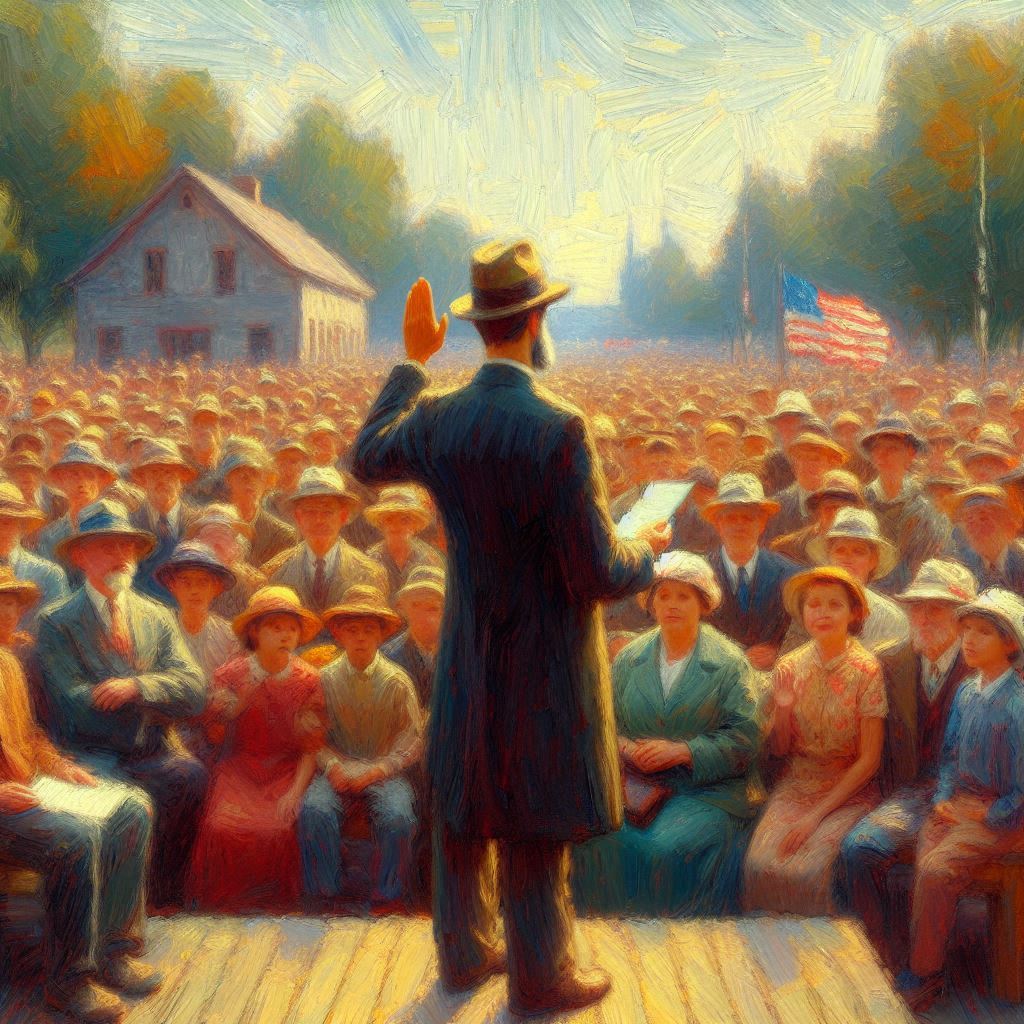
An oath is indeed, a promise….usually a solemn promise. How would you define a promise? Its effects? Its degree of seriousness? For how long is it binding and under what circumstances can a person be relieved of its restrictions? Is the word “restrictions” applicable to the makings of a promise?
Alexander Hamilton stated A promise must never be broken.
Abraham Lincoln said Commitment is what transforms a promise into reality.
Marilyn Monroe said Promises are worse than lies. You don’t just make them believe, you also make them hope.
Ralph Waldo Emerson said Every sunset brings the promise of a new dawn.
Mae West stated An ounce of performance is worth pounds of promises.
Robert Frost wrote But I have promises to keep, and miles to go before I sleep, and miles to go before I sleep.
So here we are, on QUADRILLE MONDAY – the day we write poems of exactly 44 words and are asked to include a particular word in the body of our poem.
If you haven’t guessed by now, the word I’m asking you to include in the body of your poem of exactly 44 words, sans title, is “promise”. You may use a form of the word, but not a synonym.
New to dVerse? Need to be refreshed on the rules?
Here’s what to do:
- Write a quadrille (a poem of EXACTLY 44 words, not including the title) AND include the word “promise” or a form of the word within the body of the poem. A synonym for promise does not fulfill the prompt. It must be the word, or a form of the word.
- Post the poem to your blog AND add the exact URL for your poem to Mr. Linky below.
- REMEMBER to either TAG dVerse in your post, or include a link at the end of your poem that leads readers back to dVerse (https://dversepoets.com).
- If you do not TAG or include a link to dVerse at the end of your post, I will gently remind you to do so. After all, this will increase your readership and comments, and others will find dVerse and hopefully join in the fun. If you do not add the TAG or link after my reminder, I will remove your post from Mr. Linky. I do not want to do that! So please do include the TAG or link at the end of your poem.
 dVerse
Thank you for hosting the Q Lillian. Such a simple word yet filled with meaning. I hope you all have a good week!
I always love tending the pub, Grace! Yes – I’d say a simple yet profound word, actually! Good to see you here!
Hi everyone- it’s good to be back. Mine’s a no alcohol beer please!
Good evening Lillian and poets – here in the UK we have already turned back the clocks so I had to remember to post an hour earlier for EST. An interesting prompt and as usual I vowed to stay within the the 44 word count!
44 words – that’s a promise all must make at the pub today! Quadrille Mondays are always fun! 🙂 Nice to see you here, Laura!
Hello dVersers! Fall is officially here in Boston – cool, crisp, and muti-colored! And one week from today, I will be flying to Barcelona and on November 7, boarding a ship for a transAtlantic cruise! Exciting times — and of course, there’s the US election that is also coming up quickly! November 5th! And then in January, the new President will take the oath of office, promising to uphold the US constitution – perhaps one of the most important promises ever taken in the US as it affects millions of people!
SO — let’s write some Quadrilles that include the word Promise! Looking forward to seeing what you all come up with!
PS: serving beverage of your choice with my favorite fall treat, pumpkin bars with cream cheese frosting!
Hello Lillian and all!
Loved the prompt 😀 pumpkin bars with cream cheese frosting for me please!
Happy Monday! 🩷🩷
Enjoy the pumpkin bar! Lovely seeing you at the pub today!
Thank you! It’s a pleasure being here 🥰
Hello Lillian and All. Good word to write to. Looking forward to seeing what poetry sprouts from it.
Hello Lisa! Nice to see you at the pub today…glad you like the word! 🙂
🙂
Early this week… we are no longer on DST so I am not ready with my poem yet… will link up as soon as it is written.
Ah those dasterdly time changes! No problem….I’ll be here 🙂
Thank you very much Lillian…..I hope I did that one justice, but the feeling soon fades and all the errors creep in….
Well, a stout always helps, for my diet…
Happy to serve you up a stout! Good to see you here at the pub today!
I danced through my quadrille … thanks for a neat challenge, Lillian. Cannot resist the pumpkin bars!!!!
The pumpkin bars are deeeeelicious! Glad you’re indulging. 🙂
Good to see you here and glad you enjoyed the prompt. I promise you as you read the posts, there is much diversity in using the word! Fun to read.
hi lillian
hi poets
good greif it’s dark here this evening. the first night ride home since the clocks went back.
hope everyone is well
catch you all soon
rog
See my comment below about turning the clocks back….somehow it didn’t go right under yours?
We turn our clocks back November 3rd…..even so, it’s getting dark earlier and earlier. We’ll gain an hour of sleep though – that’s always appreciated! Good to see you at the pub tonight.
OKAY FOLKS…..leaving the pub for the evening. Will be back in the morning to continue reading and expect to see lots more posts! But, not to worry, as always, I’ve left the key to the pub under the potted plant next to the door. Come on in and help yourself to pumpkin bars and a libation of your choosing. Lots available. No charge – I simply ask that you leave a poem on Mr. Linky in return! 🙂 And do put the key back under the plant on your way out so others can find their way in as well.
Lillian
It has been awhile since I have been here. Hot cider please. I am looking forward to visiting.
Hot cider on tap! Good to see you here Ali – welcome back to the pub!
Thanks for the prompt. I’ve missed writing with all of you and reading your poems.
Back late from a work related dinner, and waiting for digestion to do its stuff I have penned a dyspeptic piece of precisely 44 words…
A promising prompt…
Good to see you at the pub, Andrew!
Apologies, I posted my poem in Mister Linky, and never posted a comment. Coffee, please!
Coffee always available at the pub! Nice to see you here today!
Thanks, Lillian!
Thank you so much for hosting Lil…! Got a late start today. Surprise — I went for romance. 😉✌🏼🫶🏼🎼
Good to see you here, Rob! I’m always up for a little romance….reading in others’ poem that is 🙂
😉
Thank you for hosting, Lillian. 🙂
Always happy to host at the pub! Nice to see you here today.
Thank you. 🙂
Thank you for hosting Lillian – love the prompt. A whiskey please
Whiskey always ready for you, Paul! And I do love tending the pub 🙂
Thanks, Lillian!
Was too late to add it to Mr. Linkey. Hoever, you got me inspired and back to writing some more poems and posting them.
Hence my promise!
I’m back in the world again, having not made it to Ellen’s for Louie’s birthday due to an inflamed tendon in my ankle. I’ve been on painkillers, which has made me a bit fuzzy, so I missed reading and commenting this week. I’m just catching up on your prompt, Lill, which was very interesting. I’m off on the quadrille trail now!