
Tags
#AnnaSwir, #ArtandPoetry, #JaneHirshfield, #SaraTeasdale, art, Baudelaire, Kandinsky, Matisse, poetry, Saki, Selaocoe, Tennyson, Transnomer
Romance at short notice was her specialty.
Saki (H.H. Munro), “The Open Window.”
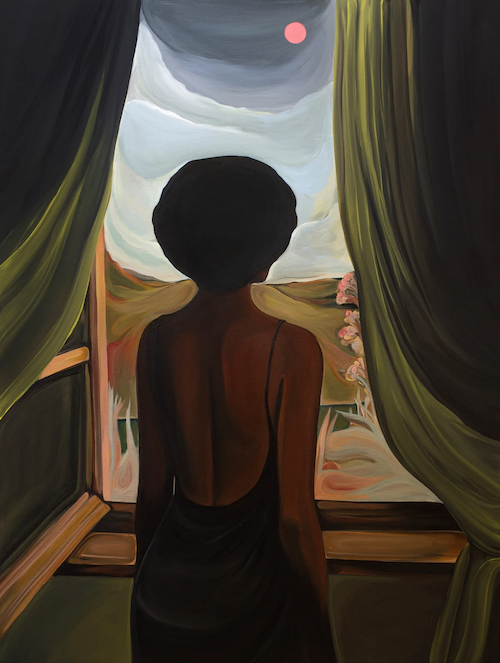
Welcome to Poetics Tuesday where once again we’ll endeavor to put pen to paper or fingers to keyboard and let our muses rise to the occasion, that is, sharing with each other our original poems. Dora here, coming to you from Dreams from a Pilgrimage, and I don’t know about you, but I’m ready to throw open every window in my modest abode, welcome in the spring air, and banish every lingering trace of the winter doldrums.
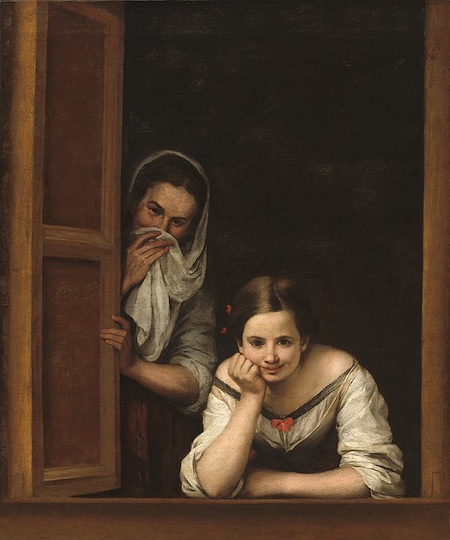
The quote above from Saki’s famous (very) short story, “The Open Window,” got me thinking about one of the most prevalent tropes in literature and art, that of the open window. In a painting it often functions variously as a source of light or an invitation to ponder the relationship between the interior view and the exterior, or perhaps something even more imaginative or prosaic. In Saki’s short story, the window is the focal point of a conversation between a young girl and her aunt’s ill-at-ease visitor, Mr. Nuttle, the end result of which has the latter bolting out the door for dear life. For the girl the window was a fount of imagination; for Mr. Nuttle, alas, it was something quite different.
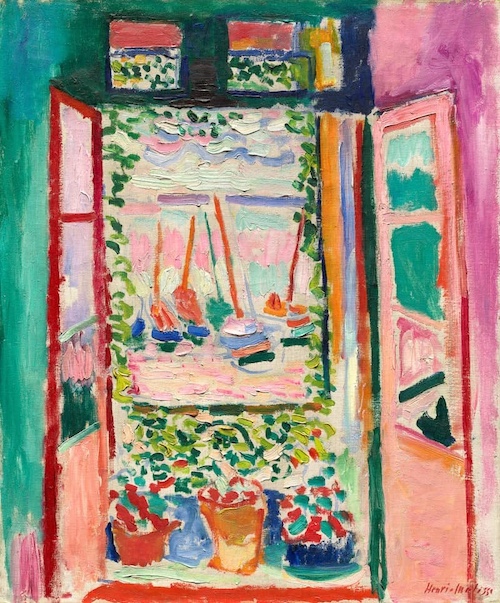
Poet David Lehman writes of Matisse’s “The Open Window” in “Three Aesthetic Questions”: Matisse “looked and knew/the harbor is life, and blessed be the light/that results in such blossoms of color,/an exuberance that proves every seascape/is a lover’s state of heart.”
Here are a few poems to get us acclimatized to the trope of an open window:
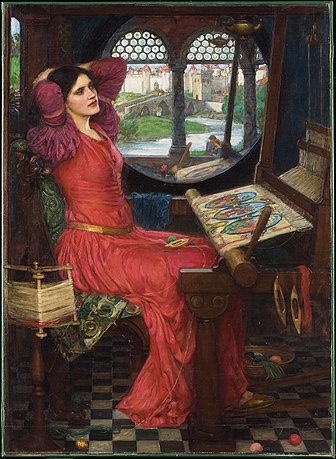

#/media/File:The_Lady_of_Shallot_Looking_at_Lancelot.jpg)
In Tennyson’s lyrical ballad, “The Lady of Shalott” (1832), the mysteriously cursed Lady of Shalott dwells within “four grey walls and four grey towers” on an island in a river leading down to Camelot. Day and night she weaves on her loom what she sees of the world through a mirror facing the open window, until the day she sees the lusty figure of Sir Lancelot, falls in love, and meets her doom.
In Jane Hirshfield’s “I Open the Window” (2023), the poet tells us just what it is she wants to accomplish by opening a window.
Tomas Transnomer in “The Open Window” (2011) stands shaving in front of an open window, the whirring of the razor directing his thoughts to a borderland between alternate realities.
For Anna Swir in “I’ll Open the Window” (1996), the act of opening the window is an act of cleansing oneself from a love that has ended.
Longfellow’s “The Open Window” (1850) finds the poet glancing up at an open window reminding him of his childhood.
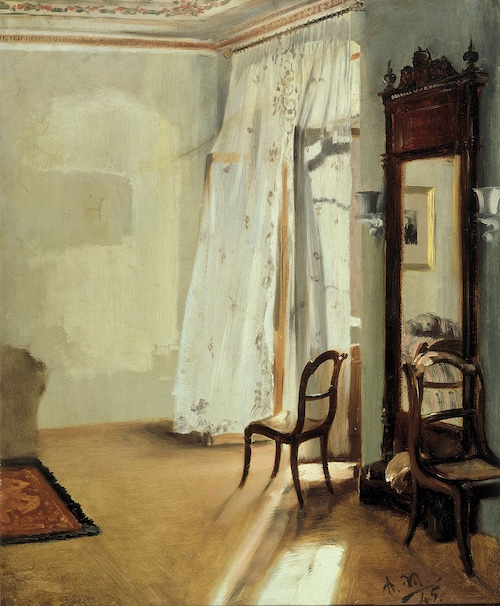
Sara Teasdale reflects on an invalid’s life and time’s passage in “Open Windows” (1920).
“Opening the Window” (1875) by Oliver Wendell Holmes makes use of the window as a metaphor for creativity.
A haiku by Kakio Tomizawa (1902-1962) “Opening a Window” is quirky and familiar.
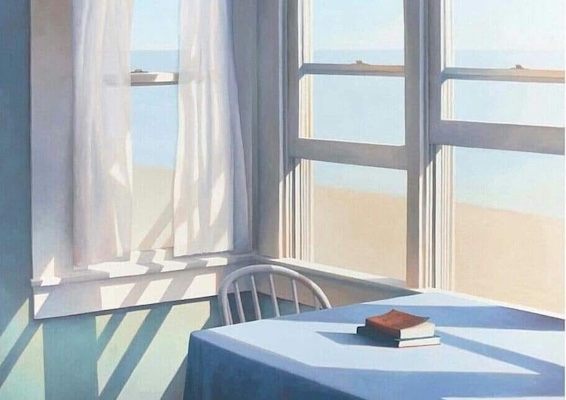
For this week’s Poetics, I’d like us to use the trope of the open window in our own poetry. We need not limit ourselves to an interior to exterior perspective. Baudelaire wrote of looking in through an open window in “Windows.” William Carlos Williams wrote of trying to open a window and realizing it was stuck in “The Window.” Maybe you’d like to write about trying to read by an open window. And I don’t know about you but driving with the car window rolled down (and the music turned up, she added guiltily) is a mandatory rite of spring as far as I’m concerned.

Imagination is what allows your mind to discover.
Wassily Kandinsky
What happens when we open a window? What vistas of the heart and mind, of our senses and perceptions lighten or preoccupy us? Do we hear bells or wind chimes from afar, sounds of a bygone time, catch the scent of wild wisteria, or the music of distant drums or a primeval surge of life?
Give us your take on the romance of the open window through your poetry.
New to dVerse? Here’s how to join in:
* Write a poem in response to the challenge.
* Post your poem on your blog and link back to this post.
* Enter your name and the link to your post by clicking Mr. Linky below (remember to check the little box to accept the use/privacy policy).
* Read and comment on your fellow poets’ work –- there’s so much to derive from reading each other’s writing: new inspiration, new ideas, new friends. Enjoy!
* And remember, Mr. Linky will remain open until 3pm EST on Thursday, March 13th. You can, however, write a poem to the prompt and link it up to Open Link Night.
 dVerse
Welcome, everyone, to the dVerse Poets Pub! Grab a seat and tell us what you’ll have from the kitchen and bar. We’re a come as you are and stay a while bunch, eager to read and share our poetry.
Here’s hoping the prompt throws open the windows of your imagination!
Hello, I tried to open my windows but it was a bit difficult…. (and maybe that’s the whole point)… if possible i just want a beer tonight.
Anytime you bring the librarian over to visit, I count it a win! Beer coming up — Cheers!
Hello Dora and All! Wonderful prompt and poetry/art choices to inspire us. I have to link and run but will be back later to pad along the poetry trail.
Cheers, Li. Catch you later!
Hello Dora! Love your post with well curated art and poetry. Will catch up in the morning.
Thanks, Punam! Have a good night!
I have only a couple of weeks to get used to US daylight hours, and then it’s all change again! I love the prompt, Dora, which I’m sure will harvest some fantastic poetry.
Why must we play with the clock so?! But no complaints today from me, the weather is so balmy, 70 degrees (21 Celsius) and I’m loving it. 🙂
Our weather is changing at the moment, Dora, the temperature has plummeted, and I’m back to wearing a thick cardigan.
Greetings everyone! Feeling frustrated .. my computer died with ‘my life’ inside. Thankfully a new PC arrives this Friday. Attempting to publish on anything other than a desktop is next to impossible. I have been reading your poems, enjoying them immensely ~ ready to jump back in soon. Love the open window challenge, Dora.
That’s awful, Helen! I’m heart-scalded for your sake. I killed my laptop by spilling salt water on it years back and some of what’s lost will forever remain so. We miss you here and can’t wait till you’re back on your new computer. Hang in there, and thanks for letting us know what’s up.
What’s behind the bar to cheer up a dark mood?
Sorry to hear that, Nolcha. How about a glass of Bailey’s? Liquid music to soothe the soul, the Irish would say. And I’ll join you. Here’s to wishing the dark mood’s swift passage!
Beautiful prompt that sparks the imagination!
I’m happy you liked it, MM. Your poem, by the way, is so good!
Hi Dora, you Queen of Cool, you. Serving any good coffee?
Coffee?? My dear Lady Poet, sui generis, you can have as much and as many piping hot cups as you like as long as you keep writing poetry like the wonderful one of yours I just read.
Well that was a truly wonderful prompt Dora, with interesting examples. I hesitate between a cold coffee or Guinness, which is just about the same thing…perhaps coffee would work best, in a Guinness bottle…
Ha ha ha. Cold coffee and Guinness are kind of the same, aren’t they?! 😄
Haha! Coffee camouflaged coming right up, Ain! 🙂
Hello, Dora, thanks for hosting, beautiful poems and prompt!
Hi Jay! I’m so glad you enjoyed the prompt. Thanks for dropping by. 🙂
I love the prompt, thank you Dora 🙂
Thank you, Paul. Loved your poem! 😍
What a wonderful prompt, Dora!! Annoyingly, it’s one of those times when I feel I can only respond with an image rather than a poem but I love the prompt, nonetheless, and may write to it another time ☺️ What a gorgeous choice of artwork you’ve given us!! Especially Kandinsky and Jim Holland 👌🏼🩷
You’re a dear for dropping by, Nina, and being as eclectic artistically as you are uniquely talented in each medium, whatever you produce will be just right. However you respond, let me know! I’m not as consistent in my blog reading these days as I’d wish to be. The artists you picked out? My favorites too. 🤗😘
🩷 Oh, Dora! 🩷
💞💞💞
Hi Dora! Hi Everyone! 🙂
I liked this prompt… my poem took on a life of its own, becoming an homage to the working man.
Who would have thought! 😀
Thank you.
I loved it! And we need more such homage to the working man as the billionaires seem to be getting more than their share of adulation. 🙂
great prompt Dora. Took me a few drafts to get to something interesting.
also, we looked at windows back in 2017, here’s mine from then: https://erbiage.wordpress.com/2017/07/18/winter-window-pains/
gee I’ve been at this for a minute!
it’s actually been ten years! Yikes!
😂
Eric, It was a wonderful poem and I so enjoyed it! It really does take several drafts to produce such work.
Yes it does. But I find I rarely have the time to devote to it. Sometimes it’s all I can do to get a rough draft ready by the time Mr. Linky is done.-EricSent from my iPhone
I think many find the time constraints limiting. So do I. But as seeds of ideas, first drafts, perhaps they lead to future polishing and refining for future postings, submissions to poetry journals and such? Or your own poetry chapbook. 🙂
I love this Challenge
I’m so glad! 🙂
Hi Dora, I’m late with this post but I’m adding it here anyway: https://roberta-writes.com/2025/03/14/roberta-writes-dverse-the-romance-of-the-open-window-dverse-poetry/. It’s a fun prompt.
I’m always glad to see you here, Robbie! I left an open window just for you. 🙂
You are very kind, Dora. Sometimes it takes me a bit longer to pull my thoughts together for a poem.
As it should, to write something worth sharing. I have no problem with an unofficial nod to that desire. Hope your Dad’s staying strong and there is peace in your heart as you navigate these trying times.
Hi Dora, dad is much improved on the new treatment plan. Thank you for asking and for your kind patience.
Wonderful! That’s so good to hear, Robbie. 💞
great collection of poems; still to read the rest. but I love the haiku and that Jane Hirshfield one —
I love how we learn from both the ones to our taste and the ones that aren’t. I like those two as well.
I just read ‘The Open Window’ for the first time in decades. It was wonderful reading it again, the exquisite restraint of the narrative, and that conclusion !! A Xmas cake post, full of goodies 🙂
A Xmas cake post! I love that. Thank you. That Longfellow poem is so full of nostalgia it makes you sigh, but not painfully, thanks to “the warm, soft hand” beside. That last line puts it all so beautifully in perspective.
Wonderful images, Dora!
Glad you enjoyed them! 😀