Tags
#PoetryPrompt, #SandraCisneros, definition/meaning, definitions, language and feeling, poetry, Spanish/English, Wordsmithing, Writing Experiments
Call for Poetry Submissions
In celebration of our fifteenth anniversary in 2026, the dVerse Poets Pub invites poets from around the globe to contribute to our upcoming anthology, Krisis: Poetry at the Crossroads. Submission period: April 1 – June 30, 2025. Click here to learn more.
¡Hola, amigos! No soy Dora la exploradora, simply yours truly at Dreams from a Pilgrimage. Welcome to this week’s dVerse Poetics where I’m donning my more famous tocaya’s hat to challenge you with some Spanish words.
At school they say my name funny as if the syllables were made out of tin and hurt the roof of your mouth. But in Spanish my name is made out of a softer something, like silver . . . .
“Esperanza” in Sandra Cisneros, The House on Mango Street (1984)
Every language has its unique musical lilt and flow contained even in a single word as I found while hearing a poem made up of English and Spanish words, a poem written and read by Mexican American writer Sandra Cisneros (b. 1954), winner of the 2019 PEN/Nabokov Award for Achievement in International Literature. Cisneros was born in Chicago, the only daughter in a family of six brothers. In her stories and poems, she deals with the formation of Chicana identity, exploring the challenges of being caught between Mexican and Anglo-American cultures, facing the misogynist attitudes present in both these cultures, and the constant migration of her family between Mexico and the United States, “always straddling two countries but not belonging to either culture.”1
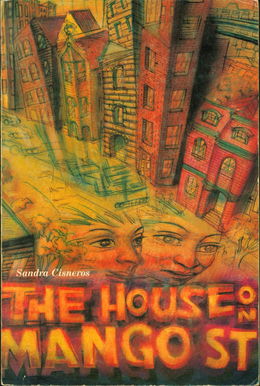
Cisneros is best known for her novel, The House on Mango Street (1984), drawn from her own experiences. It’s a coming-of-age classic in which Esperanza Cordero, a young girl growing up in Chicago, recounts her family’s struggles with poverty, food and housing insecurity, and coming to terms with her cultural hybridity.
In English my name means hope,” Esperanza says. “In Spanish it means too many letters. It means sadness, it means waiting.
The House on Mango Street
In “I Have No Word in English For,” Cisneros lists twenty-five Spanish words dictionary-like but non-alphabetically, yet seemingly objectively. You soon discover that each definition appropriates a keenly personal shade of meaning. The first word, “apachurrado,” for example, literally means “crushed” in English, the CollinsDictionary.com’s Spanish to English translation being:
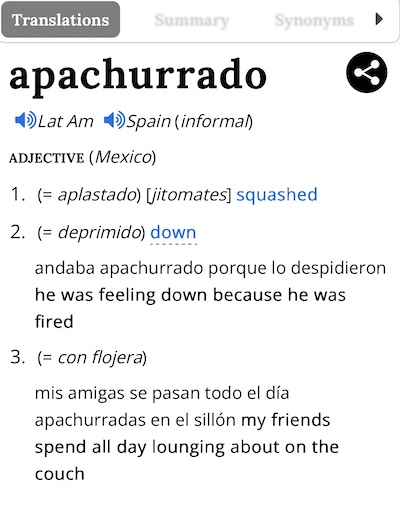
But in her poem Cisneros gives the word a connotation more emotionally laden than its denotation. I encourage you to hear her poem read so you can get the full euphonic flavor of the words. Click on the title below for the link to the poem and the reading.

I Have No Word in English For
By Sandra Cisneros (The New Yorker print edition, September 16, 2024)
Apachurrado. Hat run over by a truck. Heart run over by unrequited love.
Estrenar. To show off what’s new gloriously.
Engentada. People-overdose malaise.
A estas alturas. Superb vista with age.
Encabronada/o. A volatile, combustible rage.
Susto. Fear that spooks the soul away.
Ni modo. Wise acceptance of what fate doles.
Aguante. Miraculous Mexican power to endure conquest, tragedy, politicos.
Ánimo. A joyous zap of fire.
Divina Providencia. Destiny with choices and spiritual interventions.
Nagual. Animal twin assigned at birth.
Amfibio. Person with the gift of global perspective due to living between borders.
Alebrije. Amfibio with wings from geographical travel.
Ombligo. Buried umbilical. Center of the universe.
Toloache. Love concoction made with moonflower and menstrual blood.
Tocaya/o. Name double. Automatic friend.
Amiga hermana. Heart sister closer than kin.
Un pobre infeliz. The walking wounded maimed by land mines of life.
Un inocente. Mind askew since birth; blameless.
Chupacabrón/a. Energy vampire disguised in human form.
Cenzontle. Tranquillity transmitter in bird or human form.
Friolenta/o. Tropical blood. Vulnerable to chills.
Chípil. Melancholia due to an unborn sibling en route.
Desamor. Heart bleeding like xoconostle fruit.
Xoconostle. Must I explain everything for you?

Now for your Poetics challenge:
While you can write your poem on any theme, I’d like you to include one of two options this week:
1) Use one (or more) of the italicized Spanish words from the Cisneros poem above and incorporate it into your own original poem. Be sure to look up the word you choose to get its objective definition and compare it to Cisneros’s poeticism before trying it out on your tongue. The challenge would be akin to tasting a new or exotic fruit and seeing how it melds with your own poetic palate;
OR
2) Use within your poem a familiar word(s) or phrase(s) from a language other than English, transliterated if using a non-Roman alphabet, which you feel expresses a distinctively peculiar thought or emotion.
Whichever option you choose, be sure to provide the word’s meaning for us so that we can discern how it’s used in your poem.
New to dVerse? Here’s how to join in:
* Write a poem in response to the challenge.
* Post your poem on your blog and link back to this post.
* Enter your name and the link to your post by clicking Mr. Linky below (remember to check the little box to accept the use/privacy policy).
* Read and comment on your fellow poets’ work –- there’s so much to derive from reading each other’s writing: new inspiration, new ideas, new friends. Enjoy!
* Mr. Linky will remain open until 3pm EST on Thursday, May 15th.
 dVerse
Welcome, everyone, to the dVerse Poet’s Pub!
Doors are open and we have a smorgasbord of refreshments including Mexican Tres Leches cake and Chiapas coffee, so take your pick.
Meantime, see you on the poetry trail!
Sounds delicious
Going with a semi-topical dessert menu today!
It was a hard prompt for me to write, but with the creative definition it made it a bit easier… it brought back some memories of mine when I lived in Arizona.
Oh what a great perspective your trip will bring! Can’t wait to read, Björn.
Dora, thank you for hosting. I just loved Cisneros poem. Amazing, really.
Save some cake for me please. See you all tomorrow.
So glad to see you, and wish you sweet dreams, Punam! That slice of cake will be waiting for you in the morning.
The cake was yummy. Thanks, Dora.
You always do the coolest prompts, QCD!
A coffee, white, for me, please, and I’ll be back tomorrow to make the rounds.
Btw, I have replied to both of your kind comments at my blog. 🙂
🤗💞
Coming right up, LP, and thanks for the compliment, my friend. I loved your poem.
Well, Dora, I really was “hook, line, and sinker” with this one! Thank you indeed for luring me with bright cosmopolitan examples, taking me back to William Blake and the “harm-joy” of innocent friendship gone sour.
On that acerbic note I think I need to take up your kind offer of coffee and cake, and no tree-fruit today!
Bon appetit my friend.
Glad to have lured you in, Kathy! I had not thought of that Blakean connection — perfect! You never disappoint and I’m looking forward to reading your poem. A cake and coffee coming up, my friend. Enjoy!
Coffee and cake has gone down a treat, Dora! Trusting you are keeping your tummy topped up as you go about your poetic perusing/invigilating your linguistically opportunistic theme…
I’m well fed with words and treats and every once in a while, the two combine as they do in yours, Kathy. Glad you joined us.
Pingback: translation – K.
I love her work, thanks for a creative prompt Dora.
You’re welcome. She’s a great writer, and inspiring. I’m heading over to read your offering. 🙂
Dora! despite it being in the midst of my working days, I had to squeeze in a response to this wonderful prompt and I hope I have done it justice…
A cup of tea would be lovely please!
A cup of tea for you, Andrew! I just read your poem which was a delight, wedding Spanish and English so seamlessly.
This prompt led to amazing responses. Thanks for it!!!!
I’m so glad you’re enjoying them, Judy. Your response was wonderful!
Pingback: Roberta Writes – d’Verse: Poetics: “I Have No Word in English For” Ubantu #poetry #Zuluculture
Eeek! I’m late: https://roberta-writes.com/2025/05/16/roberta-writes-dverse-poetics-i-have-no-word-in-english-for-ubantu-poetry-zuluculture/ A great prompt Dora.
Not too late for me, anyways! I loved your poem, Robbie, and enjoyed the traditional story reading!
I hope you’ll share your poem (and reading) for OLN this coming Thursday, Robbie.
Thank you, Dora. Sometimes it takes me longer to find inspiration or to actually find time to post the poem. I appreciate your understanding
I know what you mean and feel the same. “Ubantu” — I won’t be forgetting that word for a while.
Pingback: A tale of Sisu and Meraki – Not all who wander are lost
Pingback: coulda, woulda, shoulda – Ren Rising