Happy 2026 to all my fellow dVerse poets! Well, another turn of the calendar year, and it’s a fresh start, a blank page, and another venture into the unknown with our unique soundings into the universe, our own poetic voices, incandescent, particular.
Lately, I’ve been drawn to read some of Elizabeth Bishop’s poems and their poetics struck me as something familiar and odd at the same time. One recognizes shades of Wordsworth’s “emotions recollected in tranquility” and Robert Lowell’s “confessional nonsense” (Bishop’s words) and Marianne Moore’s “imaginary gardens with real toads in them.”

That became more explicable when I read her thoughts on what a poem should contain. She wrote,
The three qualities I admire in the poetry I like best are: Accuracy, Spontaneity, Mystery” (in “Writing Poetry is an Unnatural Act”).
While we’re speaking in threes, three of her most well-known poems, “The Moose,” “The Filling Station,” and “In the Waiting Room,” all avidly marinate in these traits. The latter poem describes an awakening. “The Filling Station” reminded me of William Carlos Williams’ “The Red Wheelbarrow,” unsurprisingly since for Williams, like Bishop, the “mystery” is in the ordinary details. Bishop’s “The Moose” is an encounter with an otherworldly sweetness. These poems dwell on the minutiae only for them to give way to the larger sense of things, painting the canvas with the fine brush of verisimilitude to reveal the unexpected or incongruous.

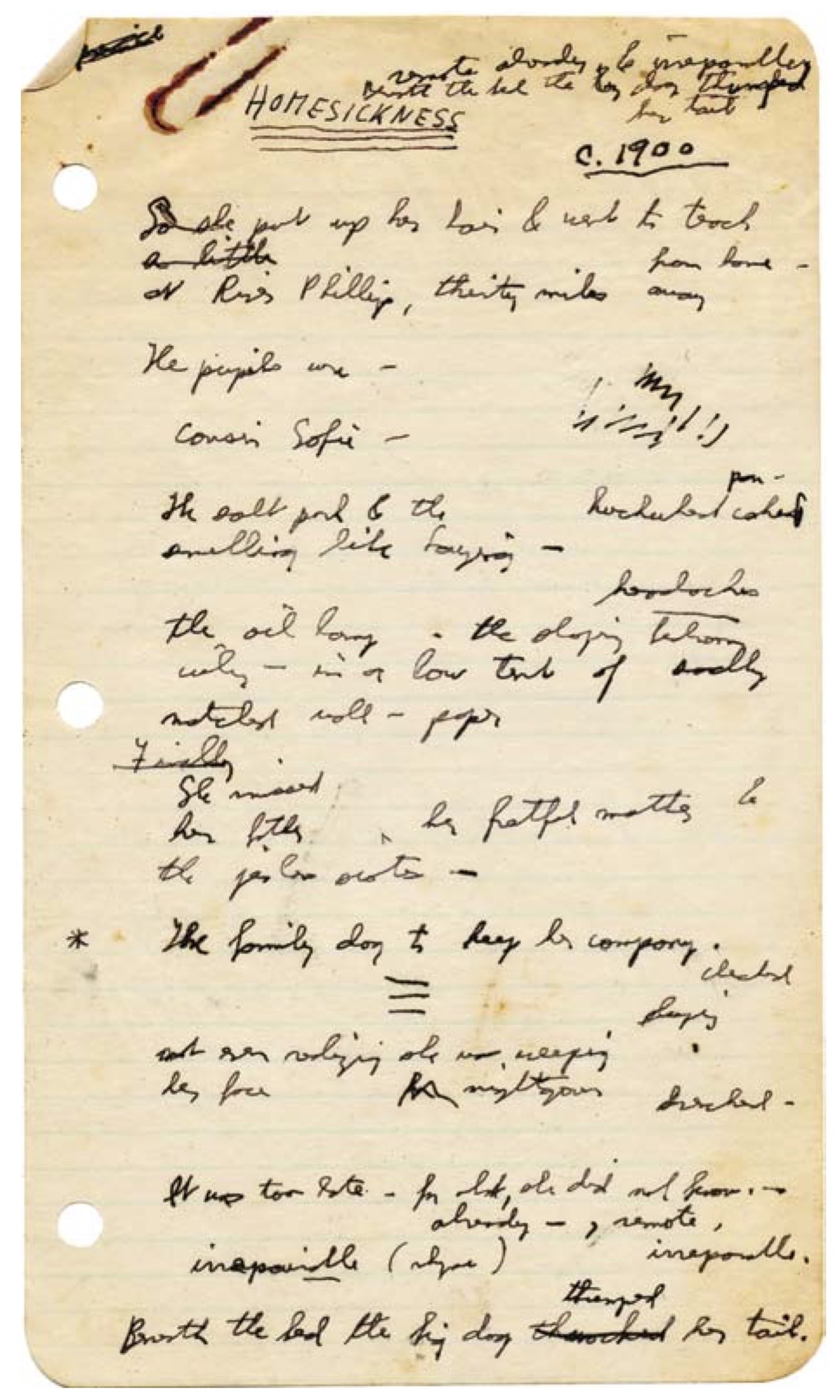
The Filling Station
by Elizabeth Bishop,The Complete Poems 1927-1979 (Farrar Straus and Giroux, 1983)

Oh, but it is dirty!
—this little filling station,
oil-soaked, oil-permeated
to a disturbing, over-all
black translucency.
Be careful with that match!

Father wears a dirty,
oil-soaked monkey suit
that cuts him under the arms,
and several quick and saucy
and greasy sons assist him
(it’s a family filling station),
all quite thoroughly dirty.

Do they live in the station?
It has a cement porch
behind the pumps, and on it
a set of crushed and grease-
impregnated wickerwork;
on the wicker sofa
a dirty dog, quite comfy.

Some comic books provide
the only note of color—
of certain color. They lie
upon a big dim doily
draping a taboret
(part of the set), beside
a big hirsute begonia.

Why the extraneous plant?
Why the taboret?
Why, oh why, the doily?
(Embroidered in daisy stitch
with marguerites, I think,
and heavy with gray crochet.)

Somebody embroidered the doily.
Somebody waters the plant,
or oils it, maybe. Somebody
arranges the rows of cans
so that they softly say:
esso—so—so—so
to high-strung automobiles.
Somebody loves us all.
For your first poetics challenge of the year, I’d like you to dip your word-brush into Bishop’s poetic inkpot, as it were, consciously incorporating accuracy (detail), spontaneity (immediacy), and mystery (revelation) to write your own original poem. Use the three poems by Bishop mentioned above as your examples. Colored by your own poetic voice, take us there, to that place, that person, that occasion; peel back a layer or two of experience, and show us what you found.
New to dVerse? Here’s how to join in:
* Write a poem in response to the challenge.
* Post your poem on your blog and link back to this post.
* Enter your name and the link to your post by clicking Mr. Linky below (remember to check the little box to accept the use/privacy policy).
* Read, enjoy, and comment on your fellow poets’ work –- there’s so much to derive from reading each other’s writing: new inspiration, new ideas, new friends.
* Mr. Linky will remain open until 3pm EST on Thursday, January 8th. Miss the cutoff? No worries. Save your poem up for Open Link Night next Thursday.
 dVerse
Pub doors are open — Come on in, poets, and welcome.
To those who celebrate, it’s still the week of Epiphany and though I can’t offer you gold, frankincense, and myrrh, I do have on the sideboard coffee + cookies + a holiday cake slice of your choosing. At the bar, there’s plenty to brighten the last of the holidays.
I’m looking forward to reading your poems!
thank you Dora for getting the poetry ball rolling with this gift of three – a hot choc and slice of fruit cake sounds about right this wet and freezing night
Hi Laura, Wet and freezing! That won’t do. Cloudy but above freeaing here in the mid-Atlantic states. Come right in and sit right down for your goodies. Cheers!
Hello Dora and All. I like your challenge and enjoyed the filling station poem selection. Looking at the image it feels like the building is leaning forward, perhaps at some point to fall flat on its face. I’m heading out to GR in a few minutes, but hope to link up later. Could I please have a few cookies to eat on the way?
Hi Lisa,
Thank you so much! So glad you stopped by for cookies, which are coming right up. Can’t wait to see what you got for us later!
You’re welcome, and thanks! Cheers!
I love Elizabeth Bishop! She’s one of my favorites! thanks for the prompt
I’m so glad, Sarah! Thank you. Can’t wait to “see her” translated into your own voice. 🙂
Thank you Dora — so interesting.
I’m so gad you liked it, Ain!
Ain – I’m struggling again to comment on your Substack – keep signing in but not recognized though I know I subscribed ages ago
Hello Dora and all!
What a fantastic prompt to come back to! I love Bishop and the way she incorporates mystery into ordinary details.
Wishing you all a very happy new year 🥰 I will be here today and tomorrow to read and comment ❤️❤️
Cake for me please 😀
Hi Sanaa,
Bishop is wonderful, isn’t she?! And I absolutely loved your perfect response to the prompt Happy New Year to you too, my friend. Cake coming up! 🙂💖
Here’s my take https://magz70-qytix.wordpress.com/2026/01/06/13046/
I hope i posted it the right place ?
my autocorrect changed the hastags dVerse .
Hi Maggie! Thank you for joining in on the prompt. The link should be entered into Mr. Linky (the bottom icon). Just click on it and follow the instructions. I’ll go ahead and add it for you so you can see how it shows up with everyone’s links. 🙂
oh sorry. I’m so new to this 💜
Thanks for pointing that out and helping . 🌷
You’re welcome! And I absolutely loved your poem. Wonderful. 🙂
I second that
Happy New Year, all. I am under the weather; I will be around hopefully soon as I begin feeling better.🤒
Happy New Year, Melissa! Take care of yourself and feel better soon, my friend. ❤️
Great prompt, Dora! I’ve edited a poem I wrote few days back to fit the prompt. I’m not sure if it completely fits the prompt though.
Sounds great, Jay, and I’m looking forward to reading it. 🙂
Really liked this prompt, Dora and I hope I have done it justice…
I’m so happy you liked it, Andrew, and I’m sure you more than rose to occasion. Heading over to read it in a few.
Sorry for not getting going yet… it has been a long holiday including Tuesday where we had a holiday.
Long holidays are rare enough to be sacrosanct in my neck of the woods, Björn, so you’re more than absolved. 🙂
Many thanks Dora, I do like Bishop’s work, one of my faves.
Thanks, Paul. This prompt was a great way of reacquainting myself with her poetry.
Hi Dora, Happy New Year, this is a terrific prompt. I’m writing but my poem is long and I’m traveling home today. I’ll only be able to post tomorrow.
Safe travels, Robbie! I’m so looking forward to your sharing your poem tomorrow. Thank you! And Happy New Year, my friend!
💚
Here’s mine, Dora: https://roberta-writes.com/2026/01/09/roberta-writes-dverse-borrowing-bishop-and-cffc/
Pingback: Holding Soil With Earthworms – Selma
Happy New Year, dear Dora. Sending blessings for harmony and warmth.
I’m headed over to read your poem, dear Selma! Better late than never. 🙂💖 All the best in this New Year!
Hi Dora, not sure you’ll see this but I wrote to your very inspiring prompt:
http://www.poetlaundry.com/2026/01/still-lifemagazine-cover.html
thank you~
This was a poem to slowly savor and enjoy, Jennifer, and I did, most deeply. To me, it almost felt like a benediction, devoutly rendered..
Thank you my friend. I’m so glad you enjoyed my attempt!