
Hello, everyone! Dora here, from Dreams from a Pilgrimage. Good to see all of you here at the dVerse Poet’s Pub for a round of poetics. Pick up a glass of cheer or a cup of comfort and settle down in your favorite spot as we contemplate a tool of rhetoric in prose and poetry known as a simile. There’s nothing like a well-turned phrase with a simile that makes us smile with pure joy at its relatability or humor.
I float like a butterfly, sting like a bee.”
Muhammed Ali, 1964, after his first title fight against Sonny Liston
As you know, a simile is a comparison between two unlike things using the words, “like” or “as.” The word “simile” itself is a Latin word meaning “like.” And we use a simile to describe or explain something unfamiliar, or to expand on or distill an abstraction, by relating it to something more familiar. As a rhetorical tool, it‘s very effective in conveying meaning while giving pleasure in discovering resemblances. But it also satisfies our deep emotional or psychological need not merely to inform but to relate to one another.
During the Apollo 14 mission in 1971, while on the lunar highlands working in moondust which they had never seen before, Alan Shepard and Edgar Mitchell could use only “like’s” to describe it:
“When you put your scoop in, it smooths out—just like plaster.”
“I was going to say—like cement.”
Poets are only doing what comes naturally when we find likenesses.
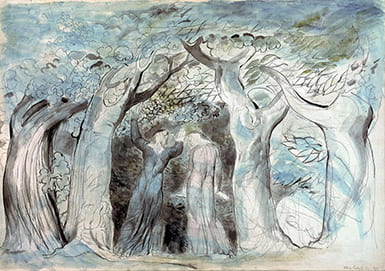
As little flowers, which the chill of night has bent and huddled, when the white sun strikes, grow straight and open fully on their stems, so did I, too, with my exhausted force.”
Dante, Inferno, Canto 2
When we read, “O my Luve is like a red, red rose/That’s newly sprung in June;/O my Luve is like a melody/That’s sweetly played in tune,” we can’t help but smile at the perfect joy the poet Robert Burns relates, or feel the isolation of Wordsworth’s “I wandered lonely as a cloud,” admiring all the while the simple perfection of the comparison.
Here are various examples of simile in poetry to run your eyes over:
“A seal swims like a poodle through the sheet/of blinding salt . . . .” (Robert Lowell)
“If they are good it would be seen;/Good is as visible as green . . . .” (John Donne)
“[God] hangs in shades the orange bright,/Like golden lamps in a green night.” (Andrew Marvell)
“A light rain, as tranquil as an apple.” (Anne Sexton)
“She rides her hips as/it were a horse.” (William Carlos Williams)
Sometimes a simile can be supercharged, where the comparison casts an extra layer of meaning. In Yeats’ “No Second Troy” he writes:
“What could have made her peaceful with a mind
That nobleness made simple as a fire,
With beauty like a tightened bow, a kind
That is not natural in an age like this . . . .”
Fire may be simple, but it is also destructive. A tightened bow may be beautiful, but it’s also threatening. All this comes to play with the deliberate use of these two similes.
Sometimes a simile will determine the structure of an entire poem as in John Ciardi’s “Most Like An Arch This Marriage.”
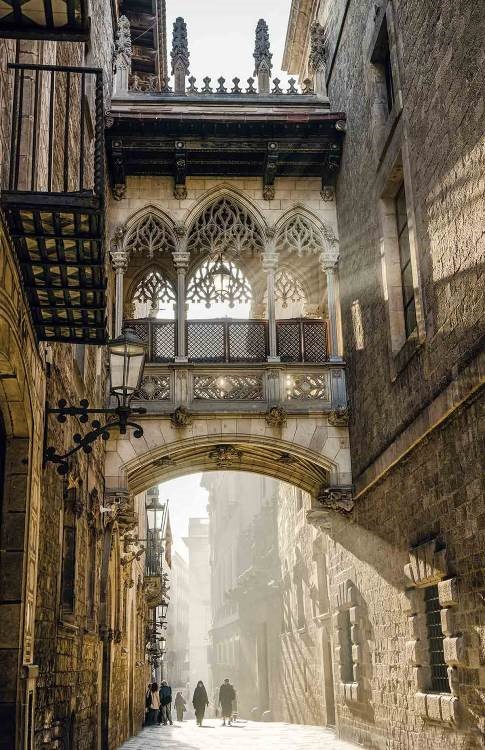
Most Like an Arch This Marriage by John Ciardi (1958)
Most like an arch—an entrance which upholds
and shores the stone-crush up the air like lace.
Mass made idea, and idea held in place.
A lock in time. Inside half-heaven unfolds.
Most like an arch—two weaknesses that lean
into a strength. Two fallings become a term.
Two joined abeyances become a term
naming the fact that teaches fact to mean.
Not quite that? Not much less. World as it is,
what’s strong and separate falters. All I do
at piling stone on stone apart from you
is roofless around nothing. Till we kiss
I am no more than upright and unset.
It is by falling in and in we make
the all-bearing point, for one another’s sake,
in faultless failing, raised by our own weight.
Similes can run rampant throughout a poem like Traci Brimhall’s “Love Without a Drop of Hyperbole In It.”
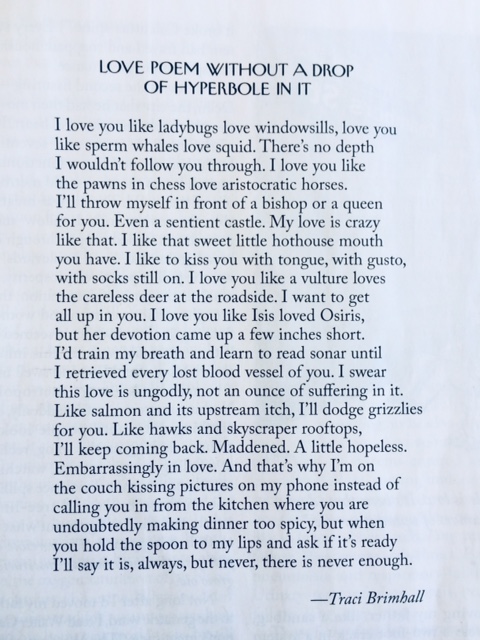
Or a simile can help punctuate a poem’s climax as in Mary Oliver’s “Morning in a New Land.”
Morning In A New Land by Mary Oliver
In trees still dripping night some nameless birds
Woke, shook out their arrowy wings, and sang,
Slowly, like finches sifting through a dream.
The pink sun fell, like glass, into the fields.
Two chestnuts, and a dapple gray,
Their shoulders wet with light, their dark hair streaming,
Climbed the hill. The last mist fell away,
And under the trees, beyond time’s brittle drift,
I stood like Adam in his lonely garden
On that first morning, shaken out of sleep,
Rubbing his eyes, listening, parting the leaves,
Like tissue on some vast, incredible gift.’
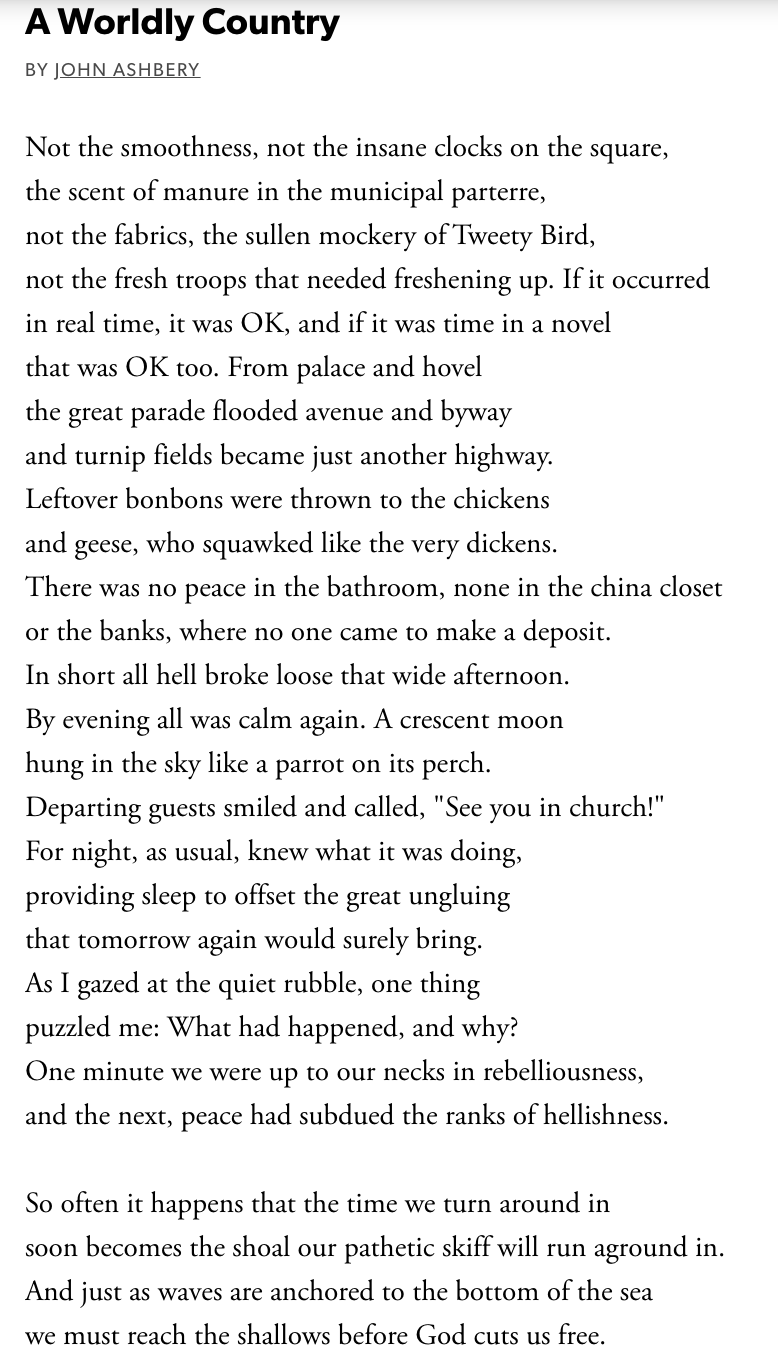
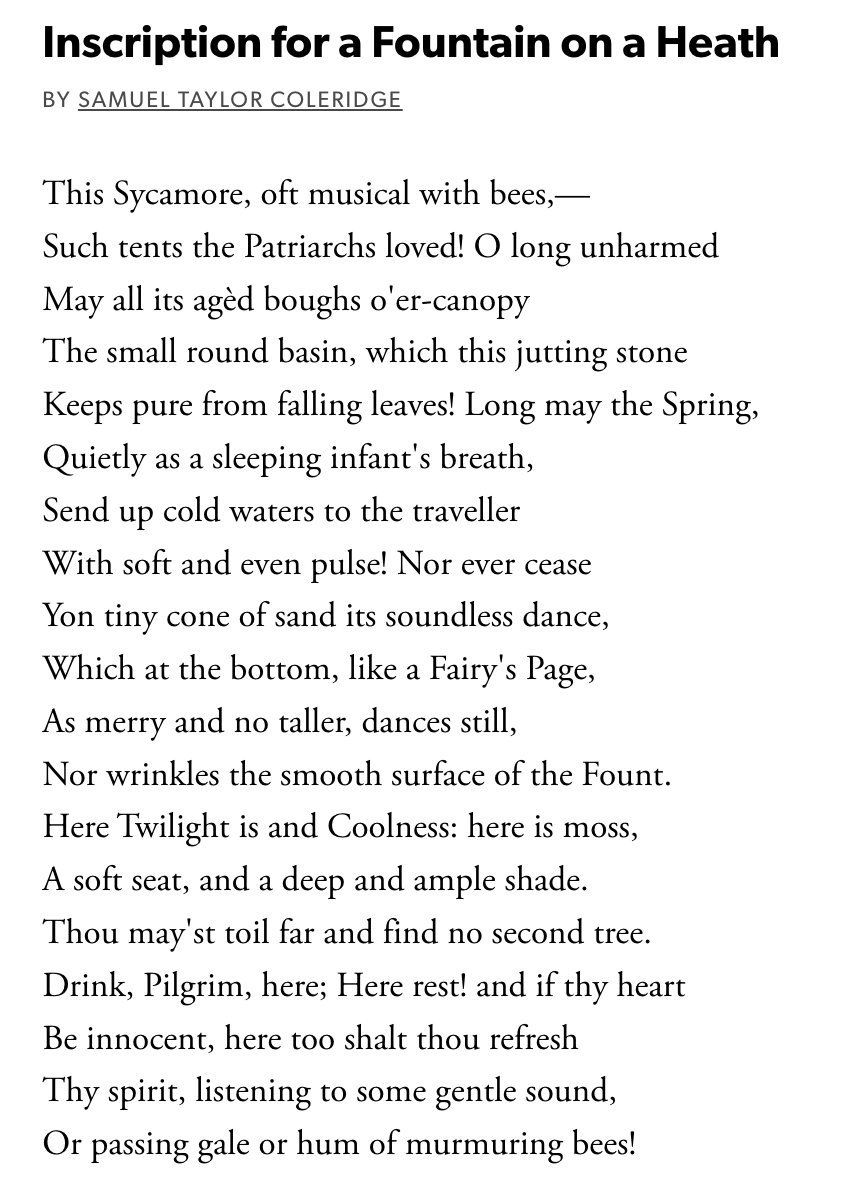
John Ashberry’s “A Worldly Company” couches a simile smack dab in the center of his poem so that it hangs illuminatingly over the whole. Coleridge’s Inscription for a Fountain on a Heath centers his simile so that it delightfully impresses on what precedes and follows.
Whatever the subject you choose to write on for this poetics challenge, I’d like you to use the rhetorical device of a simile. You can use similes all the way through like Brimhall; or use one or two to bring your poetry to full effect, whether in the beginning, middle, or end; or use it like Ciardi to structure the whole of your poem, enlarging on a single image of comparison. You may also choose to smile or not smile while doing so. I hope you smile.
New to dVerse? Here’s how to join in:
* Write a poem in response to the challenge.
* Post your poem on your blog and link back to this post.
* Enter your name and the link to your post by clicking Mr. Linky below (remember to check the little box to accept the use/privacy policy).
* Read and comment on your fellow poets’ work –- there’s so much to derive from reading each other’s writing: new inspiration, new ideas, new friends. Enjoy!
* Mr. Linky will remain open until 3pm EST on Thursday, February 5th. If you miss the closing time, do link your poem up to the next dVerse OLN so we can all still enjoy it.
 dVerse
Hello, dVersians! My head’s reeling with all the horror that’s been released in the Epstein files, showing much of our ruling, moneyed, and media classes to be either corrupt monsters themselves or controlled by them. So I’m doubly glad for your poetry today to remind me there’s much to be grateful for in this old world.
Pub doors are open, pantries brimming with your favorite choice of drinks and all manner of edibles. Fresh from the oven? A pineapple upside down cake. Come have a slice!
Hi Dora and all .
I’m all upside-down today, so I will take a slice 😃
I think I know how you feel, Maggie. Hope this slice hits the spot. 🙂
Hello Dora and All. I love your poem choices and images. Good prompt that I found to be easier to write than a laundry list 😉 Pineapple upside down cake sounds perfect to go with my hot coffee with oat milk, please? Can’t wait to read the poems coming out of your prompt.
Hi Lisa! I’m so glad to see you here today. I’ve got your slice of cake and coffee right here! Enjoy! 🙂
Thanks, Dora! Just got home from spending time in GR with my family at fmg. The cake and coffee were so warming and delicious on the drive over. Cheers!
Oh, that’s wonderful, Li. I’m so glad you can see them regularly. A joy to treasure.
Indeed, Dora ❤
I was a little late to the party and will go directly to read before heading to bed…. my contribution is a little bit toungue in cheek… hope it gives you all something to smile about.
It did indeed, Björn! Thank you. 🙂
hi all
upside down cake YES PLEASE not had that in years.
thanks for the challenge of tbhis one
rog
You got it, Rog, especially as you smashed the challenge! 🙂
Oh My Goodness!!! Pineapple Upside-Down Cake ~~~ our Mother loved making them and we loved gobbling them down. I would enjoy an ‘oversized’ slice with a pot of Twinings Earl Grey? Thanks, Dora for a neat challenge.
Never-can-turn-down a pineapple-upside-down is my personal motto, Helen, engraved on my coat of arms, just so you know. 🙂 And here’s a heaping helping along with Earl Grey. So good to see you here!
Hi Dora! Thanks for the challenge/prompt. This is Ren– I’m back with a new blog for 2026, and now posting under my real name: Lynne. Good to see everyone 🙂
Welcome back, Lynne! I just clicked on your new blog before I saw this comment and I love it! Great to have a fresh start for the new year and I’m glad you’re doing it with us. Thank you! 😊💖
❤
I chose smile :-)) Thank you again, Dora, for a wonderful challenge. ❤
I knew you would, Jennifer, of all people. You are most welcome, my friend. 🙂
Hi Dora! Wonderful prompt! Will write soon.🫶🏻
Thank you, Melissa! Can’t wait to see what you come up with. 💖
Very late to the party…..will return tomorrow to read and comment. Thanks so much for tending the pub, Dora!
This party is a late-nighter, Lill, and I’m off to bed now. But so glad I stayed up to catch your wonderful poem. You really took me there, so to speak!
Great post and challenge Dora 🙌
Thank you, Ange! Just got back after a full morning and so ready to walk the poetry trail. Looking forward to catching up with you! 🙂
🙌
Thanks Dora, I enjoyed the prompt, I had some fun with Aussie similes.
Ah, I can’t wait to read, Paul.
Hi Dora! I hope there’s a slice of pineapple upside down cake left for me.
Fantastic prompt and I love the poems you shared.
Mine won’t make you smile, but you know how the muse works…
Your skill with words always makes me smile. A slice of cake headed your way, Punam — Enjoy! 🙂
Thank you for the prompt, Dora. I wrote one poem that I decided not to post, but I came up with another.
I haven’t had pineapple upside down cake in a long time. Yes, please!
Saved a slice for you, Merril. Thanks for dropping by! I can’t wait to read, your poem. 🙂
😋
Pineapple upside down? Oh my! Yes, please. two slices please–I’ll eat one and save the other for later when I sit and chat with my Mama who loved this cake. Blessings.
Dora, this is the right prompt for these hard times forced on us. Thank you. I wrote something short and childish. will publish in two hours.
https://selmamartin.com/smiling-similes-for-you/
Oh that’s wonderful, Selma. I hope you enjoy the cake. It’s my favorite just now, with mango mousse coming in a distant second place. 🙂
Blessings to you too, dear Selma. I’m looking forward to reading what you’ve served up, something delightful, I’m sure. 🤗🥰❤️
I’m a bit late, Dora, but here’s my poem: https://robbiesinspiration.wordpress.com/2026/02/08/robbies-inspiration-dverse-poetics-tuesday-sunday-stills-and-the-flower-hour/
Thanks for the scrumptious cake, Dora. I am glad my words make you smile. ❤️