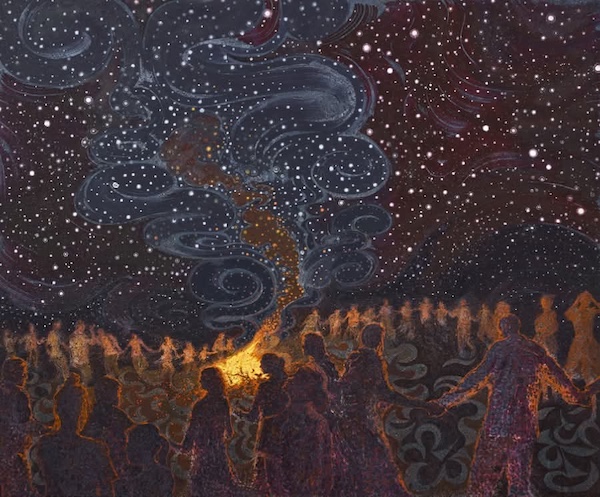
Josh Raz (UK b. 1993), “Shifting Axis” (2023), oil on canvas 165 × 200 cm
Welcome, everyone, to Tuesday’s Poetics. I’m Dora (Dreams from a Pilgrimage), today’s dVerse pubtender and fellow traveler on this planet we call Earth, where the evil few spill the blood of many for power and profit. In some places the holocaust of the land and people is almost complete. In others, the bloodletting is just beginning. Yet others, horror continues unremittingly. These landscapes, be it in the city or field, have become or will be unrecognizable, burnt husks of what they once were, buried in rubble, soaked in the blood of the innocent and helpless, spreading farther and farther.
We cannot yet fathom the horror and trauma being endured by the living in these regions, though their landscapes bear testament to them. The desolation, loss, and death are absorbed into the very fabric of their being, into their bodies, into minds trying to make sense of the senseless.
The landscape becomes internalized, either as mirroring or amplifying what is felt or endured bodily.
If this introduction is unsettling to you, I apologize. It is difficult to write as if when one part of humanity is enduring the unendurable, the other remains unaffected. Do we not belong to each other?
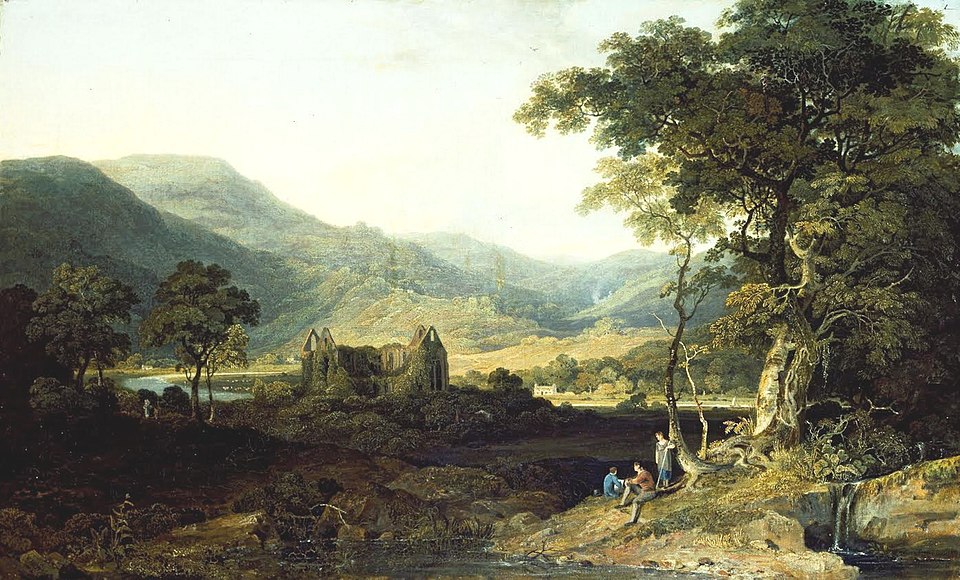
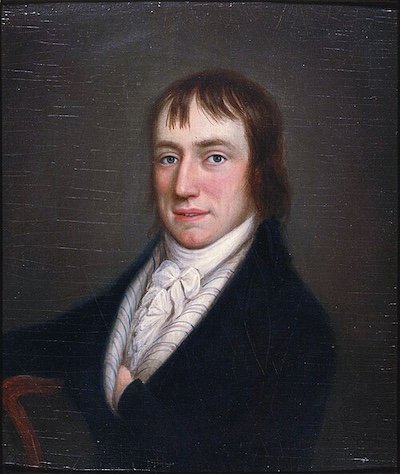
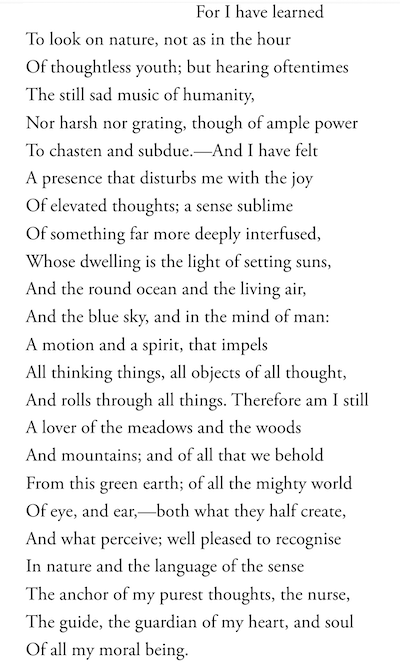
In an idyllic time, when the tremors of the French revolution had become more muted in England, it was the landscape surrounding the ruins of Tintern Abbey along the Welsh border that William Wordsworth internalized to such an extent that he imbued it with a preternatural quality.
To know who you are, you have to have a place to come from.
Carson McCullers
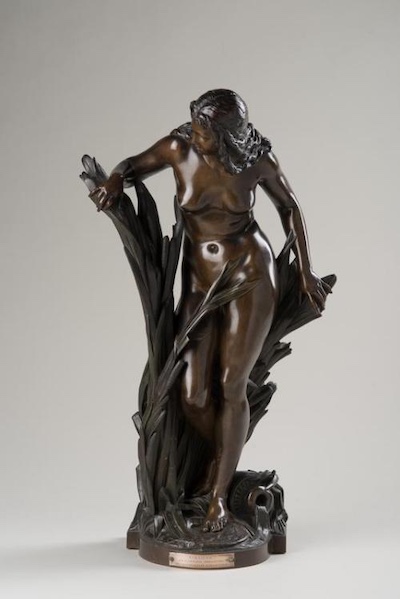
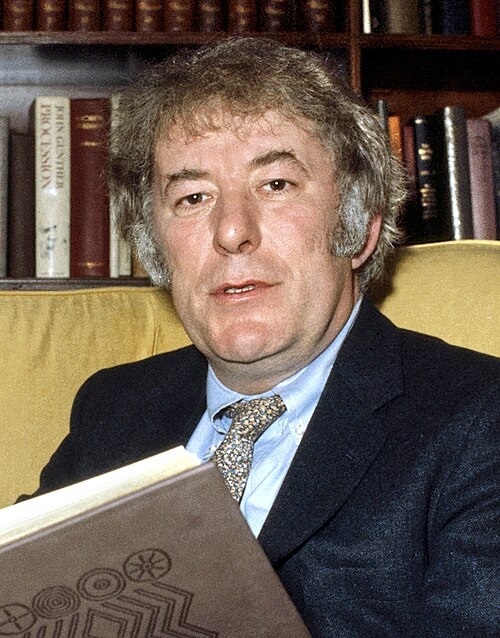
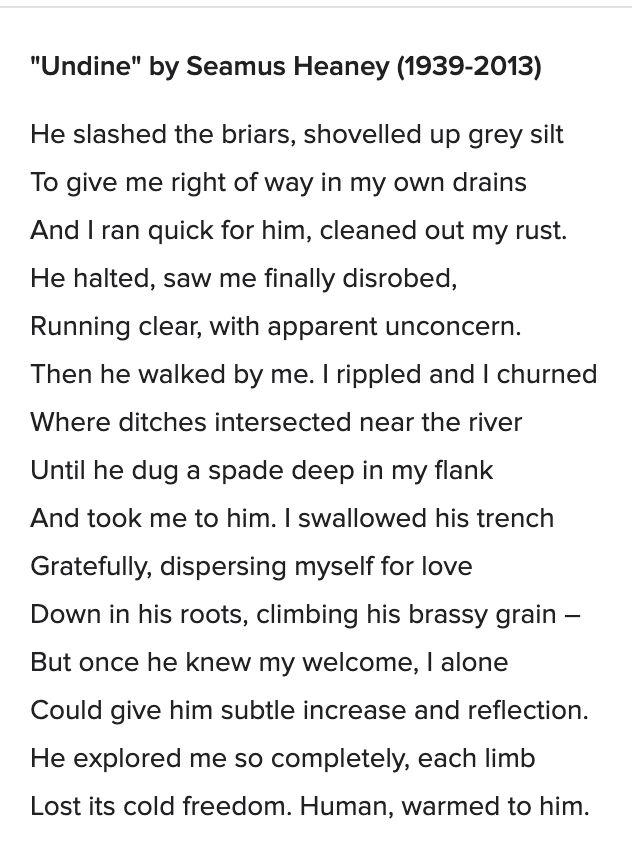
Nobel laureate Seamus Heaney is one for whom his native Irish landscape is ever near and dear, so much so that many have commented on the earthiness of his poetry. His poem “Undine” is a good example insofar as the landscape becomes personified, literally embodying this “orphaned memory” of “watching a man clearing out an old spongy growth from a drain between two fields” (Seamus Heaney, Preoccupations: Selected Prose 1968-78, 1980, p. 53). [An undine (UN-deen) is a water-nymph or sprite. When undines marry humans, it shortens their lives on Earth, but earns them an immortal human soul.]
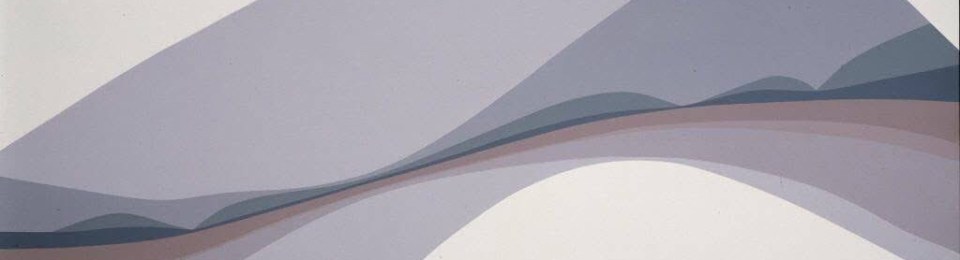
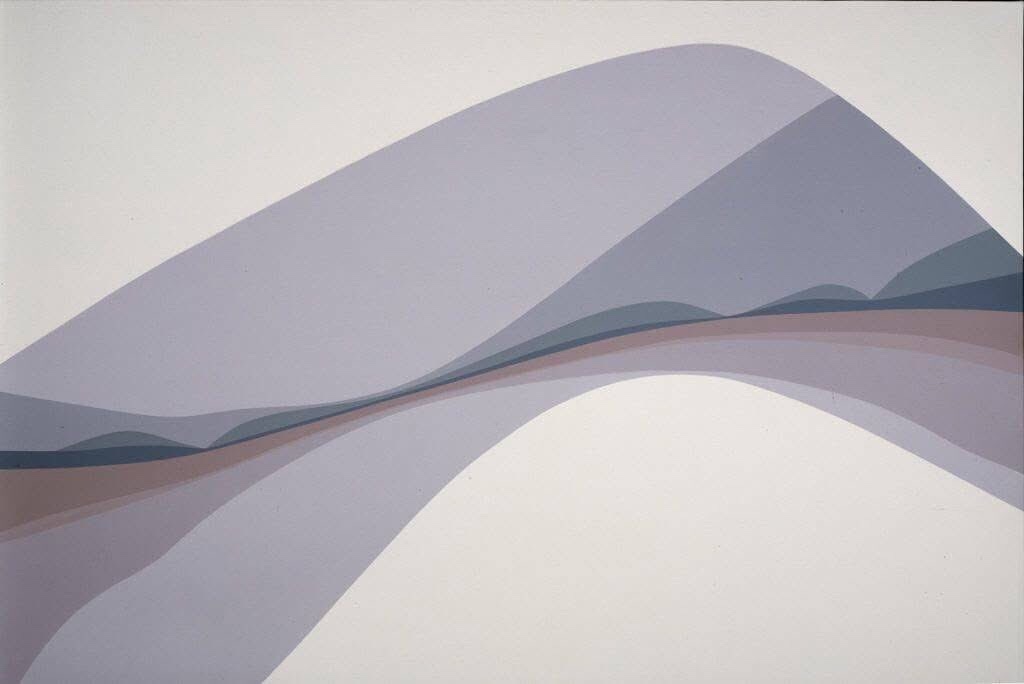
Helen Lundeberg (USA 1908-1999), Landscape, 1968, acrylic on canvas 101.5 x 151.7 cm
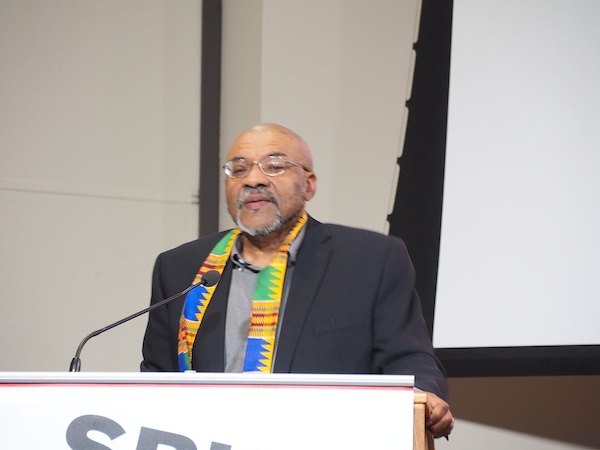
In Kwame Dawes’ Nebraska: Poems (2019), each of his poems seem in some way to embody the landscape of the plains, its wide, open spaces and its wintry bleakness, as he struggles with life there as a transplant from Jamaica where, though born in Ghana, he had spent his childhood and early adulthood. In “Before Winter,” he captures a moment that is impermanent. Here in this poem, he says, is “me thinking about the body and mortality . . . a moment of what it means for this particular body. That is, my own body. Thinking about weight, thinking about my ankle, thinking about these things, to walk through this alien territory. And there’s a sense in which I am alien in this space. I’m an interloper. This is not my sort of native landscape and place. And yet all the language of comfort—hibernation, the idea of change and seasonal change—has become part of my hope. And that way in which I’m embracing that, even as my body sort of is resisting that, I think becomes that kind of statement about this immigrant body, this immigrant person in this landscape” (New Yorker Poetry Podcast, February 26, 2020).
Before Winter by Kwame Dawes I imagine there is a place of deep rest—not in the resting but after, when the body has forgotten the weight of fatigue or of its many
betrayals—how unfair that once I thought it clever to blame my body for the wounds in me: the ankle bulbous and aching, the heaviness
in the thigh, and the fat, the encroachment of flesh. It is hard to believe that there are those who do not know that it is possible to let things
go, to then see the expansion of flesh—it is so easy, and that knowing is a pathology. What is unknown to me is the clear day of rest—
I carry a brain of crushed paper, everything unfolds as if by magic, every spot of understanding is a miracle, I cannot take any credit
for the revelations, they come and go as easily as the wind. You must know that this is a preamble to an epiphany I will record—
the late-morning light of October, the damp soiled back yard, the verdant green lawn, the bright elegance of leaves strewn
over it all, turning nonchalantly in the wind, and the Nebraska sky blue as a kind of watery ease, a comfort, it is all I can say, the kind
one knows, even standing there waiting for the dog to squat; one that I will remember for years but will never have the language
to speak of—one of those precious insignificances that we collect and hoard. The moment lasts ten breaths, and in that silence
I imagine that I can see spirits, I can know myself, and I will not fear the betrayals of body and love and earth, and the machinations
of self-made emperors and pontificates. It will be winter soon. I know my body is collecting water in its nether regions, the weight of the hibernating
mammal, storing everything in drowsy, slow-moving preservation. I mean I am losing myself to the shelter we build to beat back
sorrow and the weight of our fears. I have covered thousands of miles in a few days, and I feel my parts flaking off, a shedding of yellow
pieces covering the turning earth, and I am helpless to this soft disappearing that some call sleep. I will stretch out and breathe.
Do you know I don’t know how one can walk by a tree and not be happy at the sight of it?
Fyodor Dostoevsky
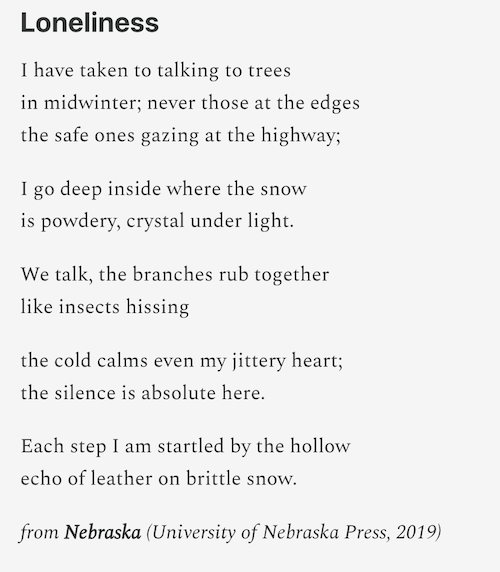
In “Loneliness,” Dawes uses the elements of the alien landscape to construct a home with his words, placing his body “deep inside, where the snow is powdery, crystal under light.”
Kwame Dawes
O O O find your poemhole plug it keep it open as you can a broad beach laved by tides
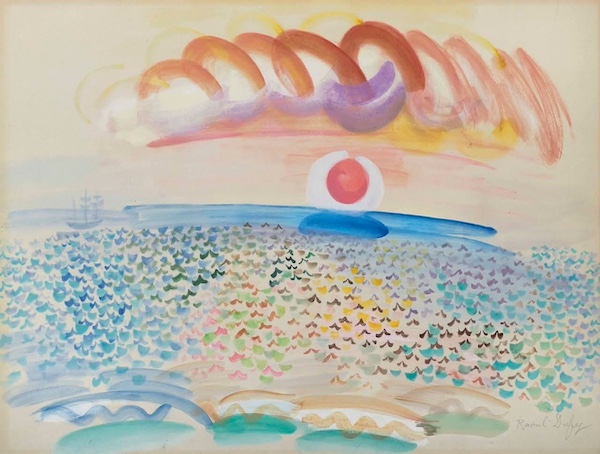
Raoul Dufy (France 1877-1953) Sunset over the Sea (gouache and watercolour on paper 47.1 x 62 cm)Joy Harjo in 2019
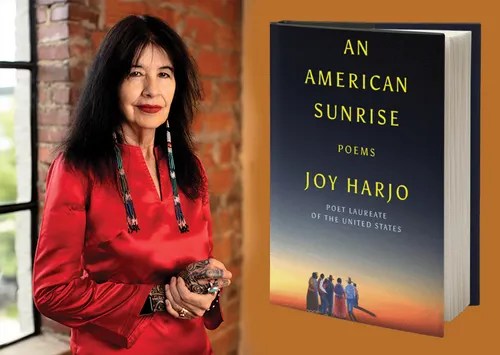
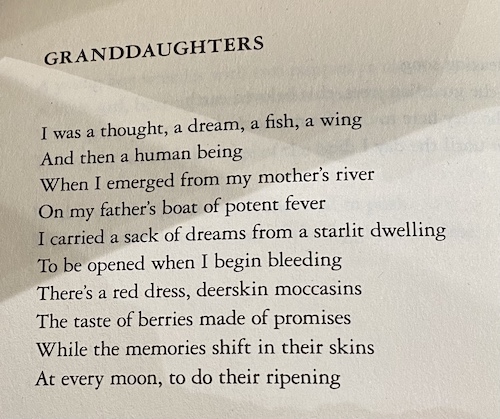
The first Native American poet laureate of the United States, Joy Harjo, in An American Sunrise: Poems (2019), confronts the site where the Msvoke people, including her own ancestors, were forcibly displaced. In “Granddaughters,” as Kwame Dawes points out, “there is no line separating the natural world and her human body” (American Life in Poetry: “Granddaughters”)
Your poetics challenge today is to incorporate a landscape or cityscape into your poetry that either mirrors or amplifies your interior landscape (or lack thereof). Be sure to use the examples above to guide you as to what I mean by “embodying a landscape.” Is there a place that’s special to you, that moves you, that has become a part of you? Perhaps you have a memory of encountering a landscape that has changed you or enlightened you? What particulars of this landscape have inspired, comforted, encouraged, strengthened you, or done just the opposite? Put it all in a poem, and take us there.
New to dVerse? Here’s how to join in: * Write a poem in response to the challenge. * Post your poem on your blog and link back to this post. * Enter your name and the link to your post by clicking Mr. Linky below (remember to check the little box to accept the use/privacy policy). * Read and comment on your fellow poets’ work –- there’s so much to derive from reading each other’s writing: new inspiration, new ideas, new friends. Enjoy!
Mr. Linky will remain open until 3pm EST on Thursday, March 12th. If you miss the closing time, do link your poem up to the next dVerse OLN so we can all still enjoy it.
Hello Dora and All. So many good poems and pieces of artwork in your post. The Kwame Dawes poem resonates deeply. I’m all set for drinks and eats, just had gluten-free macaroni salad for a late lunch and am drinking cuppajoe with oat milk.
I appreciate your thoughtful and passionate intro, and it influenced my muse today. Will link up in a few, then off to GR to see fam.
Hi Robbie! Can’t wait to read what you come up with given the landscapes you have already introduced to us from your beloved South Africa and beyond. 💖
Hi Dora / Hi all — Cool prompt Dora. Wasn’t easy but it was fun. I took us to my favorite area on earth the Oregon wilderness. I interviewed the Cascade Mountains — they had much to say! 🙂👍🏼✌🏼
I’m grateful for the thumbs up, Ange! Thank you. Especially as your poetic response was phenomenal, dragons not only popular but welcome in my landscape. 😉💖🙌
I’ve noticed that too, Eric. I’m humbled by these threads that weave out of the various landscapes enrich, even enable, the lives we lead though very often they’re just there in the background. But they are, in some sense, the very woof and weft, the fabric, as it were, of our existence.
Dora, I totally agree about how tough it is to decide “what to include/leave out.”
March, this year, has been the hottest in the last fifty years here. The bare trees I could see from my balcony became my muse. I hope you like what I have written. 🥰🤗
Sorry for the delay in response, Punam, but I finally got a chance to relax and settle down to enjoy your poem which is simply worth the wait! I loved it. It’s all that I would have expected from your muse, and more, my friend. What a treat to read! 🤗❤️🥰
No worries, Dora. I am still responding to comments of last month. I am glad you could relax and you made my Monday by saying you loved it! Thank you, dearest Dora. 🤗🥰❤️
Robbie What a treat to read your waterfall poem after my own turbulent weekend (healthwise)! I’m looking forward to seeing your painting when you’re finished with it. 🙂🥰🤗
 dVerse
Hello, dVersians! It’s summer weather we’re having on the East Coast and I, for one, am not complaining!
Come right on in and help yourself to libations and sustenance. I’m eager to read your landscape poetry.
Hello Dora and All. So many good poems and pieces of artwork in your post. The Kwame Dawes poem resonates deeply. I’m all set for drinks and eats, just had gluten-free macaroni salad for a late lunch and am drinking cuppajoe with oat milk.
I appreciate your thoughtful and passionate intro, and it influenced my muse today. Will link up in a few, then off to GR to see fam.
Thanks for dropping in, Li. Enjoy the day with your family. It’s so beautiful outside right now. Hope it’s the same your way in Michigan. ❤️
You’re welcome. Glad you’re having good weather. It’s been rainy all day and we fought through a hailstorm on the way back. Still had fun with family.
Glad you’re home safe and sound. 🙂
❤
I’ll think about this, Dora. An intriguing challenge 💓
Hi Robbie! Can’t wait to read what you come up with given the landscapes you have already introduced to us from your beloved South Africa and beyond. 💖
🌈🌹
Hi Dora / Hi all — Cool prompt Dora. Wasn’t easy but it was fun. I took us to my favorite area on earth the Oregon wilderness. I interviewed the Cascade Mountains — they had much to say! 🙂👍🏼✌🏼
Hi Rob — I’ve always wanted to visit but I’ll settle for hearing them talk! :)😉🙌☮️
This is a wonderful selection of poems Dora (and art, as always) (K)
Thank you, Kerfe. I put ’em up as I (re)discover them, and always glad to know when the appreciation is shared. 🙂
Dora this is a memorable post for so many reasons you reflect my views and have included some of my favourite poets thank you 🩷
I’m grateful for the thumbs up, Ange! Thank you. Especially as your poetic response was phenomenal, dragons not only popular but welcome in my landscape. 😉💖🙌
🩷💕🩷
Love the prompt Dora, many thanks.
You’re welcome, Paul. I enjoyed what you did with the desert landscape in your poem. So good.
so i’ve had some time to read you all tonight and it’s fascinating finding threads that run across our various works.
I’ve noticed that too, Eric. I’m humbled by these threads that weave out of the various landscapes enrich, even enable, the lives we lead though very often they’re just there in the background. But they are, in some sense, the very woof and weft, the fabric, as it were, of our existence.
i wonder how my cousin might answer, if she were a poet, living in the 46th floor in manhattan?
also when flying the upper surface of clouds often seem to me to be a sort of landscape…
I imagine there are many poems to be had from that particular eyrie, a bird’s eye view and philosophy?!
Great prompt with plenty of room for breadth, width and depth. Thanks Dora.
Thank you, Sean. I loved your poem for the same! 🙂
Pingback: Spring | paeansunpluggedblog
Hi Dora. What a great prompt! As always, you have shared some wonderful poems. Since I missed the deadline, I have shared my poem at OLN.
I’m glad you enjoyed them, Punam. It’s tough deciding what to include/leave out! I’m looking forward to reading yours, my friend! 🥰
Dora, I totally agree about how tough it is to decide “what to include/leave out.”
March, this year, has been the hottest in the last fifty years here. The bare trees I could see from my balcony became my muse. I hope you like what I have written. 🥰🤗
Sorry for the delay in response, Punam, but I finally got a chance to relax and settle down to enjoy your poem which is simply worth the wait! I loved it. It’s all that I would have expected from your muse, and more, my friend. What a treat to read! 🤗❤️🥰
No worries, Dora. I am still responding to comments of last month. I am glad you could relax and you made my Monday by saying you loved it! Thank you, dearest Dora. 🤗🥰❤️
HI Dora, I didn’t manage to get this posted yesterday but better late than never: https://roberta-writes.com/2026/03/13/roberta-writes-dverse-quadrille-bird-poetics-embodying-a-landscape-thursday-doors/. Have a wonderful weekend. Hugs.
Robbie What a treat to read your waterfall poem after my own turbulent weekend (healthwise)! I’m looking forward to seeing your painting when you’re finished with it. 🙂🥰🤗
I’m sorry to hear you’ve been unwell, Dora. Sending you love and light.
🙏❤️
Pingback: How Is It I Breathe? – K.