Tags
Choka, FormForAll, Gay Cannon, Japanese Poetry, Love Poems, Man'yoshu, online poetry, Somon, tanka, The Craft of Poetry
Today I would like to introduce to you the exquisite Lady Nyo, the alter ego and non de plume of the wonderful Jane Kohut-Bartels. I am so honored that she has consented to host an article on Man’yoshu Japanese Poetry. Basically it’s poetry in the oldest traditions and she is so well versed in the subject. I know many of you are reveling in the beautiful stories she is weaving about Lord/Lady Nyo. So please enjoy.
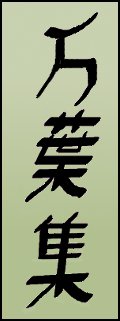
“Ten Thousand Leaves, Love Poems from the Man’yoshu”
“Thick and fast stream my thoughts of you
Like the layers
Of endlessly falling snow
Upon the cedars.
“Come to me at night, my man.”
—– from the Man’yoshu

It was the first golden age of Japanese civilization. In the eighth century appeared the great metropolis of Nara, (the imperial capital) its broad avenues lined with magnificent temples. Culture rushed in from Korea, China and over the Silk Road, from as far away as Persia, and even from Venice.
We think of Japan in isolation, as it was to become centuries later, but in the 7th to the 10th centuries (approximately) the cultural influences were vast and wide and foreign.
In the 8th century, Japan found it’s first voice, a clear and powerful voice to become one of the most impressive, sophisticated and frank compilations of poetry the world has ever seen. (There are other earlier and then later collections of poetry, but the Man’yoshu is considered to be the best of the poetry collections. There are many reasons (cultural and court changes, etc) but this is a long study and can’t be done in this short presentation.
There are not 10,000 poems (leaves) but over 4,500. Most of these are love poems, where lovers speak with disarming frankness and clarity, speak to us across 1300 years as if they were us. Actually, the poems express a decided lack of neurosis that we have come to view sex in the last few centuries. There is nothing of barriers when it comes to the human heart, longing, emotions and sexuality in these poems. Many of them are openly, expressly erotic.
The authors or contributors of these poems extended from Emperors, Empresses, courtesans, samurai, priests, beggars, fishermen, peasants: a cross section of remarkable variety. A truly democratic endeavor. This was never again to happen in Japan, not at least to this extent.
Otomo No Yakamochi (718-785) is considered to be the main compiler of the Man’yoshu. These poems actually span a 130 year history, from around 630 AD to 759 AD.
There are three basic divisions of the poetry in the Man’yoshu.
Banka: elegy on the death of an Emperor or a loved one.
Somon: mutual exchanges of love or longing poetry.
Zoka: Poems of Nature, hunting, etc.
This short presentation will focus only on the Somon form.
Generally the Man’yoshu poetry is considered to be declarative rather than introspective, imagistic rather than abstract. There is an incredible freshness to it all.
There are basically two forms of poetry in the Man’yoshu: choka (long poem, 5-7-5-7-5-7, etc. ending in 7-7) and tanka. (5-7-5-7-7). The ‘long poem’, choka (which isn’t very long by our modern and Western standards) died out of fashion, and tanka became the predominant form of Japanese poetry for the next 1200 years.
Although one would think so, there isn’t a lot of Buddhist influence in the poems. If any religion, there is more Shinto influence especially in the Zoka form, but even that isn’t large. This may seem strange to us, with our notions of culture in Japan, but even centuries later, with the Priest-Poet Saigyo, there is little Buddhist thought within his poems. Religion just doesn’t play such a dominant role in most Japanese poetry, especially at this time.

“Going over the fields of murasaki grass
That shimmer crimson,
Going over the fields marked as imperial domain,
Will the guardian of the fields not see you
As you wave your sleeves at me?”
— Princess Nukata
This poem is considered by many to be one of the greatest poems in the Man’yoshu. It is presented near the beginning of the collection, giving it prominence. The answer by her former husband (she is now married to the Emperor) Prince Oama, (his brother) is a beautiful poem in its own right.
“If I despised you, who are as beautiful
As the murasaki grass,
Would I be longing for you like this,
Though you are another man’s wife?”
— Prince Oama
“Do not let men find out
By smiling at me so apparently,
Like the clouds that clearly cross
Over the verdant mountains.”
— Lady Otomo Sakanoue
There are more poems by this poet than any other woman in the Man’yoshu. What is remarkable are the amount of women poets included in the Man’yoshu. This is only possible because the Confucian philosophy was not prominent yet in Japan. When it became influential, women lost much status: before they were allowed to own property, title, name, divorce, to keep custody of their children. After, they were relegated to indoors, stripped of much power and status.
“Whose words are these,
Spoken to the wife of another?
Whose words are these,
That bade me untie
The sash of my robe?”
— Anonymous
Many of the poems in the Man’yoshu were folk songs, or parts of folk songs. And this repeated interest in ‘the wife of another’ was an object of male desire; the Man’yoshu is full of this theme.
“As I turn my gaze upward
And see the crescent moon,
I am reminded
Of the trailing eyebrows
Of the woman I saw but once.”
— Otomo Yakamochi
This was written by Otomo at the age of 16!
“I have fallen into a yearning
With no requite,
For a girl who, when night comes
Sleeps pillowed in another’s arms.
— Anonymous
“If men can touch
Even the untouchable sacred tree,
Why can I not touch you
Simply because you are another’s wife?”
— Otomo Yasumaro

To finish with some anonymous poems:
“The flowers of the plum,
Were covered with fallen snow
Which I wrapped up
But when I tried to have you see
It was melting in my hands.”
“This body of mine
Has crossed the mountain barrier
And is here indeed!
But this heart of mine remains
Drawing closer to my wife.”
“The moon crossed the sky
And I saw him only once
In its pale light
Yet, the person whom I saw
Does appear to me in dreams.”
“I shall not take a brush
To this hair that lies
Disheveled in the morning,
For it retains the touch
Of my dear lord’s arms that pillowed me.”
— Anonymous
“I am honored to present this short piece on the Man’yoshu and I especially want to thank Gay for her encouragement and friendship. Without her help and influence I don’t think this would have been written. I am so impressed with the poets and staff of dversepoets and with the fine poetry on this site.”
Glimpse of a white wrist
Feel the pulse of blood beneath-
This is seduction!
But catch a wry, cunning smile
One learns all is artifice. …Jane Kohut-Bartels
Write your own modern contributions to the Man’yoshu! It should be fun because most of the pieces here are in tanka form…and we can do that! (it doesn’t have to be tanka, it could be choka, a longer form, or just freeverse). But the general theme should be love poems, longing, etc…in the category of “Somon”.
 dVerse
For today we offer the beautiful Lady Nyo and an historic poetry. I know you will enjoy it. She gives us wide berth in ways to utilize its harmonies in our own poetries. There’s jasmine tea and rice cakes for you in our corner by the window. The trees are nearly bare today but the air is fresh and only cool. Curl up, write, read, meditate. You’re so very welcome.
what a great article jane….sounds like love is in the air..smiles…looking forward to reading what this bunch of wickedly talented poets will bring to the table..
Jane, this is such a wonderful prompt. I think in a former life I must have been a Japanese poet or reader of Japanese poetry or…? These forms strike me to the core. I will be out this afternoon but will have my notebook and pencil with me. You never know when something will come along. Thank you, Gay, for inviting the lovely Lady Nyo to share this with us. Victoria
Beautiful poetry…
This is a fantastic exploration of the form, the history! Gay, thanks so very much for bringing Jane along! I often leave her space in awe….for me to write of love…in a POSITIVE way…well, that’s uncharted waters here! lol I’ll try! 🙂
Hello all, and thank you so much for reading this short essay on the incredible “Man’yoshu”. I have fallen in love with this period just through its poets…..
Victoria! These poems do strike at the heart, go deep into the soul, as if these centuries fade away and we are experiencing these things directly. Which we are during life, neh?
Perhaps you were a Japanese poet in the Heian court, Victoria. I am beginning to believe that anything in history and poetry is possible!
To all here: Gay did such a wonderful and welcoming job in her encouraging this article. The calligraphy is hers and it’s beautiful. Unfortunately, it wouldn’t ‘sit’ on my blog, and the pix got scrambled…but that is my problem, with my few computer skills.
I only hope that this short piece will inspire poets to go and tackle this delightful, emotional, and so damn true collection about men and women!
Emotionally? We haven’t digressed much from the original mold, whatever that was.
Lady Nyo…waving her sleeves at everyone here!
This was just exquisite, Jane. And my favorite of all the posted selections was your own poem at the end. Thanks so much for bringing your expertise in this area here to dVerse and sharing it with us. I will try to work something up tonight–but fair warning: I’ve written three tankas in my life, and they were some of the hardest things I ever wrote–took me days. They are deceptively simple, but so beautiful they are worth the effort. Off to see what I can do. Thanks again for hosting this excellent prompt, and thanks to Gay as well.
Can’t wait. Great stuff up already. I mean really great!
I am utterly entranced by these poems! Thank you for introducing them, I will be digger deeper to learn more 🙂
I have not done justice to the form AT ALL, but enjoyed the attempt immensely 🙂
“Thick and fast stream my thoughts of you
Like the layers
Of endlessly falling snow
Upon the cedars.
“Come to me at night, my man.”
Ahhh….sigh.
Fantastic article. Thank you Gay and Jane. I love learning new things. My only issue is that I really don’t write love poetry very well so the theme was a big challenge as well as the form. Still, I thoroughly enjoyed the efforts. Thank you.
Beth
Y’all don’t listen to this. Her sequence of tanka blew me away! Stunning, loving, beautiful, quintessentially everything Jane is telling us about. She made it look easy.
haha! Looks are deceiving…
These poems are so deep and passionate!
And yours was so strong and passionate!
YESSSS! I am beginning to believe that anything in history–and poetry–is possible. Before, during…and after, for these are selfsame, bound into one immortal soul. It is called LOVE. Thus is God?
Lady NYO…you have blessed this community today!
PEACE!
Hello Gay, Hello Jane, the poems are simply beautiful. I can understand them and feel their love and longing. I think I had been writing poems in this form. Tonight there is still longing in my heart , and I can write love for a dead husband or talk to nature. I can do a manyoshu! I will attempt, but I cannot promise the outcome because I am not a poet. Thank you Jane, and Gay, for a very lovely evening.
I enjoyed yours very much. Step by step you are finding your own voice. That’s part of the reason I like offering so many methods of approach. Sometimes the “way” presents itself and you find yourself and your life in the poem you want to write and it leads you to another and yet another. Welcome to the TAO of poetry.
Dear Ocean Girl…
The Man’yoshu is chock full of poems…grief is one very predominant theme, and I avoided it because it is heartwretching.
However, we draw deeply upon those things that make up our history and create poetry from them. Memories of a dead spouse seem to be the strongest of emotions any of us can have…and the Man’yoshu is full of them.
I have set myself a challenge: in the next year, to write my own Man’yoshu…the Somon and Zoka themes….collect them and see about publishing them. Perhaps it would be better to collect many poems by many poets! Here would be a great beginning.
I am so impressed at the poems I have already read by poets here: these expressions are deep and go to the root of our hearts and experiences. The ‘best’ in my opinion, are raw, declamatory lines of longing, because this sometimes is where the emotions are clearer…or the verse is.
Regardless….and regardless the form….these poems speak directly to the human condition.
They are about as honest as honest can get.
Lady Nyo
thank you lady nyo for an incredible piece…already dropped my post for the day but i will see if i can whip up a love poem for you tomorrow…smiles.
Looking forward to it Brian! I’ve seen what you can write in love songs.
I love the session and poetry form ~
Thanks for sharing this ~
Pingback: Man’yoshu Poetry? (What’s that?) With Ladybug « ManicDDaily
This is such a wonderful prompt, and such an interesting and informative article. I’m afraid I’m not much in the mood for writing this style of poem–and really could not have even tried if it had not been such a great article. Not talking so much about lack of love here as deep deep fatigue. (Agh.) Perhaps I should have written about that. Who knows? Thanks so much.
Glad you enjoyed it. Jane is great. Even without writing one, it is so satisfying to find out about poetry of other times and other cultures!
Well wonderful poets, I’ve read your offerings up until now. I must depart the bar for the realworldpayingjob…it’s a boring job but bills must be paid, and information disseminated. Off I toddle into the world of manifests and job sheets!
Dig deep and understand your fatigue (I have it too) and write about that…..I have seen this done in Japanese….the exhaustion after a battle, even the boredom of court routine, and it sings and haunts.
Best here for your labors. All parts of life have poetry in them.
Lady Nyo
Wow.. wonderful poetry.. I can’t wait to try the form 🙂 Going to get my diary now..
How many hours more for the linky to close?
Its great to be here.. and specially I have enjoyed Lady Nyo’s poetry before and this write is absolutely perfect… could not resist but sharing some of my Haiku from past. Hope you all will like it.
Shashi
ॐ नमः शिवाय
Om Namah Shivaya
http://shadowdancingwithmind.blogspot.com/2011/08/whispers-rain-rain-rain-again.html
At Twitter @VerseEveryDay
just thought i’d sneak in for a minute.. need to start work early today.. so no poetry with my breakfast.. but be back in the evening to visit..
Pingback: ∙◦Ͽ◦∙ autumn memories ∙◦Ͼ◦∙ | my heart's love songs
your poem above is stunning, Lady Nyo! my thanks to you and Gay for a wonderful post! tanka is one of my favorite poetry forms. i’m not certain my attempt is correct ~ i followed the examples above and did not use a kakekotoba (middle pivot line) as i normally would when writing tanka.
i look forward to visiting everyone on Friday!
Hi Dani…that kakekotoba can stop a poem in mid flight! LOL! It’s fine to avoid it, I think, depending upon lots of things.
Choka probably doesn’t have that stumbling block….???? I don’t know because my choka is so wanky.
I have just fallen into using the pivot line because it’s become habit now. It’s a resting place and a jump off place and I am very conscious about it now. Before? Well, my tanka really was just freeverse….or so said Jane Hirshfield. LOL! She was right, but boy did I resent that!
I think of tanka like this: two bite piece of sushi. It should be sparse, light in a way, and off hand when it is best. Or possibly not. I guess it just depends on the topic?
I don’t mean that the topic shouldn’t be important, worthy or deep, but the handling??? I think I picked this habit up by reading Samurai Death Poems…..and some of them are hysterical.
Well, good luck, Dani and all else. This is a wonderful path that those who are not very versed in tanka begin. And the Man’yoshu.
Lady Nyo
Attempted Tanka for the first time. Hope they are good!!
Thanks for the article, Lady Nyo. I loved every piece of verse in it,
Really interesting article! Thank you.
Om Namah Shivaya….I missed you.
ॐ नमः शिवाय
Om Namah Shivaya
Not sure I’ve captured the right spirit for this, but had a lot of fun trying! The post makes a fascinating read, and issues a great challenge…
It was a pleasure to read this piece by Lady Nyo, a wonderful overview of the Man’yoshu, which to day remains one of the greatest compilations of poems. These poems have been a strong influence on my own writing, and it’s wonderful to see its influence spread even further.
Awww, missed out again – the combination of being on the other side of the world and having only intermittent internet connection where I live. But I posted y effort anyway, here: http://passionatecrone.blogspot.com/2011/11/missing-you.html
Now off to enjoy the others!
Far too late but posted this oneanyway!
I also missed the deadline but had to give it a try anyway.
http://kerryoconnorpoems.blogspot.com/2011/11/weeping-mulberry.html
I really enjoyed this article. Thank you both for the hosting and the writing. I suspect I’ll come back from time to time and reread it for inspiration.