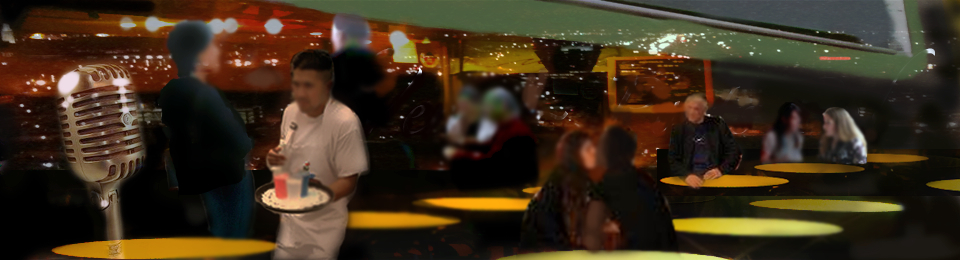
To some of the world’s artistic minds, the history of our world – real or fictional – strikes as stark and resounding a chord as any dose of their own creative bounds. Myth and legend captivate as any of the great fairy tales of old, filling our heads with visions of heroes and villains and lands beyond the mists; and history – well, they’ve always said that truth is stranger than fiction.
Our guest off the bookshelves tonight proved the true artistic quality of each in his tireless pursuits through both the creative and academic worlds.
Charles Williams was a bit of a dabbler in all things literary. Poet, novelist, and critic, he was perhaps best known, however, for his part in a little group called the Inklings. The Inklings, if you’re unfamiliar, were a wonderful group of British writers from the 1930s and 40s whose ranks also included J.R.R. Tolkien and C.S. Lewis. An informal writers and literary discussion group – something I’m sure many here at the bar tonight could get behind – the Inklings were all Williams’ friends, and though their meetings had a distinctly Christian bent to them, they allowed a bit of relaxation time for the lot of them.
But while today Williams is often remembered – if remembered at all, tragedy though it be – for his connections, in his time he was known for his studies of the classical and, in his own eyes, for the sprawling, complex verses he wove to the theme of Arthurian poetry. Tonight, I’d like to showcase a piece from one of his two books of that particular style. Though lengthy, those who stick through it will find a rich array of language to greet them, and an interesting mix of history and myth, swirling together into a grand poetic experience.
But just a head’s up – if you find his craft a little on the denser side of things, you certainly wouldn’t be the first.
The Vision of the Empire
alpha
The organic body sang together;
dialects of the world sprang in Byzantium;
back they rang to sing in Byzantium;
the streets repeat the sound of the Throne.
The Acts issue from the Throne.
Under it, translating the Greek minuscula
to minds of the tribes, the identities of creation
phenomenally abating to kinds and kindreds,
the household inscribes the Acts of the Emperor;
the logothetes run down the porphyry stair
bearing the missives through the area of empire.
Taliessin walked through the hither angels,
from the exploitation of grace to the place of images.
The morn brightened on the Golden Horn;
he heard behind him the chariots’ clatter
that bore a new matter to all the dialects;
he saw the nuntii loosened on the currents
over the sea, in the mechanism of motion,
rowers’ arms jointed to the imperial oars.
Chariots and galleys sprang from the shores;
the messengers were borne over sea and land.
The king’s poet gazed in the mirror of the Horn.
beta
The moon rose on the Golden Horn.
I saw the identities imaged in a sapphire sea:
beyond Sinai Ararat, beyond Ararat Elburz –
light-sprinkling, flaked-snow-sparkling,
chastities of ranged peaks of Caucasus,
snow’s glow on the world’s brows
changed with deep vales of verdure.
The missives of identity came from the scribes
where the tribes gather and keep holiday
on the name-day and birthday of their father the Emperor.
The Empire’s sun shone on each round mound,
double fortalices defending dales of fertility.
The bright blades shone in the craft of the dancing war;
the stripped maids laughed for joy of the province,
bearing in themselves the shape of the province
founded in the base of space,
in the rounded bottom of the Emperor’s glory.
Spines were strengthened, loves settled;
tossed through aerial gulfs of empire
the lost name, the fool’s shame,
fame and frame of lovers in lowlands of Caucasia,
rang round snowy Elburz.
The organic body sang together.
gamma
Elburz rose in the Golden Horn.
South from the sea-bone, Thule, the skull-stone,
herbage of lone rock,
the scheme of Logres, the theme of the design of the Empire,
rose in balance and weight, freight of government with glory.
Merlin, time’s metre, climbs through prisms and lines;
over near Camelot and far Carbonek,
over the Perilous Sell, the See of union,
the phosphor of Percivale’s philosophical star shines.
Lancelot’s lion, bewildered by the smell of adoration,
roars round Guinevere’s lordly body.
Merlin defines, in blazons of the brain,
shield upon shield, station upon station;
and the roads resound with the galloping lords.
The swords flash; the pirates fly;
the Table stands rigid in the king’s hall,
and over their seats the plotted arms of the soul,
which are their feats and the whole history of Logres.
Down the imperial highroad the white nuntius rides
to heighten the hearts of Lateran, Gaul, and Logres.
delta
The milk rises in the breasts of Gaul,
trigonometrical milk of doctrine.
Man sucks it; his joints harden,
sucking logic, learning, law,
drawing on the breasts of intelligo and credo.
I, Taliessin, born of the Druids by the sea,
drank also in the schools of Gaul;
I have drunk at the tables of all the doctors;
I have modulated song to the waters of Logres,
the running of Thames, the tidal basins.
I heard the iron chariots on the roads of Gaul,
but the fleets took me, distances of the sea;
the dialect of Logres was an aspect of Byzantium;
the grand art was taught in the heart of the harbours of Arthur.
epsilon
The mist rolled down the edge of an old sun;
mammoth and bear prowled on the broad ledge of the shoulders.
Strength articulated itself in morals
of arms, joints, wrists, hands;
the planes of palms, the mid-points of hid cones,
opened in Lombardy, the cone’s point in Rome,
seminal of knowledge, pontifex of the Arval college
of spiralling instincts, all roads (active and passive) from Rome,
to be bridge-builders in Gaul, clerks of audience in Byzantium.
Finger-nails, weaklings of seedtime, scratched in the soil
till by iron nails the toil was finished in the time of our need,
the sublime circle of the cone’s bottom, the seed-springing
surrender:
hands of incantation changed to hands of adoration,
the quintuple psalm, the pointing of Lateran:
active and passive in a single mystery,
a single sudden flash of identity,
the heart-breaking manual acts of the Pope.
zeta
Why moves the Pope in the marches of the Empire?
why do the golden palaces pale to the Papal
vesture, flesh and bone of reparation?
what was the crossing of the will of the Emperor?
eta
The Adam in the hollow of Jerusalem respired:
softly their thought twined to its end,
crying: O parent, O forked friend,
am I not too long meanly retired
in the poor space of joy’s single dimension?
Does not God vision the principles at war?
Let us grow to the height of God and the Emperor:
Let us gaze, son of man, on the Acts in contention.
The Adam climbed the tree; the boughs
rustled, withered, behind them; they saw
the secluded vision of battle in the law;
they found the terror in the Emperor’s house.
The tree about them died undying,
the good lusted against the good,
the Acts in conflict envenomed the blood,
on the twisted tree hung their body wrying.
Joints cramped; a double entity
spewed and struggled, good against good;
they saw the mind of the Emperor as they could,
his imagination of the wars of identity.
He walked slowly through his habitation
in the night of himself without him; Byzantium slept;
a white pulsing shape behind him crept,
the ejection to the creature of the creature’s rejection of salvation.
Conception without control had the Adam of the error;
stifled over their head, the tree’s bright beam
lost in the sides of the pit its aerial stream;
they had their will; they saw; they were torn in the terror.
theta
Elburz sinks through the Golden Horn:
the feet of creation walk backward through the waters.
The single galley hardly moves,
the stiffening mechanic of arms and oars fails;
patched with undyed canvas the purple sails
drag at the flagging hands of man;
the sea’s unaccumulated distance drags at the sailor’s hearts.
The sea-borne Asian mine,
stuff of Caucasia fashioned in Byzantium,
earth’s gold sprinkled over the sea
and plated round the poop of the visionary spirit,
shines no longer nor lustily gleams.
On the brazen deck blasts of hot ashes
fall from unseen volcanoes; harsh birds,
stabbing at sea-broods, grating their mating calls,
cover it; down their flight gusts drove once the galley.
Phosphorescent on the stagnant level
a headless figure walks in a crimson cope,
volcanic dust blown under the moon.
A brainless form, as of the Emperor,
walks, indecent hands hidden under the cope,
dishallowing in that crimson the flush on the mounds of Caucasia.
His guard heaves round him; heaven-sweeping tentacles
stretch, dragging octopus bodies over the level;
his cope by two is lifted from his body,
where it walks on the sinking floor of antipodean Byzantium.
Let us gaze, son of man, on the Acts in contention.
Phosphorescent gleams the point of the penis:
rudiments or relics, disappearing, appearing,
live in the forlorn focus of the intellect,
eyes and ears, the turmoil of the mind of sensation.
Inarticulate always on an inarticulate sea
beyond P’o-lu the headless Emperor moves,
the octopuses round him; lost are the Roman hands;
lost are the substantial instruments of being.
iota
The organic body sang together;
the Acts of identity adored their Lord;
the song sprang and rang in Byzantium.
O you shoulders, elbows, wrists,
bless him, praise him, magnify him for ever;
you fittings of thumbs and fingers,
bless ye the Lord;
sockets and balls in knees and ankles,
bless ye the Lord;
hips, thighs, spine in its multiples,
bless him, praise him, magnify him for ever;
bless him in Caucasia, bless him in Lateran,
bless him in the blazons of London-in-Logres,
if there be worlds of language beyond Logres,
bless him, praise him, magnify him for ever;
if there be wit in the rolling mass of waters,
if any regimen in marshes beyond P’o-lu,
if any measurement among the headless places,
bless him, praise him, magnify him, for ever.
~Charles Williams
 dVerse
Yay, the Inklings! I haven’t read Williams. It is rather historically heavy, yet I want to go and do research on the era. It definitely does not have that Richard Burton or T. H. White feel to this Camelot. Oh to have been a fly on the wall when and if he read this to Lewis and Tolkien.
“It definitely does not have that Richard Burton or T. H. White feel to this Camelot.”
Oh, definitely not. He was going for that rich, historical-legend style, and I dare say he did it well. There’s a lot of Arthurian works out there…but none quite move as his words do. Must have been a curious counterpoint to Tolkien speaking of Elves and Dwarves in one corner, while Lewis spoke of talking lions and magical wardrobes in another.
It’s strange. Too me, his words create a more ancient image yet have a more modern structure and feel, almost a marriage of science and the chorus of ancient Greece. I enjoyed this post (thought I might need to make that clear) and appreciate your response to my comment.
think i have to come back for the poem but J.R.R. Tolkien and C.S. Lewis are two of my fav authors and loved to hear about the inklings circle… would’ve loved to sit next table and overhear their conversations..smiles
Oh my…can you imagine? I mean, some great literary minds afoot there – to be even a fly on the wall, and listen in on the wealth of works and discussion that must have passed through there…astounding. Though I do hear they could be a somewhat silly bunch as well. But hey, I think us creative types should be a little silly from time to time, don’t you?
Chris thank you for bringing this truly epic write to my attention. I made it down to delta, just browsed the rest because on the internet I have no attention span–in a book, it would be better–but I enjoyed the sweeping feel of this immensely. It’s not just the re-telling of a trope in an archaic way, which you see a lot in poems about legend, myth and history, but an intelligent poem in it’s own right. “…the sea’s unaccumulated distance drags at the sailor’s hearts.” What a line. And that whole gamma passage–not to mention the rather sardonic bodily specifics there towards the end. Enjoyed it much. It’s amazing to me that people can write this well and still be little known.
“It’s amazing to me that people can write this well and still be little known.”
It’s a crime, truly! But from what I understand, in his day, he was fairly well known. He is simply one of the many whose works did not captivate and resonate down through the ages. Then again, even in his day, it seemed like it was his more academic works that earned him praise. Investigating Dante and all that. But he did love his poetry…and for a writer, it is indeed important to love what one does, even if the world doesn’t hold that same appreciation.
You’re welcome, Joy! Though as obscure as this introduction might have been, I was almost expecting you to tell me you’d heard of him…and pull out another great example of his work to contrast it to.
And I hear you on the reading front – I may still post longer works here, but I myself have never been one to hold focus well when staring at a screen filled with “internet.” Give me a book with a work of the same length and, well, I could be entranced for hours.
I had vaguely heard of that group, the Inklings, as I’m of course a Tolkein fan, and have read C.S. Lewis’s science fiction stuff(Out of the Silent Planet) but never heard of Williams. I only wish I were as widely read as you, Chris. Really enjoyed this.
I’d never heard of Charles Williams so I greatly appreciate the introduction. C.S. Lewis’ Till We Have Faces is one of my favorite books. The language here is revelatory though all his choices I wouldn’t have made: ‘and plated round the poop of the visionary spirit’, well, I would have used a synonym :). He employs interesting phrasing and certainly packs a lot into the five pages. I especially responded to ‘Inarticulate always on an inarticulate sea…lost are the substantial instruments of being’. Thank you again.
*chuckles* Fair, Anna, quite fair! “Poop of the visionary spirit”…well, I suppose when you’re getting into it as long as he tended to (and again, my goodness, he had whole books of poems touching on this length), sometimes the language and the intricacy stumbles a bit in the writing. Curious to think how such lines were received amongst his Inklings company…but then, with lines like the second you listed, I’m sure if ever he lost them, he could quickly woo them right back again.
Glad you enjoyed! Seemed like a great one to me for the segment tonight, what with the close to greatness, but oft forgotten aspect of his self, so I’m happy I made a nice choice.
holy cow that is a long poem…lol…my ADHD took a left turn somewhere along the way…definitely a new one on me…he certainly traveled with a great group there…writes like this stretch my mind…that is a good thing i think..smiles.
Hey, if you want a lengthy little tune to match it, I could throw up another dose of the Ancient Mariner, my friend…*grins*
Chris, thanks for bringing Williams to my attention. Such a continuation of English epic traditions. I am first in awe of the poets’ tenacity and concentration. Such a different world! I am a lover of the Faerie Queene, which seems to be something of an ancestor to this, with tons inbetween. I have gotten very unintellectual these days, but I am happy to see this and will try to get through it all. Thanks. K.