
Tags
Beth Winter, dVerse Poets Pub, dVersePoets Pub, Langston Hughes, poems, poetry, Pretzels and Bullfights
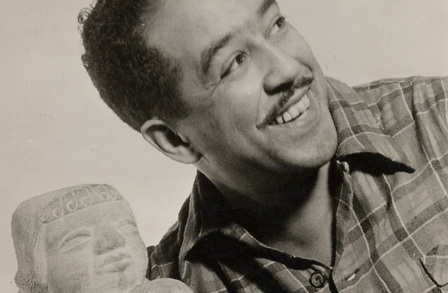
Photo by Consuelo Kanaga
When I first read the poetry of Langston Hughes, I felt the rhythm of life as he knew it. It wails with the blues and celebrates wonders with the joy of jazz. Like many poets, he wrote of life’s experience from his personal viewpoint and like many poets, was criticized for his vivid truths.
Langston Hughes was born in 1902 in Joplin, Missouri. His early years were very unsettled with parents divorcing when he was very young, his residence with his grandmother who was poor and unable to give him maternal attention, then moving to live with his mother and stepfather at age 13. For most of his childhood, his father was out of reach in Mexico. The emotional scarring from feeling abandoned by his parents haunted his life.
Acclaim for Hughes’ poetry began in high school where his first pieces were published in the Central High Monthly, a sophisticated school magazine for which he became a regular contributer. During his junior year of high school, following contact with his father, Hughes spent the summer in Mexico, a decision that convinced Hughes that he and his father could not live together no matter how much he wished it were different. That summer of conflict affected the tone of Hughes’ writing, adding more mature notes to his already intriguing lyrical style. He did return to his father after high school in an attempt to gain funds to attend Columbia University. During his train trip to Mexico, Hughes wrote his famous poem, “The Negro Speaks of Rivers.” Although initially reluctant, his father did agree to pay for one year at Columbia University.
During his year at Columbia, Hughes discovered Harlem, abandoned his formal education and immersed himself in the Harlem art scene. His poetry captured both the hardships and ecstatic abandon of Negro life during that era of segregation and discrimination. He captured the spirit of Harlem in a literary first person account in The Big Sea which was the first volume of his autobiography. Hughes was published regularly in the Crisis and Opportunity magazines and won the 1925 Opportunity magazine literary contest for poetry with his entry “The Weary Blues,” which was also the title of his first published volume of poetry.
Throughout his work, Hughes infused the rhythm of African American music traditions, specifically blues and jazz. These rhythms and influences not only opened an avenue for him to experiment with free verse but also established his unique poetic voice.
“Langston Hughes, although only twenty-four years old, is already conspicuous in the group of Negro intellectuals who are dignifying Harlem with a genuine art life. . . . It is, however, as an individual poet, not as a member of a new and interesting literary group, or as a spokesman for a race that Langston Hughes must stand or fall. . . . Always intensely subjective, passionate, keenly sensitive to beauty and possessed of an unfaltering musical sense, Langston Hughes has given us a ‘first book’ that marks the opening of a career well worth watching.” – Du Bose Heyward, New York Herald Tribune, 1926
Despite the respect of the literary world, Hughes faced heavy criticism from black intellectuals for his accuracy in portraying the life of blacks in that era. They felt his descriptions were unattractive and potentially demeaning. When “Fine Clothes to the Jew” was published, Hughes was accused of parading racial defects before the public. In response, he stated “The Negro critics and many of the intellectuals were very sensitive about their race in books. (And still are.) In anything that white people are likely to read, they want to put their best foot forward, their politely polished and cultural foot–and only that foot.”
Hughes was successful to the point of making a living as a writer, not only through poetry but through stories, screenplays and his very popular column in the Chicago Defender in which his fictional character, Jesse B. Semple, known as Simple to most, gave Hughes an outlet for discussing serious racial issues. The Simple columns have been collected into several volumes and are still popular today. Known as the “Poet Laureate of the Negro Race” in his later years, he maintained his belief in humanity and hope for a world where people could live together with understanding.
Hughes died in 1967 from complications due to prostate cancer. Rather than traditional funeral speeches and eulogies, his life was celebrated through the music that he loved with jazz pianist Randy Weston and a final escort of jazz and the blues.
I look at the world
BY LANGSTON HUGHES
I look at the world
From awakening eyes in a black face—
And this is what I see:
This fenced-off narrow space
Assigned to me.
I look then at the silly walls
Through dark eyes in a dark face—
And this is what I know:
That all these walls oppression builds
Will have to go!
I look at my own body
With eyes no longer blind—
And I see that my own hands can make
The world that’s in my mind.
Then let us hurry, comrades,
The road to find.
Po’ Boy Blues
BY LANGSTON HUGHES
When I was home de
Sunshine seemed like gold.
When I was home de
Sunshine seemed like gold.
Since I come up North de
Whole damn world’s turned cold.
I was a good boy,
Never done no wrong.
Yes, I was a good boy,
Never done no wrong,
But this world is weary
An’ de road is hard an’ long.
I fell in love with
A gal I thought was kind.
Fell in love with
A gal I thought was kind.
She made me lose ma money
An’ almost lose ma mind.
Weary, weary,
Weary early in de morn.
Weary, weary,
Early, early in de morn.
I’s so weary
I wish I’d never been born.
I’m Beth Winter and I thank you for joining me in this exploration of Langston Hughes and his incredibly influential poetry. Choosing poetry from his works to include with this essay was difficult and I highly recommend exploring his work further.
Sources:
Poetry: A Magazine of Verse
Poetry Foundation
Poem Hunter
Poets.org
KansasHeritage.org
 dVerse
wow thanks for this beth…langston hughes is awesome…the first poem by him that i read was “i too am america” and really moved me deeply..
oo oo oo …..one of my favorites…smiles…i have his complete collected works….and def enjoy reading through it on occassion…and you have just given me reason to pull it out again…smiles….nice beth!
Thanks for introducing me to a poet that I’d never heard of before, Beth. That’s what’s so good about these articles – we get our poetic horizons broadened for us.
I had heard of him but sharing this story and the poems you chose to share entice me into reading him. I will be checking a book out soon. Thank you kindly Beth — superbly written.
Ah, quick question, Beth: Can you point us to one or two interviews people have done of you
PS: The link at the end of this post is a mistake and doesn’t work. Your blog is at: http://eclipsingwinter.com/
fixed it beth…it was a coding issue….
Thank you, Brian. I couldn’t reach it by cell phone 🙂
Thanks so much for sharing one of my favorite poets!
Thank you so much for this introduction. I’m currently reading my first novel by James Baldwin, also a “Negro” author from Harlem in the same era– what a coincidence? Or is it providence? I can’t wait to learn more! ~ peace, Jason
James Baldwin is an excellent writer.
Beth, although I love your introduction and enjoyed the bio thoroughly, I don’t care for these poems. I’m sure I would enjoy some of his work, but this style isn’t really what I gravitate toward. Nevertheless, thank you for sharing. Isn’t it interesting how many different styles and approaches to poetry there are, and we all like different things? Yet, here we are enjoying commonalities and appreciating differences.
exceptionally interesting bio and samples
interesting he had to retort about not putting only the best foot forward, something so many artists have had to defend against
“esp” liked,
“I look at my own body
With eyes no longer blind—
And I see that my own hands can make
The world that’s in my mind.”
thanks so much beth 😉
Thank you. I dearly love the work of Langston Hughes, and it was good to find some here thatI hadn’t come across before, as well as more details about his life than I already knew. I particularly love the blues rhythms of the second poem you chose.
WOW fantastic post, ditto what Tony said, I hadn’t heard of him either, but I’m already at work writing a song in his style !! Thank You Beth !!!
Langston Hughes … rhythm and sing-song like, very nice and simple. Thanks Beth!
I really love Langston Hughes’ poetry, and I enjoyed your article very much, Beth. Thanks for doing all the research. I can’t remember the name of the Hughes’ poem; but one I so often think of has the line ‘life ain’t been no crystal stair’ or something very similar.
As you probably already know, Beth, we have in Seattle the Langston Hughes Performing Arts Center which was established in 1969 😉 My first experience with his work was not reading his poetry but seeing a short play written by him…it was in the 80’s and I don’t remember which one it was except it was a political one…most of his poetry is very moving… and I just read that in April this year the African American Film Festival will be held there in the newly renovated building ..we are very fortunate to have this cultural center as a part of our “scene”….
Thank you Beth. I am not familiar with Hughes, and appreciate dVerse all the more for this. There was a time when there were people who wrote about difficult issues like this who had to fear for their lives, their livelihood, their family – and yet, they persisted.
It takes real courage to write like this, and I hope I will find courage to write about things I hope to make an impact upon, and not just the beautiful, the romantic and the safe.
I would like to speak out more clearly against the slow death of culture, of memories of the world.
That is how your article has inspired me, Beth.
One of my favourite poets, and partly the inspiration for my ‘Teas in Harlem’ series. 🙂
OOOOH… in what I often refer to as a “previous lifetime” I was a teacher of English and very much enjoyed introducing Langston Hughes especially to young teen-age boys…who could find someone with whom they could relate and see poetry as something other than school-time comparisons between self and trees 🙂
What a joy to see his work featured so beautifully here.