
Tags
Beth Winter, dVerse Poets Pub, dversepoets, Pretzels and Bullfights, ralph waldo emerson, Transcendentalism
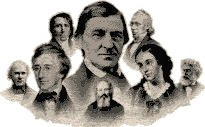
In my monthly contributions to Pretzels & Bullfights, I endeavor to lead us through the different literary periods and highlight a poet or two from each period. In November, we entered the Romantic Period, a major movement that stretched from approximately 1798 to 1870. In the midst of the Romantic Period, a deeper movement took hold in America. Transcendentalism became the foundation of literary expression for the great writers in the beginning to mid-nineteenth century.
Transcendentalists believed that knowledge was not limited to what is experienced through the senses but also grew from intuition and contemplation of the spirit. The seeds of knowledge gestated through combinations of internal and external fuels. Transcendentalists were skeptics of formal religion. They believed that the divine spirit was a personal experience, that faith resided within and that established religious practices were a detriment to spiritual growth and enlightenment. Transcendentalism as a basis for thought began in Germany with Immanuel Kant, a writer who asserted that not all things can be known with absolute certainty and that lack of scientific evidence of existence does not mean that something does not exist. His theories and philosophical stance contrasted the very scientific ideals of the time.
In America, it began much like other shifts of thought begin, a meeting of minds. Unlike early movements, accurate records exist to mark the beginning of this literary movement to Ralph Waldo Emerson and the first meeting of the Transcendental Club in Cambridge, Massachusetts in 1836. Many prominent writers participated, including Henry David Thoreau, Margaret Fuller, William Henry Channing and George Ripley.
Imagine the struggles in America at that time in history. The fledgling country wanted to expand westward although anchored by opposition to slavery and the limitations on the rights of women, both issues an unsettling undercurrent in society. Although the essence of Transcendental philosophy was and is universal, the Transcendental Literary Movement was primarily an American experience due to societal factors and the role that freedom of religion played in the establishment of the new country. The founders understood that a philosophical-literary movement could not solve problems, but it provided the vocabulary to allow for reasonable discussions toward resolution.
Although Transcendentalism was seen as a new way of understanding truth, it incorporated many facets of the Romantic Movement, primarily the reliance on the natural world as a platform of expression. Transcendentalist writers viewed the hardships of life and limitations of society as barriers between self and spirit then grasped the natural world as a way to free thought from distracting influences. As a result of moving beyond limitations, the human mind, thought and spirit could grow beyond all imagined potential.
Ralph Waldo Emerson was the very reluctant founding father of this movement. His reluctance was due to his preference to be very much like a cat in a window, carefully observing the world around him but not participating in the activities. Emerson was born in 1803 in Boston, Massachusetts, a graduate of the Harvard School of Divinity and ordained as a minister in the Unitarian Church. He resigned from the clergy shortly following the loss of his first wife to tuberculosis. His exit from the clergy was not a denial of faith, rather a questioning of the role of established religions. He remarried and tragically lost his first child to an untimely death. He could have succumbed to bitterness, become hard-edged and distrustful but did not allow such negativity to consume him. He became stoic and displayed an optimism that might seem unusual for someone who suffered extreme emotional losses.
Emerson recognized two levels of reality, both the physical world of his more scientific counterparts and the internal spirit/supernatural, a reality that he called the Oversoul. These levels of reality are evident in his poetry just as our unique belief systems appear in our work.
I chose the following poem by Ralph Waldo Emerson to present today for various reasons. It is an example of how well he blended nature and spirit together in one cohesive poem. The visuals are not only highly descriptive but celebratory in tone and of course, the last two lines move me nearly to tears in the degree of love he displays.
Was never form and never face
So sweet to seyd as only grace
Which did not slumber like a stone,
But hovered gleaming and was gone.
Beauty chased he everywhere,
In flame, in storm, in clouds of air.
He smote the lake to feed his eye
With the beryl beam of the broken wave;
He flung in pebbles well to hear
The moment’s music which they gave.
Oft pealed for him a lofty tone
From nodding pole and belting zone.
He heard a voice none else could hear
From centred and from errant sphere.
The quaking earth did quake in rhyme,
Seas ebbed and flowed in epic chime.
In dens of passion, and pits of woe,
He saw strong Eros struggling through,
To sun the dark and solve the curse,
And beam to the bounds of the universe.
While thus to love he gave his days
In loyal worship, scorning praise,
How spread their lures for him in vain
Thieving Ambition and paltering Gain!
He thought it happier to be dead,
To die for Beauty, than live for bread.
The Transcendental Movement gave voice to a wealth of talented writers and although short-lived, was too influential in literary development for me to encapsulate in one article. In my next installment of Pretzels & Bullfights, I will delve into the life and writings of another prominent Transcendentalist, Henry David Thoreau, whose philosophy was both similar and very different from that of Ralph Waldo Emerson. I hope this article has sparked your curiosity and imagination. I’m Beth Winter and I thank you for joining me for Pretzels & Bullfights.
Until next time…
References:
American Transcendentalism Web
Philosopedia
The Literature Network
Biography.com
Poemhunter.com
 dVerse
Missed this and your wonderful voice “teaching” me about something I would otherwise have slept through in college. Sad but true…except my missing that voice.
Thank you, Joe *hug* You are very kind. I seem to have “blank page syndrome.” I am praying for a quick recovery.
I love to learn about things I never had in school.. the little poetry I ever learned was Swedish… I think I like the transcendental movement.. and to some extent I think it’s still influential–
Thank you. I’m pleased I was able to present something informative
oh wow beth… thanks for this…deeply moved by his poem but also by his personality… a man with a stunning character and will to live…
Thank you, Claudia 🙂
Thanks for the feature on the movment and on Emerson, Beth ~ I am appreciative of your research & time for writing this ~
You are welcome. I’m pleased you enjoyed it.
Thanks a lot for shining a light on this key poet’s work and also the transcendentalism movement in general Beth – RWE a continuing source of inspiration to me for sure… With Best Wishes Scott http://www.scotthastie.com
Thanks, Scott. Both the poet and movement inspire me as well.
Very intereting and informative, thankyou so much
Thank you 🙂
Beth, this is so good–I never quite caught on to transcendentalism but you have explained it so clearly. I’m much looking forward to the next installment.
Thank you, Victoria. The movement is still alive although many aren’t aware of a name to associate with their beliefs. 🙂
Fascinating, Beth. Ah, I knew I loved the thinking of Immanuel Kant, but had not caught up with this about him. Now I warm to him even more! I’ll be equally fascinated, I know, to read your comparison of Emerson and Thoreau. Thank you!
I am looking forward to the next installment. Your articles are alway so well researched articulated and interesting. We are so lucky to have you. Thank you.
thoreau and emerson…nice..both influences in some ways on me….i like the listening to the sound of the pebbles slung…the beauty in the little things…i find myself there often….
I appreciate that you took the time to condense this into an informative and enjoyable read. I very much look forward to the next installment.
So nice to get a refresher course in this informal atmosphere for much not retained from school, or perhaps we never studied it in depth….it means something different to me now…since I’m attempting to write poetry….thank you, Beth.
What a fascinating article although the name given to the movement in the US is Transcendentalism, the elements of the movement were evident worldwide, albeit in different forms and under different names. What is interesting is how such philosophies were so common throughout Europe, the UK and even places like Australia in the early 19th century.
There was an enormous open-mindedness at the time and a spiritual seeking which did not last and yet which has begun to resurface in recent decades around the world.
And as always, while the US had its own impressive thinkers they drew upon the great minds of Europe and England – as always in human history the seeds of thought were spread far and wide and reciprocally.
What is also curious is why, with such a solid and powerful foundation the US went on to become the most religious of all developed nations in a fundamentalist sense and the most conservative.
Beth, I’m usually too “busy” to read these articles. I think really it’s just been my resistance to learning, to feeling like I’m back in college, or to be challenged to acknowledge the great contributions of the masters. Don’t know. But today I’m here. And I’ve learned something. Thank you so much for such a well written article. You made it so interesting. I look forward to the continuation.
So glad I stopped by today. Funny how an interest in one area like philosophy aligns well with the literary as well. One of my favorite philosophers, yet I never made the connection to Emerson or Thoreau who are also among my favorites.
Thanks for a wonderfully stimulating article, Beth.
Thank you for a thoroughly interesting and engrossing article. As a dyed-in-the-wool agnostic and a card-carrying Unitarian Universalist, I have much admiration for both Emerson and Thoreau, and others of their ilk. Could never see myself swinging all the way over to transcendentalist no matter how spiritual I might get, but find all the theories fascinating and like to ponder over them from time to time…Thanks again for an interesting read.
I enjoyed the perspective you bring to the transcendentalists, and particularly to this Emerson poem which is new to me. I am forever astounded that he kept the forms of European poetry despite what he says of beauty here. It took Whitman to break the European mold. Thanks, Beth.
Thank you for your excellent article and introduction to transcendentalist literature. It has the feel of the Gnostic belief system and the teachings of Christ before his adoption by the organised Christian church, notably the early church of Rome. As you know these spiritual teachings and knowledge are still very much alive and well today if we know where to look.