
Tags
Bob Kaufman, Diane Seuss, Esther Hicks, Gordon Lightfoot, Kahlil Gibran, Paisley Rekdal, Pelagio Palagi, Truong Tran

Hello to All who are gathered here today in the dVerse Universe, a site of pubtalk and poetry. I am your host, Li(sa,) ready to serve drinks and snacks from the magic cupboard. This Monday is where You and Your Muse are prompted to write a Quadrille. The name for the quadrille form is taken from an 18th Century dance, but as you may know, it is also dVerse’ poetic form of just 44 words (not counting the title) and includes one word the host provides to you.
String is an attractive, versatile word that can be used as a noun, a verb, or an adjective. It has an onomatopoeic quality to it. It can’t help but evoke its wordly neighbors sing and sting. String suggests a linear grouping that can be applied to a large number of items. For example a creative or performing artist can have a string of hits. Aesthetically beads form a necklace, bracelet, rosary, etc. when put on a string, or are strung (see what I did there with past tense?) Strings make me think of musical instruments and items that can hold shoes together. Food items with strings are made of cheese, teeny tiny slips of deep-fried potatoes, and spaghetti. Strings of words make sentences. Strings of thoughts build concepts. Idiomatic uses of the word include, “string ‘em up,” “stringing someone along,” and so many more.
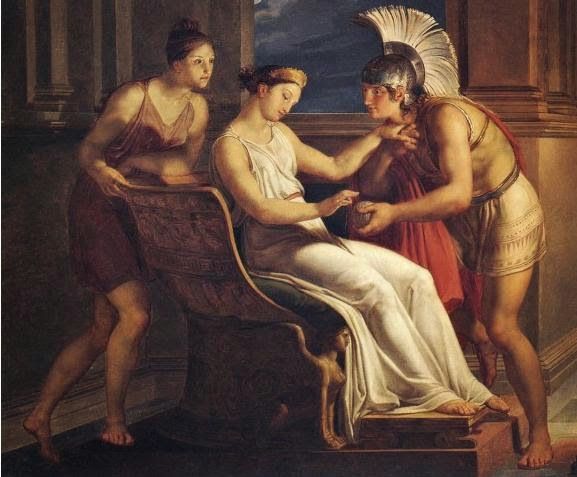
Ariadne giving Theseus string before he enters the labyrinth
The first excerpt is taken from a memoir poem about place but seems to transcend time:
Excerpt from Allegory by Diane Seuss
…
In the north, all forms stood for themselves.
There was no need to fill them with anything.
Chalices in which wine would be superfluous.
And every moment a form, a string of tongueless bells.
…
Here, internationally famous poet, Gibran, gives sage advice about the union of marriage:
Excerpt from On Marriage by Kahlil Gibran
…
Sing and dance together and be joyous,
but let each one of you be alone,
Even as the strings of a lute are alone
though they quiver with the same music.
…
The next poem shows great affection for the traveling emigrant’s mother.
the hidden by Truong Tran

known for her cooking the consistent
perfection of spring rolls evenly fried
her secret to brush it
with just a hint of apple juice
to add some color give some flavor

she is the mother of five a wife
a widow it is easy to forget
her strength in its subtlety
she keeps it hidden

like the smell of apple juice
that reminds me
of my family the eighteen days
we spent on a tanker

the sticky metal floors streaked
with the vomit of children crying
a pearl a day she removed
from a string milky white marbles

on an army issued blanket
a make-shift playground
that kept what was ours
i would have to be good
no crying no complaining
it was mine to keep it was mine to lose

being thirsty that i remember
drinking juice from a can tomato
apple a concoction of both
my mother traded her red jade bracelet

for a jar of water
the kind you drank if you had money to buy
if you spoke korean the kind
that was plain without the taste of salt

she said uống từ từ—drink it slowly
i was given a third of this precious water
the rest she saved     hid in a suitcase
Then there’s the past tense, strung. A contemporary of Ginsberg, I can see the beads and smell the incense from here:
Excerpt from Blues for Hal Waters, by Bob Kaufman
My head, my secret cranial guitar, strung with myths plucked from
Yesterday’s straits, it’s buried in robes of echoes, my eyes breezeless bags,
lacquered to present a glint . . .
My marble lips, entrance to that cave, where visions renounce renunciation,
Eternity has wet sidewalks, angels are busted for drunk flying.
I only want privacy to create an illusion of me blotted out…
The final example, again using strung, incisively describes a process. I’ll let you decide what process the poet describes.
Vessels by Paisley Rekdal

Shouldn’t it ache, this slit
into the sweet
and salt mix of  waters

comprising the mussel,
its labial meats
winged open: yellow-

fleshed, black and gray
around the tough
adductor? It hurts

to imagine it, regardless
of the harvester’s
denials, swiveling

his knife to make
the incision: one
dull cyst nicked

from the oyster’s
mantle — its thread of red
gland no bigger

than a seed
of  trout roe — pressed
inside the tendered

flesh. Both hosts eased
open with a knife
(as if anything

could be said to be eased
with a knife):
so that one pearl

after another can be
harvested, polished,
added to others

until a single rope is strung
on silk. Linked
by what you think

is pain. Nothing
could be so roughly
handled and yet feel

so little, your pity
turned into part of this
production: you

with your small,
four-chambered heart,
shyness, hungers, envy: what

could be so precious
you’d cleave
another to keep it

close? Imagine
the weeks it takes to wind
nacre over the red

seed placed at the other
heart’s mantle.
The mussel

become what no one
wants to:
vessel, caisson, wounded

into making us
the thing we want
to call beautiful.
The source of each poem is found at the poem title links. Learn more about each of these excellent poets by clicking on the link of the poet’s name.

Once again, we have come to the place where you put your proverbial pen to paper and warm it with your poetic spirit's will in words.

• Pen us a poem of precisely 44 words (not counting the title), including some form of the word string (past tense of it is ok also.)
• Post your Quadrille piece on your blog and link back to this post.
• Place the link to your actual post (not your blog url) on the Mister Linky page.
• Don’t forget to check the little box to accept use/privacy policy.
• Please visit other blogs and comment on their posts!
• Have fun (but only if you want to!)
Sources:
top image quote
Ariadne Giving Some Thread to Theseus to Leave Labyrinth by Pelagio Palagi
 dVerse
Welcome to One and All. The Pub is Open!
Hello, it is getting colder here. This morning there was frost in the grass and on the window of cars.
Welcome, Bjorn. Oh wow frost already!? Hope it’s a fluke and you get your Indian Summer.
We have had Indian Summer, but I guess we will enter true autumn soon.
Oh darn. We still have high 70s – low 80s each day here in Michigan.
Loved all the different ways string can tied and your choice of poems too Lisa- Torrential rain here all day and cold so I’m just about to eat my soup -will be back later for a read
Welcome, Laura! String is pretty versatile, you’re right. Thanks on the poems. So many poems out there with string or strung in them. Ooh, not sure if torrential rain is ever good. Hoping it stops soon and warms up. Seeya later!
Hi Li. Love your choice of poems. Thanks for hosting.
I have to be up early tomorrow morning, so I will link my poem and scoot and come back later tomorrow to catch up with my reading.
Welcome, Punam. Thank you on poem choice. My pleasure on hosting. Thanks for joining in on the prompt. Have a good evening, my friend, and see you tomorrow.
You are welcome. Good night. See you tomorrow.
Good evening poets, and thank you Lisa for hosting. I enjoyed the poems you chose as examples for ‘string’, and I look forward to reading. It’s been raining all day here and there is a distinct chill in the air. A large hot chocolate with Baileys please, Lisa.
Welcome, Kim. My pleasure on hosting. Glad you liked the poem choices using the prompt word(s). Sounds like you and Laura may live in the same region? A large hot chocolate with Baileys sounds like just the remedy for the distinct chill. Coming right up. Cheers!
Hi Lisa and All — This was a wonderful prompt to write to, so thank you for hosting. Would love a cup of coffee to keep me awake on this rainy afternoon before I head out on errands! Thanks, Lisa!
Welcome, Dora, happy to see you. Thanks much and glad you liked the prompt. My pleasure on hosting. A nice hot cup of coffee to drink as you head out on errands. You’re welcome and Cheers!
Thank you for hosting, Lisa. Enjoyed reading the poems you’ve selected and also the prompt word. 🙂
Welcome, Kitty. Pleased that you enjoyed reading the poems and like the prompt word. Thank you 🙂 Happy Monday!
You are welcome, Li. 🙂
❤
Thank you for such a rich presentation Lisa, very enjoyable..
Ain, thanks, my friend.
Gimme wine!
Welcome, Nolcha. Two chilled glasses of Rosso Dolce Roscato, one for you and one for me. Cheers!
Are you ready to start drinking? I am. Thanks for the wine selection!
🙂
hi lisa
hi poets
what a fun prompt
catch up soon I hope
rog
Welcome, Rog. Happy you like.
Hi Rog, I am unable to post a comment, however, I wanted to let you know I read your poem. ha – when one gives the heart freely there is often the risk of heartbreak.
Tha k you for taking the time to read
Thank you for hosting! WIll be back in the AM, coffee in hand, to read along the trail here. My first thought was a string of pearls….have no idea why. So went with that.
Welcome, Lillian. Just read about your Black Pearls. Wonderful poem. See you in the morning 🙂
Love the prompt word Lisa! ☺️ Are you serving Cosmopolitans tonight? It is Martini Monday isn’t it?
Glad you like the prompt word. Welcome, Christine. Indeed it *is* Martini Monday. 🙂 I shared a toast with Moscato earlier with Nolcha, but what the heck, mixing up 2 Cosmopolitans, one for you one for me. Cheers!
Perfect! Cheers Lisa ☺️ 🍸
Thank you for hosting Li(sa)… 😉 Fun prompt my friend. 🙂✌🏼🫶🏼
Welcome, Rob. Glad you like the fun prompt 🙂
Thanks for hosting Li, enjoyed the prompt – a double shot of whiskey please 🙂
Welcome, Paul. Glad you enjoyed the prompt. I like what you did with it. Yesterday I drank a glass of Roscato with Nolcha and a Cosmopolitan with Christine. Setting up two double shots of whiskey for us today. Cheers! 🙂
Hi Lisa, thanks for hosting – fun word to pull at the heartstrings
Welcome, Truedessa. My pleasure on hosting. I like what you did with the word. You transported me to another place ❤
Hi, Lisa. Drive-by poeming for now. Back to read soon.
Thanks for the inspiration!
Welcome, De! Thanks for stopping by. I just read your wonderful lasso the sky poem ❤
Pingback: Broken strings- Quadrille Monday # 209 – Keep it alive
I made it in time!
https://1994ever.com/2024/10/04/string-along-5th-october-2024/
Welcome, Shaun. You sure did 🙂 Happy you made it.
Dwight’s poem:
Pingback: String Along – 5th October 2024 – 1994ever