
Welcome poets, today I thought we should learn about kennings again. This is a prompt we did back in 2014, and I think it is worth repeating. A kenning is a very brief metaphoric phrase or compound word and it means “to know” (derived from Icelandic, but exist in many other languages like Swedish and German). It was used extensively in Old Norse (later Icelandic) and Anglo Saxon poetry as a means of adding both colour, and better metre to the skaldic songs. For instance “whale-road” was used as a kenning for the sea in Beowulf, and “wave-stead” replaced ship in Glymdrápa.
The written Norse texts were written down much later, unfortunately the runestones which would be contemporary are much more mundane than the text of the sagas.
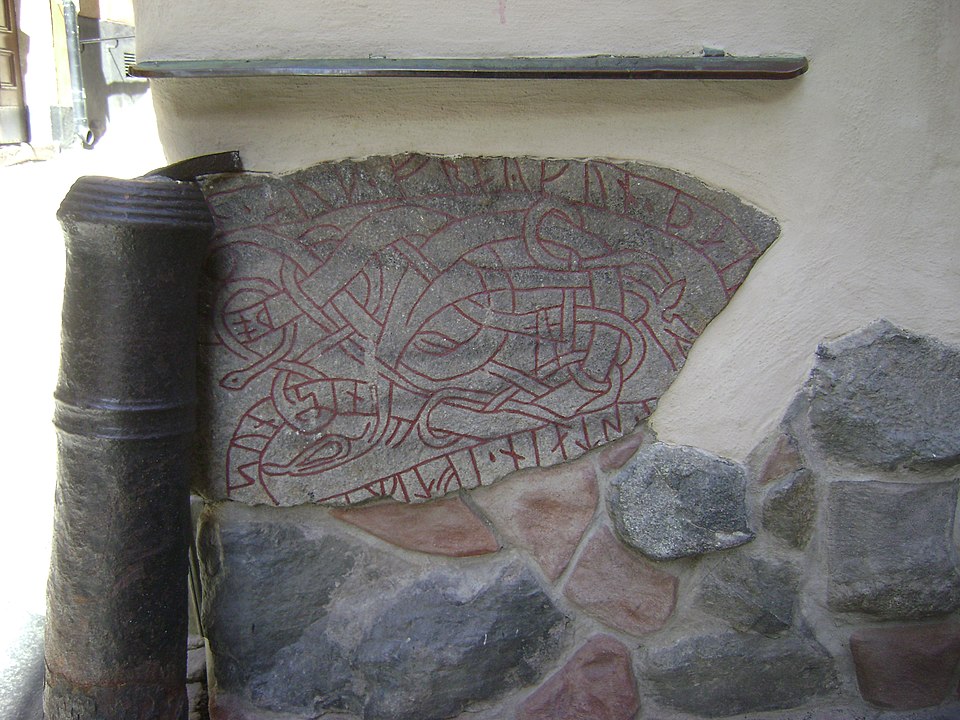
It could be formed around a genitive or directly as a compound word and in English we may use a hyphen. It is normally done by combination of nouns but there is no such rule. In Nordic languages compound words are freely formed by writing them together and if you are daring you may skip the hyphen. It’s actually still used in many languages to form new words. Consider for instance “fernseher” for television in German (meaning view from afar), or “couchpotato” for a lazy person watching too much TV. A language that evolves, constantly needs new words and one way to do it as kennings.
Today I want you, dear poets, to create new kennings and use it in your poetry. The process is simple, just consider something you want a new word for and create one or several kennings for this. It can then form an ode, a riddle poem or any type of other poetry. There are examples to find at several places on the internet. But before doing that, I can give you an example I wrote some years ago, where I at least partially used the process of kennings to write a poem celebrating International women’s day (March 8).
Sweet moon-dancer
and the meal-creator
Our garden’s friend,
and diamond-bearer,
lullaby-singer
honey-whisperer
Our decision-maker
and unpaid labourer.
The butterfly-charmer
and home’s defender.
Today is women’s day,
like every day should be
Usually you start with a base word that has some relation to what your meaning is and then you add a descriptive word. Let yourself associate freely and include all your fantasy in the creation and don’t hesitate to mix senses ( for instance with Synesthesia). Also the use of Mythology could be a good way to create association (Thor-hammering would for instance be thunder). The combination of two words becomes a kenning. For instance “butterfly-charmer” for women.
- Write a poem and post it to your webpage, and link back to dVerse.
- Enter a link directly to your poem and your name by clicking Mr Linky below
- There you will find links to other poets, and more will join
- Read and comment on other poet’s work, we all go here to have our poems rea
 dVerse
Hello friends, we are serving up ale, mead and meat grilled over open fire. Sit down and listen to the skalds beside the fireplace.
If you want something lighter we have elderberry-blossom cordial sweetened with honey and cakes with sweat spices.
I like the look of the drink, but I’m not sure about sweat cakes, Björn. Sweet ones would be better!
🙂 sweat cakes was good for Vikings only.
🤣
Good evening poets, and thanks for hosting Björn. I remember teaching kennings and having a lot of fun with my students. It’s always good to return to them,
I remember we have had a few times, but it was such a long time since
This is an amazing challenge!!! I appreciate when the learning process is part of the exercise. Thanks!!!
Thank you… I have used it from time to time but it is really amazing when used rigtht
Hello Björn and others. An interesting prompt. I look forward to reading the responses to it.
I would love elderberry-blossom cordial with a slice of cake.
Of course I have it for you… and love to see what you do with the prompt-
Thanks, Björn. I hope I get it correct.
I do not think there is a wrong way of doing it… 🙂
Posted. 🙂
Fit like! Dae ye ken wat ahm sayin’? would be (Glaswegian) Scots for “do you know”…’ken’ is Scots for ‘know’ and used extensively, so is interesting to see a derivative here
Och the noo’ mon, whit are ye askin’ us tae do now… I’ll be wantin’ an ale if ahm tae do this…
Ale for the scot… in Swedish it we say känna, in German it is kennen… so yes it is well known. Even some nick-names are sometimes kennings which I think is fun.
Hello Bjorn and All. Oh it has been a whirlwind week. Couldn’t resist the prompt and the spark came right away. I tried mead yesterday when out for dinner with a friend but way too sweet for my liking. I chose a dry cider instead. It’s chilly this afternoon, so could you pour me hot cocoa with a shot of Baileys please?
I have a dry mead if you dare, but cider it is otherwise…
I dare to dry-mead, yes please 🙂
I’m coming in hot! Some ice water from the bar, please!
Of course
Hi Björn, and all. Thank you for hosting and for the prompt. We had a recent Top Tweet Tuesday prompt requiring kennings, but I’ve written a new one today. I’ll have a dry red wine to sip while I read.
Of course… a good cab I hope is fine.
I helped myself from the open bottle at the bar last night. 🙂
Cordial and honeycakes, please. 🎃
Perfect… we still have a lot of that
Thank you for hosting, Bjorn. This was interesting and fun prompt. 🙂
It is a fun way of doing poems.
Yes, it is. 🙂
I really like this challenge, Bjorn. Thank you~
It is one of my favorite tools
Many thanks for this Bjorn, such fun, and a great opportunity to play with phrases – kennings.
Love the subject, Bjorn! I will be back tonight to make the rounds.
A favorite of mine too
Such a fun prompt Björn. Thank you sir, for hosting! 👍🏼🙂✌🏼🫶🏼🎼
Thank you for contributing
Never heard of kennings before, but sure wanted to have a play once I did. Very interesting and stimulating prompt Bjorn.
Thank you… some of it I knew about (like for making good nick-names)