
It’s Tuesday, and the dVerse Poets Pub is open with hot dragon-cooked snacks and beverages, as well as a selection of delicious dragon poetry. I’m Kim from writinginnorthnorfolk.com, your host for this week’s Poetics.
For centuries there have been poems about dragons. In some, they are portrayed as menacing, violent creatures that must be defeated. In others, they represent a source of wisdom, a protector of the innocent, or a treasure guardian. Dragons have also been used as metaphors for internal struggles.

William Blake (British, 1757–1827) The Great Red Dragon and the Woman Clothed with the Sun (Rev. 12: 1–4), ca. 1803–1805 – Brooklyn Museum
In children’s poetry, dragons are often portrayed as friendly creatures, inspiring wonder and awe in young readers. One of my favourite dragon poems to teach younger pupils was ‘A Small Dragon’ by Brian Patten.
It’s a magical, atmospheric poem. Who wouldn’t like to think that a small dragon might live in a woodshed, or indeed any shed? What endears it to me is that it comes from Love Poems, a collection for adults about relationships, and Patten describes this poem as one that wasn’t intended for children but was adopted by them.
An effective dragon poem captures the essence of power, mystery, and ancient wisdom. It weaves vibrant imagery that paints a picture of a creature both majestic and fearsome, evoking a sense of awe and wonder, exploring the dragon’s connection to elemental forces and its place in mythology and folklore. An excellent example of this kind of poem is ‘Far over the Misty Mountains Cold’ by J.R.R. Tolkien.
In this poem, dragons are formidable creatures guarding vast treasures, embodying danger and power. The motif of a brave hero confronting a dragon to claim its treasure is a recurring trope, symbolizing the triumph of human courage over beastly adversity.
A poem that transforms the dynamic between the characters in Saint George and the Dragon is ‘Not my Best Side’ by U. A. Fanthorpe.
It’s the classic tale of the knight and dragon from the dragon’s perspective. It subverts the traditional charisma of the hero by comparing his physical attributes with the dragon.
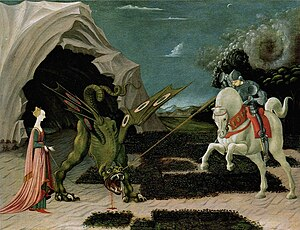
Saint George and the Dragon by Paolo Ucello found on Wikipedia
Your challenge is to write a poem about a dragon:
- You could start with a strong image, a scene that instantly transports the reader to a realm of imagination.
- Try to get under the skin of your dragon and into its essence, conveying its majesty or personality, and a sense of wonder and awe. Explore its predatory instincts, fiery breath, ancient wisdom, its magic or vulnerability.
- Unveil the dragon’s enigmatic nature, hinting at its concealed motives and the depths of its consciousness, its capacity for both destruction and creation, its fierce independence and its connection to the elements.
- Your poem should culminate in an unexpected twist or revelation, a moment that leaves the reader pondering long after they have finished reading, a surprising insight or a hidden truth that challenges assumptions.
If you are new to dVerse and/or Poetics, here’s how to join in:
- Write a poem in response to the challenge;
- Enter a link directly to your poem and your name by clicking Mr Linky below;
- There you will find links to other poets, and more will join, so check back for their poems;
- Read and comment on other poets’ work – we all come here to have our poems appreciated;
- Please link back to dVerse from your site/blog;
- Comment and participate in our discussion below, if you like. We are a friendly bunch of poets.
- Have fun.
Mister Linky is open until Thursday 3 p.m EST.
 dVerse
Good evening to all my poet friends and welcome to the pub, where we have dragon toasted cheese toasties, smoked paprika chips, and hot chocolate with dragon-melted marshmallows, followed up with hot and cold rinks of your choice. I’m really looking forward to reading all your dragon poems.
Tough and so very interesting..particularly like the sudden twist at the end part. Thank you, Kim
I look forward to reading your poem, Ain.
Hi Kim and everyone! Hot chocolate with dragon-melted marshmallows — oh my stars! Let’s have one, possibly two, as I overload on you with a dragon holding out a marshmallow on a stick! Or another method, less tricky perhaps?! 🙂
Hi Dora! I couldn’t help chuckling at the dragon holding out a marshmallow on a stick! You’ve cheered me up this cold, dark evening when we’re expecting snow.
Oh my! I imagine there will be many a dragon shape forming in the snow tonight. But you’ve got me seeing dragons everywhere. Stay warm. 💞
Hello, I love the thought of dragons, and what great prompt. I was stuck in a meeting about solving the meta-crisis using AI… fascinating stuff.
I’m glad you could be diverted by dragons!
Well, it’s almost bedtime for me, so I’ll wind down here and come back in the morning to read more dragon poems. Welcome to all the poets who arrive at the pub while I’m asleep; I look forward to reading your poems i the morning.
Pingback: d’Verse Poetics 11/19/24 Pursued by the Past – Sillyfrog's Blog
Sounds like a fun prompt, Kim. I hope you had a good night’s sleep! Thanks for hosting!
Good morning, Dwight. So pleased you like the prompt.
Pingback: Croton – The Phoenix Tree Writes
Thanks for this wonderful prompt, Kim! I decided to share an older poem I wrote, although it’s probably more tangential than what you might have had in mind. Still hope it’ll be a worthwhile read though!
I’m glad you like the prompt, Chris! I’m looking forward to reading your poem.
Excellent prompt Kim. I am offering a little dragon tale — but it ain’t no nursery rhyme. It is monumental horror, and it walks among us now. 🐉😠✌🏼🫶🏼
I’m so pleased you like the prompt, Rob. I’ve just got up and am looking forward to reading your dragon tale!
Pingback: Old Dragon - How would you know...
Smoked paprika – is there any other kind worth having – so crisps and a pint please, Kim and thanks for the prompt which turned out personal…
Smoked Paprika and a pint of Dragon Stout coming u, Andrew!
Pingback: The Fire Drake a poem by Paul Vincent Cannon | parallax
Thank you Kim, always up for time with dragons – the best mythical, legendary, creatures ever.
I’m so pleased about that!
Pingback: The dragon employed – erbiage
Pingback: dVerse Poets – Poetics – The Bag Lady
Pingback: Camouflage? | Kim Whysall-Hammond (The Cheesesellers Wife)
Pingback: A Dragon’s Visit – Frank J. Tassone
Pingback: Mighty Wonders and Simple Pleasures | Elderberry Tea
Asked to write about dragons? Yup, I’m in!
Perhaps the pub could hire the creme brulee dragon? (link to the image I’m referencing)
A creme brulee dragon! I want one too! I look forward to reading your poem, Nicole.
Thank you for an interesting prompt. I’ve never written on this topic before, thank you, Kim. 🙂
I’m delighted you like the prompt, Kitty, and look forward to reading your poem.
Pingback: The Mountain Mist – Yard Sale of Thoughts
Pingback: Let it sleep – Reena Saxena
Pingback: Chuckwalla – JJJ Interactive Books
Pingback: Night of the Dragon for dVerse Poets | lifelessons – a blog by Judy Dykstra-Brown
Pingback: Roberta Writes – Chinese Dragon Colour Palette for d’Verse and Thursday Doors
Pingback: Dragon Hunt – Dreams from a Pilgrimage
Pingback: A Dragon’s Lament
I know I missed the window here but I did write something of dragons, just a little slow to get to it. Much appreciate the prompt. Cheers.
https://frankenberrysattic.com/2024/11/22/a-dragons-lament/
I’m pleased you liked the prompt, Stephen. I’ll be over to read shortly.