
Tags
Christina Rossetti, dVerse poetics, dVerse Poets Pub, In spirit of Valentine's Day, poetry prompt, Robert Burns, Sanaa Rizvi, The heart wants what the heart wants, Writing Emotion
***Announcement***
Please join us at dVerse LIVE on Saturday, February 15, from 10 to 11 AM EST. Google meet link will be provided at Open Link Night on Thursday.
“Love recognizes no barriers. It jumps hurdles, leaps fences, penetrates walls to arrive at its destination full of hope.” – Maya Angelou
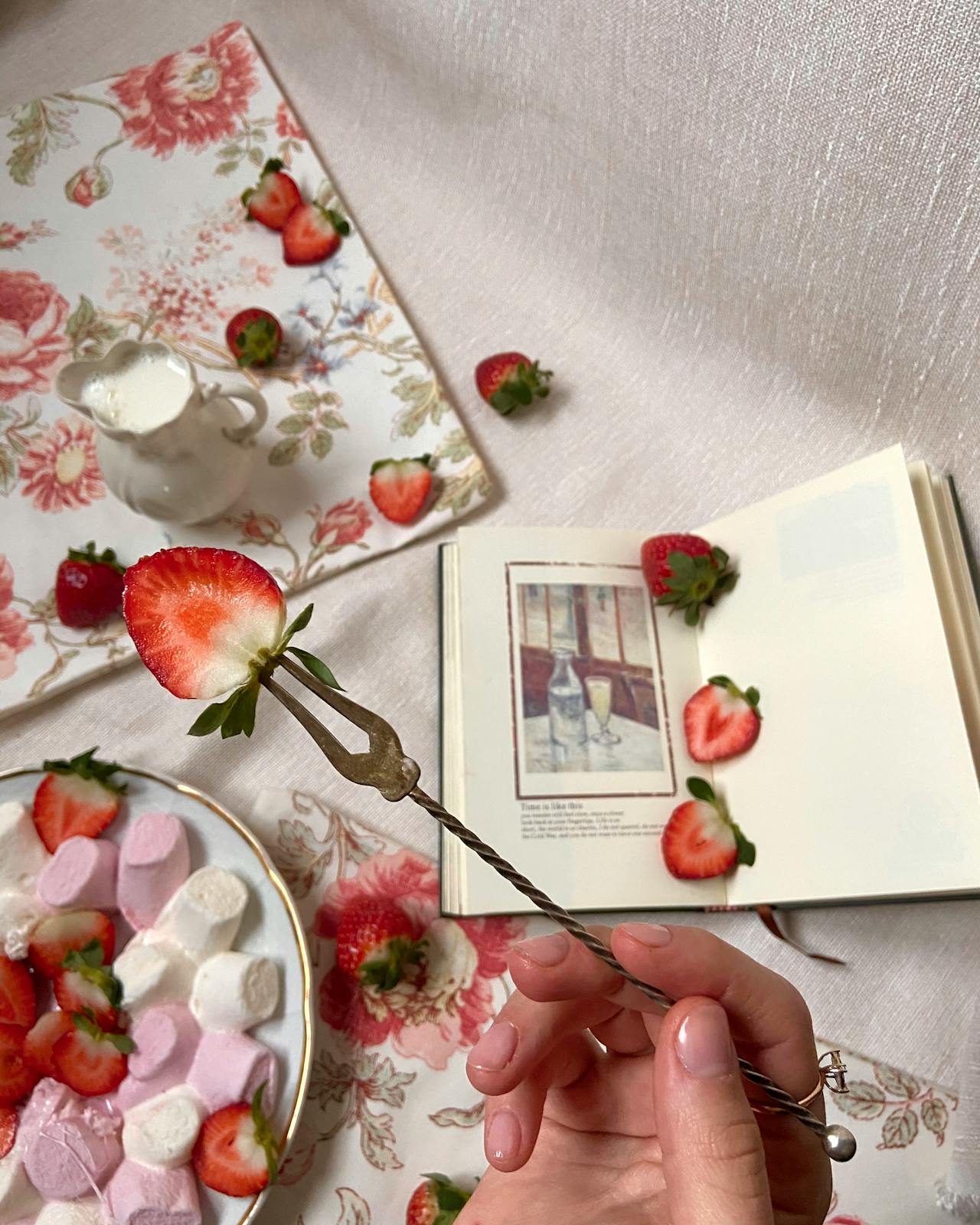
Photo courtesy: Sliced Strawberry on a Cutlery by Mariam Antadze, Pexels
Good evening, all!
Sanaa here (aka adashofsunny) delighted to be hosting Poetics today! Being a Romantic Poet, the month of February holds a certain allure for me, and since it’s Valentine’s Day this Friday, I thought it’s only fair to stir your muses accordingly.
The history of Valentine’s Day—and the story of its patron saint—is shrouded in mystery. We do know that February has long been celebrated as a month of romance, and that St. Valentine’s Day, as we know it today, contains vestiges of both Christian and ancient Roman tradition. But who was Saint Valentine, and how did he become associated with this ancient rite?
While some believe that Valentine’s Day is celebrated in the middle of February to commemorate the anniversary of Valentine’s death or burial—which probably occurred around A.D. 270—others claim that the Christian church may have decided to place St. Valentine’s feast day in the middle of February in an effort to “Christianize” the pagan celebration of Lupercalia.
Celebrated at the ides of February, or February 15, Lupercalia was a fertility festival dedicated to Faunus, the Roman god of agriculture, as well as to the Roman founders Romulus and Remus.
Lupercalia survived the initial rise of Christianity but was outlawed—as it was deemed “un-Christian”—at the end of the 5th century, when Pope Gelasius declared February 14 St. Valentine’s Day. It was not until much later, however, that the day became definitively associated with love.
During the Middle Ages, it was commonly believed in France and England that February 14 was the beginning of birds’ mating season, which added to the idea that the middle of Valentine’s Day should be a day for romance.
The English poet Geoffrey Chaucer was the first to record St. Valentine’s Day as a day of romantic celebration in his 1375 poem “Parliament of Fowls,” writing, “For this was sent on Seynt Valentyne’s day / Whan every foul cometh ther to choose his mate.”
Here are two of my all-time favorite love poems:
by Robert Burns
O my Luve is like a red, red rose
That’s newly sprung in June;
O my Luve is like the melody
That’s sweetly played in tune.
So fair art thou, my bonnie lass,
So deep in luve am I;
And I will luve thee still, my dear,
Till a’ the seas gang dry.
Till a’ the seas gang dry, my dear,
And the rocks melt wi’ the sun;
I will love thee still, my dear,
While the sands o’ life shall run.
And fare thee weel, my only luve!
And fare thee weel awhile!
And I will come again, my luve,
Though it were ten thousand mile.
“I loved you first: but afterwards your love”
by Christina Rossetti
I loved you first: but afterwards your love
Outsoaring mine, sang such a loftier song
As drowned the friendly cooings of my dove.
Which owes the other most? my love was long,
And yours one moment seemed to wax more strong;
I loved and guessed at you, you construed me
And loved me for what might or might not be –
Nay, weights and measures do us both a wrong.
For verily love knows not ‘mine’ or ‘thine;’
With separate ‘I’ and ‘thou’ free love has done,
For one is both and both are one in love:
Rich love knows nought of ‘thine that is not mine;’
Both have the strength and both the length thereof,
Both of us, of the love which makes us one.
For today’s Poetics, I want you all to select ONE of the following three options and write a poem:
1- Love Potions and Concoctions: Write a poem as a recipe for a love potion. Throw in some berries and cream, maybe a dash of cinnamon and chivalry. Tell us what love means to you.
2- Love Letters Through Time: Write a poem in the form of a love letter. It can be addressed to yourself, to someone special and/or in memory of a person who has passed.
3- Love in a Digital Age: Bring love into the 21st century by exploring the dynamics of modern relationships. I am referring to the age of social media, dating apps, and virtual connections. Let your poem decide whether technology enhances or complicates matters even further.

Photo courtesy: Sweet Treats on White Ceramic Plate by Studio Ani Raja, Pexels.
New to dVerse? Here’s how to join in:
- Write a poem in response to the challenge.
- Enter a link directly to your poem and your name by clicking Mr. Linky below
- and remember to check the little box to accept the use/privacy policy.
- You will find links to other poets and more will join so please do check
- back later in order to read their poems.
- Read and comment on other poets’ work– we all come here to have our poems read.
- Please link back to dVerse from your site/blog.
 dVerse
Good evening from the UK Sanaa – and how apt that you are our Valentine host. Thank you for the background info and the three options – I like letter writing so an easy choice to make
Good evening, Laura! I am so glad you liked the prompt 😀 heading over to read you. Happy Tuesday 🩷🩷
Pingback: To R wherever you are – PoetryPix
Welcome to Poetics, everyone!
On the menu, we have filet mignon with red wine reduction – Tender beef filet topped with a rich red wine sauce, served with garlic mashed potatoes and asparagus.
Stuffed chicken with spinach & sundried tomatoes – Juicy chicken breast filled with ricotta, spinach, and sundried tomatoes, served with a white wine cream sauce.
For dessert, I am thinking chocolate-covered strawberries and molten lava cake.
And for drinks, we have …. are you ready?
🥂 Love Potion Cocktail – A sparkling mix of pomegranate juice, vodka, and champagne.
🍷 Strawberry Rosé Sangria – Rosé wine infused with fresh strawberries, oranges, and a touch of brandy.
🍫 Red Velvet Hot Chocolate – Rich and creamy hot cocoa with a hint of red velvet cake flavor, topped with whipped cream.
Hope you all enjoy the prompt! See you on the poetry trail! 🥰
you can certainly organize a love party Sanaa with that menu but this late at night I think I just have room for that red velvet hot choc
Red velvet hot chocolate for the lovely day 😘 I will join you for one as well.
Good evening poets, and thank you for being our Valentine host – Laura is right, that is so fitting. As you will see, I chose to write a letter to my dear friend, who died last Wednesday.
I am so sorry for your loss, my dear Kim. Sending you gentle hugs .. heading over to read you.
Thank you so much, Sanaa. xx
🤗🤗
Valentine… a great day for poems… alas I felt that the digital age is a challenge for real romance.
Good evening, Bjorn! Yes, it is certainly a challenge in the digital age. I thought it would be appropriate to give out 3 options so that others can have a choice in writing their poems 😀
Happy Tuesday! 🩷🩷
Ever dream of forbidden things while love sleeps nearby? Just who is looking for a good time? I could feel guilty but hmmmmm.
Hello B, heading over to read your dreamscape poem! I am sure it’s going to be stellar 😀
Pingback: dVerse Poetics VD humor – Tao Talk
Hello Sanaa and All. Wishing all of you who are in love a wonderful Valentines Day. For the rest us, a wonderful day as well. Will pass on the eats and drinks, but thank you, Sanaa, for a fun prompt.
Hello Lisa, happy valentine’s day to you too 😊 I am unable to leave a response on your blog! You have portrayed the evils of digital age so aptly in your poem. Thank you for writing 🩷🩷
Thanks Sanaa ❤
You’re most welcome! 😊
Pingback: Arthur – Gypsie’s Wonderful World of Words
Pingback: Facebook Love – Addicted to Words
I’ll trade you a serving of online love for chocolate fudge, if you have any.
Yes ofcourse! Chocolate fudge coming right up! Happy Tuesday 🩷🩷
Thank you, Sanaa!
You’re most welcome 😊
Perfectly timed subject, Sanaa. I’ll have a croissant, please.
Thanks, Shay! I will join you for some croissants 🥐 Happy Tuesday 🩷🩷
Pingback: Love Letters to My Roses – Where Stories Can Spark Their Magic
Thank you, Sanaa!
Oh WordPress, I despair!
…I thought ’twas I but it seems something keeps malfunctioning…cast them to the winds I say!
Sorry if my comments are coming late. Well, not “if.”
Alas … WordPress continues to be fickle … haha
Loved your poem, Ain! 😊
Pingback: Love Like Food - How would you know...
It is time for breakfast before going to work now but my taste buds are salivating at the description of the lovely meal you offered last night, Sanaa! I wrote my poem in my Writing Group but it fits your first choice of prompt I think…
Good morning, Andrew! We do serve breakfast here at the pub 🥰 let’s see .. how about potato apple bread and omelette with a cup of tea?
Heading over to read you now 🩷🩷
Pingback: Creme de la Creme – a poem by Paul Vincent Cannon | parallax
Thank you Sanaa, your rightful prompt 🙂 and a delightful one too.
Thank you! I am so glad you liked the prompt, Paul! 😊
Delicious prompt, Sanaa ❤
Thank you so much! 🩷🩷
Pingback: Heart’s Delight – The Elephant's Trunk
Hi Sanaa. Love is a prompt that will never go out of style! Thank you for hosting. I have written a love poem, but out of deference to my wife, I will be saving it to read for our live meeting on Saturday rather than posting it for the world. So those who want to hear it will have to join us then. :>)
Looking forward to it, Dwight! 🩷🩷
:>)
🥰🥰
Pingback: Cyber Romance for dVerse Poets, Feb 12, 2025 | lifelessons – a blog by Judy Dykstra-Brown
Pingback: Roberta Writes – d’Verse ‘From Your Valentine’ prompt #poetry #d’Verse
Pingback: Loving through thick and thin wires – Keep it alive
Pingback: Steadfast Love – Morning Star Poetry
Dear Sanaa, I am late to the party but had to join in! 😀
Love your prompt and informative post and how befitting that you are our host. 💖
Thank you so much, my dear Punam 😀 so glad you enjoyed the prompt! Happy Valentine’s Day 🩷🩷
Happy Valentine’s day, dear and you are very welcome. 🥰🥰💖
Pingback: Dear departed love, | paeansunpluggedblog
Hi Sanaa. nothing new, hope it’s ok to post an old pen that sorta fits the prompt. cheers ~
Heading over to read you now, M! 🥰 Good to see you~
Pingback: A Witch’s Brew – Sunflower Tanka
Pingback: My Valentine | poetography.ink
Pingback: dVerse Poets – The Bag Lady