
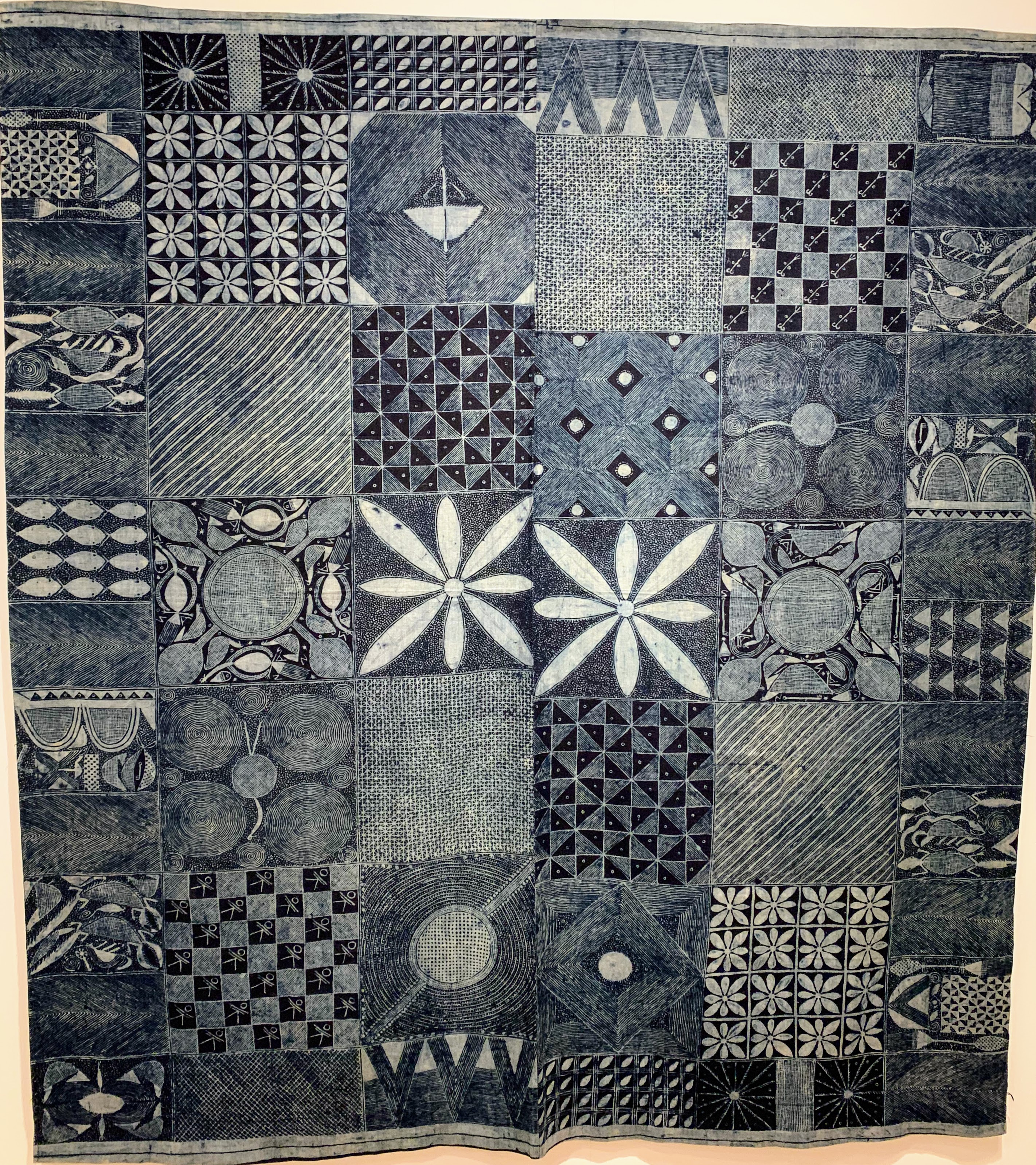
Greetings from California! We always spend a big chunk of Boston’s winter season in sunny San Diego, renting the same apartment every year in the Hillcrest neighborhood. We have senior bus passes, a library card and we’re members of the renowned San Diego Zoo, going at least once a week. February is “Museum Month” in San Diego. All museums of every kind have half-price admission. Last week we went to the Mingei International Museum in famous Balboa Park. We saw a fascinating exhibit about indigo.
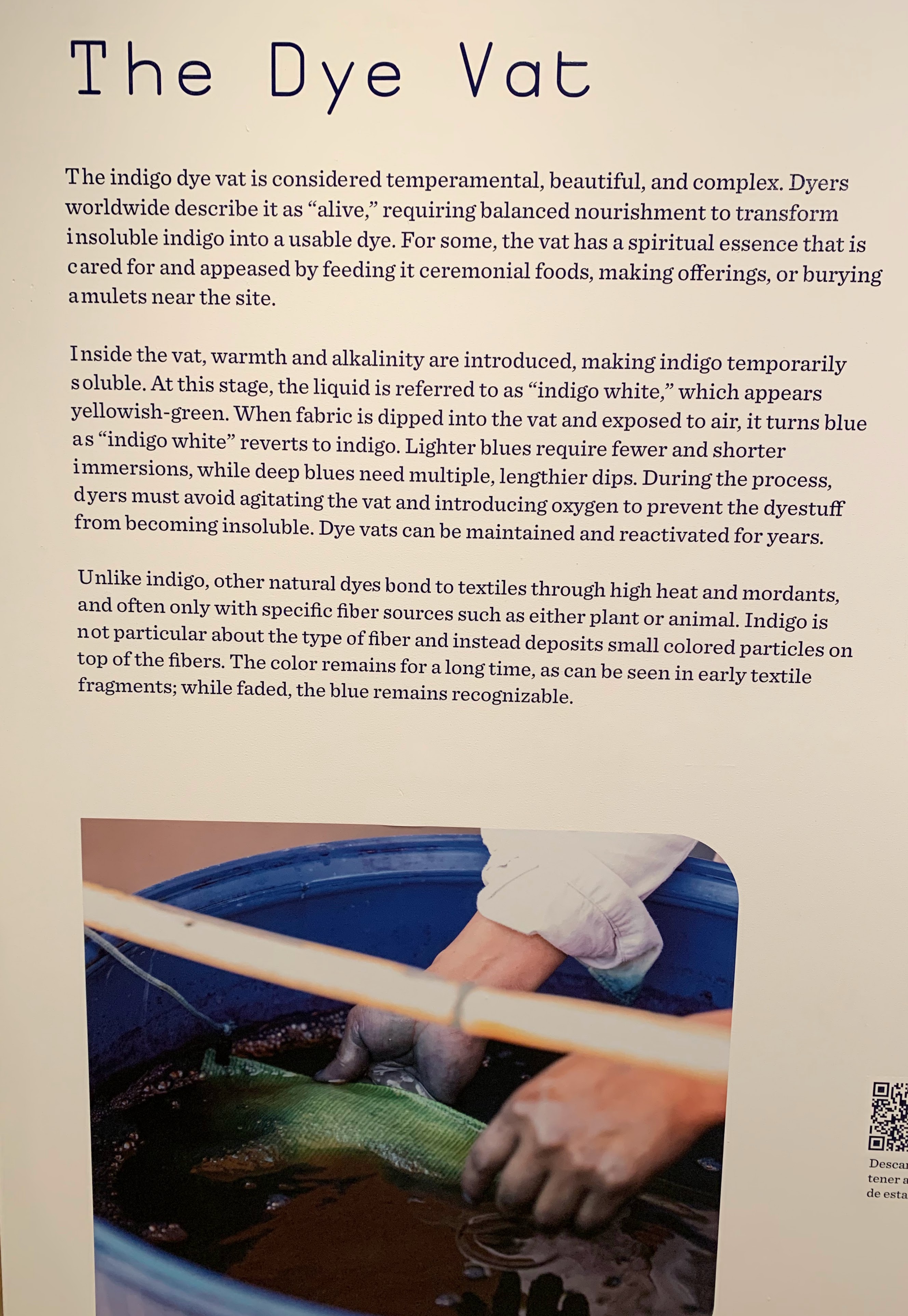
We learned that a number of plants can produce indigo dye. Indigenous people around the world have different methods of using the plant to make the dye. For example, in Japan, plant leaves are shredded, dried, left to compost (ferment); tossed, mixed and watered; then dried into balls to be used later in a dye vat. In West Africa, the leaves are pounded. In Europe, the leaves are ground. Fresh leaves can go directly into a dye pot with fresh water. An alkaline agent such as ashes, lye, or urine is added to start the fermentation process. In the vat, as its being stirred, it is a VERY yellow-ish green….not in any way purple or blue (the colors you associate with indigo). Textiles are then dropped into the vat to dye. When they’re pulled out, they’re that bright yellowish-green, almost chartreuse! As it oxidizes it turns blue!
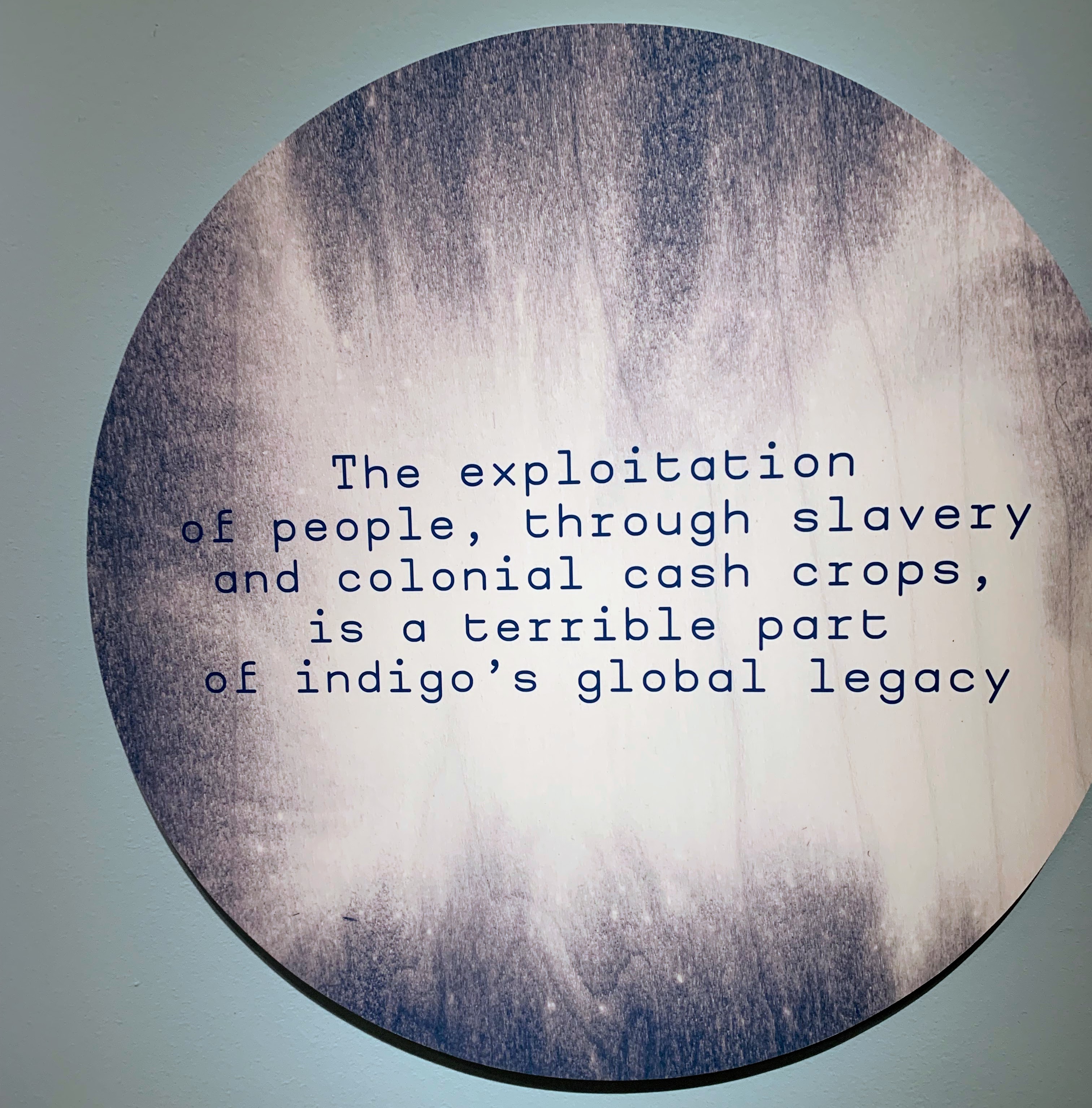
“In pre-colonial times, indigo was highly valued and traded across continents via land and sea routes. The long rich and bloody history of the Silk Road, an ancient trade route stretching across Asia, into Africa and Europe, is saturated with indigo dye cakes, powders and textiles. Colonial power – including the English, Dutch, French and Spanish – established indigo plantations worldwide. In the Caribbean and the United States, enslaved Africans were dehumanized, treated as a commodity, used for their expertise with indigo and forced to work on plantations.”
When I think of indigo, I think of denim and when I think of denim, I think of Levi Strauss. One of the most interesting things I learned recently is that “in 2022, one of the oldest pair of Levi’s still in existence was sold at auction. They are believed to be from the 1880s, and were discovered in an abandoned mineshaft, incredibly well preserved. Printed inside on a pocket is the phrase ‘The only kind made by white labor,’ a slogan Levi’s adopted later in the nineteenth century. The jeans sold for $76,000.”
So, it’s Quadrille Monday, the day to create a poem that is exactly 44 words, sans title. You must also use a particular word, or a form of the word, within the body of the poem. Today’s word is “indigo”. So to be clear, you must write a poem of exactly 44 words (not including the title) and within the body of the poem, you must include the word “indigo”. I’m looking forward to reading your quadrilles!
New to dVerse? Need to be refreshed on the rules? Here’s what to do:
- Write a quadrille (a poem of EXACTLY 44 words, not including the title) AND include the word “indigo” or a form of the word WITHIN THE BODY OF THE POEM. A synonym for “indigo” does not fulfill the prompt. It must be the word, or a form of the word.
- Post the poem to your blog AND add the exact URL for your poem to Mr. Linky below.
- REMEMBER to either TAG dVerse in your post, or include a link at the end of your poem that leads readers back to dVerse (https://dversepoets.com).
- If you do not TAG or include a link to dVerse at the end of your post, I will gently remind you to do so. After all, this will increase your readership and comments, and others will find dVerse and hopefully join in the fun. If you do not add the TAG or link after my reminder, I will remove your post from Mr. Linky. I do not want to do that! So please do include the TAG or link!
Photos and quoted information in 3rd paragraph are from the indigo exhibit at Mingei International Museum in San Diego, California. Quoted information RE Levi Strauss is from The Small and the Mighty, by Sharon McMahon, pages 26 and 27.
 dVerse
Good evening, lovely poets, and thank you Lill for hosting with one of my favourite colours. I’m still not quite back to normal, the doctor is still doing tests, so I won’t hang around for long. I will, however, be up early , so I’ll be back to read and comment in the morning.
Good to see you here, Kim. Most important thing though, is to listen to your body and take care of yourself! Feel better soon!
Thanks so much Lill!
Hi Lill. Thanks for hosting. I was going to write about the indigo revolt of 1859 by the farmers against the colonial rulers. But it wouldn’t have fitted in 44 words.
A great word to work with.
Yup, that would take more than 44 words! Indigo does indeed have an interesting history! Did you see the Levi Strauss part in the prompt?
Oh, I loved that part, Lill. Imagine from 1880s!!
Welcome dVersers! In sympatico to today’s word “indigo” I have some special offereings at the pub today: A saphire martini; mermade lemonade made with blue curacao and rum; and a Blue Hawaian made with rum, cream of coconut and blue curacao. Of course, we always have nonalcoholic choices, mocktails, coffee and tea too plus a beautiful glass of pink lemondae with 4 blueberries in the bottom of the glass. Also on hand, blueberry buckle, a blue version of Apple Brown Betty. A delicious dessert! And we have banana bread studded with blueberries!
So happy to see everyone here today. Looking forward to reading your indigo posts!
Hello Kim, Lillian, and All! Lillian very interesting info on indigo, how it’s made, who made it, and the well-preserved jeans. I love the color and yes, I think of jeans and Neil Diamond’s song, Forever in Blue Jeans. Sounds like where you stay there is a home away from home with lots of good perks while there. If you’re pouring, I’ll have a hot coffee with a shot of Baileys please.
Hot cup of joe coming with a shot of Bailey’s. Yep….San Diego is a good place to spend Boston’s winter! Glad you read the info on indigo….I know many simply jump to the prompt. In today’s busy world, I can’t blame them. But indigo truly does have an interesting history!
It’s fascinating how it looks one color in the vat but dries to a totally different color. Thanks and Cheers!
Exactly!
Love all the info on indigo… the way the colors has to oxidize to blue is so really cool…
It was really amazing to see the video of this bright chartreuse green material in the dye pot, taken out, and slowly turning blue! Who knew?
In honor of my little piece of nonsense, I’d like a Blue Lagoon, please!
A Blue Lagoon coming up! That’s vodka, blue curacao, lemonade and of course, garnished with a lemon wheel and a maraschino cherry! I’m getting to be a bonafide bartender/pub tender at dVerse!
Lillian, I talk a better drink than I really drink. Although I have to say, a Blue Lagoon sounds delicious!
Hi everyone. Thanks for hosting Lill. 🙂 I will try some blueberry buckle. I believe I may have had it in an airport in Newfoundland. The word “indigo” spoke to me, but I am seeing so much darkness right now, so my muse dragged me there.
And I will add a dollop of fresh whipped cream on top of your blueberry buckle! A gal’s gotta have some yummy dessert to make her day a little brighter, right? Glad to see you here, Mish….and gosh, I do understand! Don’t know if you look at Facebook at all? I was about to quit it….then realized it’s how I do indeed stay in touch with far away family, old friends and former students….so I’ve stuck with it. BUT, I’ve also been posting one FACT for the DAY….my way to resist! Some people have actually been sharing my posts on their pages so I feel like, as a septuagenarian, I’m at least doing a little something to oppose #47 and his minions. Check it out if you’re so inclined. In any case, loved your post…you’ll see my response there.
Lill, I read your posts all the time. I have also posted information articles although Facebook does not allow Canada to post Canadian news articles because of a recent riff with paying vs. not paying for posting news….long story. Check out CTV News, CBC news, Globe and Mail, Toronto Star, Global News, AP News for other information you may wish to share.
hi Lillian
hi poets
that shade of blue today WOW.
something strong to drink a toast to a long term Friend
whose family i have just had the honour of joining with to say a final farewell Too.
will come back and read when i can
rog
Good to see you here, Rog. Always difficult to say final farewells….hope you are okay.
All OK thanks. Just a tad blue hence indigo hit the spot
Got it!
Well, I have posted an error twice. I’m not sure what I did wrong.
hmmm…..do you mean here? I see your message now….glad to have you at the pub!
Hi again. When I click on the two links you’ve put into Mr. Linky, it gives me the message Oops, that page doesn’t exist. Computers can get temperamental! Pardon me if what I’m going to say is too basic and you post all the time…but will say anyway because I’d love to see your post:
Go in to your blog
Click on the title of your poem
Look up at the URL at the top – copy that entire URL which will include the date and the title of your poem
Then go into Mr. Linky and paste what you just copied.
In the mean time, I’ll go into your blog, if I can find it, and look for the poem you’ve posted in response to Indigo….and see if I can do that myself.
Okay…got in to your blog, found the poem, copied its URL and put it on Mr. Linky. You now have your poem on Mr. Linky – and I’ve added “the right one” so people will click on it. A bit later today, I’ll go in and delete the two that don’t work.
Thanks! I’ve been doing it the hard way – typing the URL myself which often leads to mistakes. I learn something everyday.
Yep – as a septuagenarian, I’m still learning every day too!
I always copy the d’Verse link but never thought of copying mine 🤦♀️
Indigo is such an intriguing word and process! Thanks for hosting, Lillian, and please pass me some blueberry buckle…is it still warm?
mmmm….yes…this batch is right out of the oven! Good to see you here, Lynn. Glad you like the word choice!
Indigo is delicious!
I’ve tried to reply on your post 5 times and it just won’t publish. So I hope you’ll read it here….
I LOVED how you put the entire process of taking it from plant to indigo dye to material within one poem! It’s amazing! The exhibit we saw on indigo at the Mingei Museum was incredible: chemical explanations, a video showing the process, and many many garments and material bolts showing the variety of techniques used and the wonderful creativity of the indigenous peoples. Your poem should be a part of the exhibit!
You made my day with your comment, Lillian! Yes, I found the process fascinating…thanks for sharing the museum exhibit 🙂
Hello All, Indigo one of my favorite hues.
Hi Truedessa! Glad you like the word choice!
A very interesting and informative prompt, Lillian. Indigo is such a great color and a unique prompt for our quadrille! Thanks for hosting.
Always enjoy tending the pub! Glad you like the prompt….seeing the exhibit was amazing!
One post I was particularly enamored with included a video/audio of Ella Fitzgerald singing Indigo Blue….I’d totally forgotten about that smooooth piece of music! Google it!
It was an interesting and unique prompt!
I have noticed that there are a few of the blogger’s sites that no longer let me post my comments. I am not sure what has changed since I had no trouble posting earlier! I don’t know what can be done to correct this?
I’ve noticed that as well…..will ask Bjorn about it.
Indigo is the head cheerleader of rainbow colors! Love the prompt, and don’t need anything but a sleep aid from the pub tonight (I stayed up too late before a very early ‘call time’). Thanks for hosting and look forward to seeing y’all around the pub tomorrow.
Nice to see you here tonight, Kim! How about a B&B, small amount in a snifter glass. Just the aroma will be warming….and good drink to have before bed! 🙂
Yumski!
Hi Lillian, thank you for hosting us. I think everything we have achieved has a dark past, the lens we now apply looking back, I wonder that we have learned anything given the state of affairs across the world right now. What a great prompt, so many possibilities 🙂
Good to see you here, Paul. Glad you enjoy the prompt….yep….it’s a very difficult place we’re living in now. I’ve taken to posting a FACT a DAY on my facebook page….my little way of resisting. I’ve enjoyed doing the reserach, rather than taking a newcaster’s word…I went to college many many years ago on a debate scholarship and was on our intercollegiate debate team. Have enjoyed resurrecting my reserach skills!
Go Lillian! We all need to be doing our bit in my view. He poisons the world.
love the color! thank you for the inspiration.
Thank you, Lillian. I hope San Diego is delightful and sunny. It is neither here in this ‘burb of DC, emotionally or weather-wise. Love indigo! 🙂
Ohhhh I do understand. I have a niece who is a federal employee in the DC area….so far she still has a job. But she is living in a chaotic work place right now. It is incredible the amount of damage #47/Musk have done in just a month. As a septuagenarian, I finally decided that what I could do was post a FACT for the DAY every day on my facebook page….it’s resurrected my college days intercollegiage debater reserach skills. I feel like I’m at least doing something to resist.
Glad to see you here! and glad you enjoyed the word choice – indigo!
Hello Lilian,
Its a pleasure being here! and thank you for hosting us 🙂
I always enjoy tending the pub!
Thank you so much Lillian…
I always enjpy tending the pub!