Hello friends and poets, Björn here writing on the first real days of autumn, today I would like to challenge you a bit with the literary device of changing your perspective. This is something we have done before many times, but I thought it was time to do it again.
As poets we are often used to writing from the first person singular
I am a poet
This becomes a strong statement and can therefore cannot be challenged from an emotional point of view. Most modern poets use this as it avoids ambiguity. For some poets it may be too strong or prevent you from telling anything but the absolute truth.
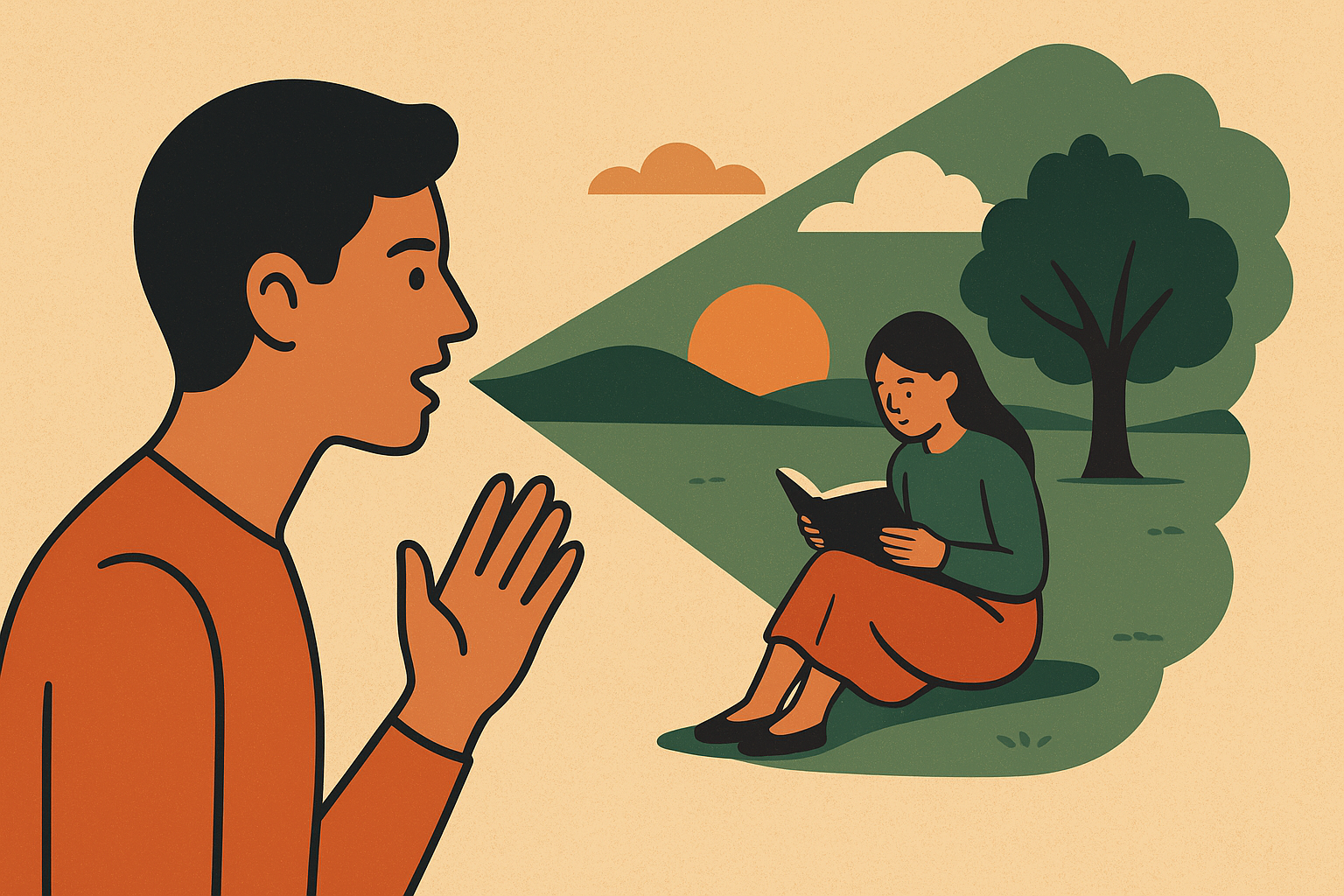
If on the other hand we write it in third persian we introduce uncertainty
She/he is a poet
This means that we probably have to know that there is evidence for the person’s ability to be a poet unless we have some divine capability to see the inner world of that person. We also have to give the gender (or sex) of that person. You may even want to write about yourself in third person. Or your perspective can be that of a spirit who has the knowledge of the person’s inner working.
And then if we select second person perspective
You are a poet — You are poets
We are now talking to someone, and it depends on the reader how this is interpreted. It can be seen as a call for action, a teacher talking to a student or an accusation. Also, in English it may even be difficult to interpret if we address the poem to one or many person.
From this we go into plural which also have different purposes as a device
We are poets
Includes a group, a collective that, to me, sounds like a manifesto. Join us the poets, we are a movement, but how are we sure that the reader really feel part of the group?
Then third person plural:
They are poets
on the other hand set a group of people apart.
We and they in a poetic manifesto draw up the lines in the sand. Do we need they to have we?
So today I would like you to challenge yourself and try to write from a different perspective or maybe even several perspectives than what you normally do.
You can do this by either writing something totally new or if you prefer, take an old perspective written from for instance first person singular and change it to third person.
Or write a poem about a collective: we. Do you need the otherness of they to define that collective.?
What do you get? How does it feel? and most importantly how do you think it will affect the reader? is the reader included or excluded?
If you feel like it you may want to combine the perspective with that of personification and write from the perspective of an abstract object such as a baloon.
When you have written your poem on your blog with a link back to dVerse, add it to Mr Linky below. Read and comment on other poet’s contributions, and have as much fun as you can.
 dVerse
Hello everyone, so nice to see so many of you joining up with us tonight. I hope that everyone will try to write and read and have fun
Good evening, Bjorn and all
Fabulous prompt 😀 I will have peach cobbler with ice cream please. Looking forward to reading everyone’s poems!
Happy Thursday ❤️❤️
Peach cobbler and ice cream for you…
Thank you! 😊
Hi Björn. A very interesting prompt. I rarely write in third person. Today I have attempted that..
Yes, I do it sometimes when I do my librarian poems
Indeed.
Greetings all! How much fun is this prompt??!!! Tons. Hoping Sanaa might share a few bites of her peach cobbler and ice cream with me !!!
I have a serving just for you… we have plenty
Don’t know what I’ve done to alter my name and the absence of my image, WordPress knows, keeping it a secret. Woonie is my grandmother name.
I have wondered so much… but things happens
I was happy to have internet connection back after a week and just in time for this old poet(!) to join your inspiring prompt 😉
Thank you. and so glad you got internet back…
Hello Bjorn and All. I linked up here and added link to comments section for Truedessa’s prompt. Do you have any hot apple pie with ice cream? I’ll take a slice if you do.
Of course we have apple pie and ice creme… all homemade.
Oh my, thank you. Cheers!
Your prompt has drawn out a fascinating variety of responses Björn…
Thank you… I hoped it would. It is worth thinking about
I think revisits are helpful for praxis, many thanks Bjorn.
Revisits often brings new perspectives
Absolutely so