Tags
Ivor Winters, June is a time to try new things, Monday Mood, Prosery prompt, Sanaa Rizvi, View from the Hills
Hello dVerse Poets, this is Sanaa (aka adashofsunny) welcoming you to another round of Prosery where we ask you to write a very short piece of prose that tells a story, with a beginning, a middle and an end, in any genre of your choice.
Since it is a kind of Flash Fiction, we here at the pub have a limit of 144 words. What’s special about Prosery is that we give you a complete line from a poem, which must be included somewhere in your story, that is, within the word limit.
You may change punctuation but please bear in mind that you are not allowed to insert words in between parts of the quotation.
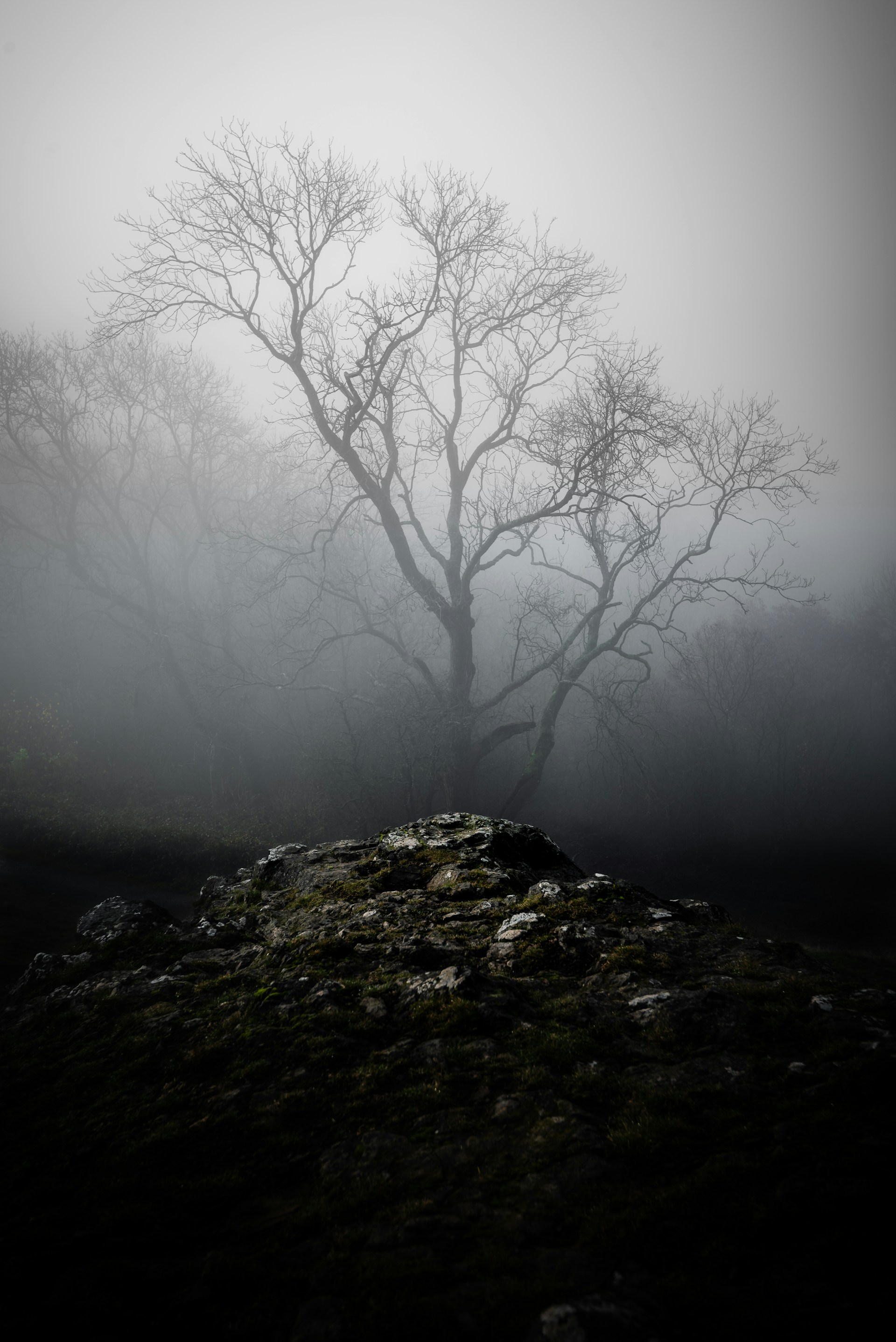
Picture courtesy: Bare tree covered with fog by Carl Jorgenson, Unsplash.
Yvor Winters was an American poet, literary critic, and professor best known for his defense of formal poetry and intellectual discipline in verse. He rejected much of the Romantic tradition, arguing that poetry should offer clear moral and emotional understanding rather than uncontrolled feelings.
In the beginning he was a modernist influenced by Imagism but later embraced traditional meter and rhyme, becoming one of the twentieth century’s most influential—and controversial—literary critics.
“On a View of Pasadena from the Hills” is one of his finest poems. It first appeared in The Journey (1931) and exemplifies his mature style: formal, reflective, and philosophically controlled. The poem is written largely in heroic couplets (rhymed iambic pentameter couplets), a form Winters deliberately revived when most contemporary poets were abandoning it.
In the poem, Yvor Winters describes a dawn landscape viewed from the hills above Pasadena. As the morning light gradually reveals the gardens, houses, and city below, the speaker reflects his childhood memories, his aging father, and the passage of time.
The beauty of the scene leads him to contemplate mortality and the impermanence of human achievements. By the poem’s end, the emerging city and surrounding natural landscape are seen as parts of a larger, unified world, suggesting a thoughtful acceptance of change, aging, and the limits of human life.
It is often regarded as one of Winters’s major achievements because it combines vivid landscape descriptions with philosophical meditation. The poem balances opposites—past and present, father and son, life and death, nature and civilization—without forcing a simple resolution. The result is a calm, deeply reflective meditation on human existence and the passage of time.
One of the most moving aspects of the poem is that the landscape becomes a way of understanding mortality. The dawn scene is beautiful, but its beauty is inseparable from awareness of change, aging, and eventual loss. That tension gives the poem its emotional depth.
Picture courtesy: Green leaves in tilt shift lens by Max Muselmann, Unsplash.
This evening, I would like you to write a Prose piece which includes the line:
“The hills so dry, so dense the underbrush, that where I pushed my way the giant hush was changed to soft explosion.”
From the poem “On a View of Pasadena from the Hills.”
Please also include the dVerse link in your published piece.
Here’s how to take part in the Prosery Prompt:
- Please visit other blogs and comment on their posts!
- Write a piece of flash fiction or other prose up of up to or exactly 144 words,
- Including the given line from the poem.
- Post your Prosery piece on your blog and link back to this post.
- Place the link to your actual post (not your blog url) on the Mister Linky page.
- Don’t forget to check the little box to accept use/privacy policy.


Welcome to Prosery monday, everyone!
On the menu we have chicken szechuan with roscato red wine, sauteed crab cakes and dry riesling or if you prefer we also have sweetheart cinnamon chip scones with coffee/tea of your choice.
Let me know if I can get you anything else 🙂 I look forward to reading what you all come up with! ❤️❤️
Crab cake sounds perfekt with a splash of wine… you really served me a challenge with those lines…
Hi Bjorn, crab cakes with dry riesling coming right up! Loved your prose piece 😀
Hello Sanaa and All! A tall glass of chilled roscato sounds perfect, please. I thought the prompt line would be tough to write to, until I started writing.
A tall glass of chilled roscato for the lovely lady 🙂 heading over to read you!
Thanks so much, Sanaa. Cheers!
Cheers 🥰
Pingback: My Hills – JAE ROSE
The whole meal sounds delicious to this foodie! but this foodie is full from a celebratory dinner … The Grill-Meister got a new job and I got to retire from mine! More time to (learn to) write poetry. So I’ll just have that tasty dessert scone. Thanks for the fab prompt – it was soooo inspiring to me.
I am so glad you enjoyed the prompt, Kim! Here’s sweetheart cinnamon chip scones for you! ❤️❤️
What a great line Sanaa, not fiction from me – just a reflection of delightful memories 😊
Thank you so much, Paul! Heading over to read you ☺️