
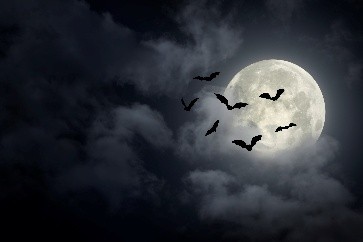
Six days before the ultimate one in October. The day of the Hunter’s Moon. As the nights lengthen, the orange lights on my creeper-vine decorations ignite at twilight, with the lawn ghosts following soon after.
What I said almost a year ago holds true now:
Oak, maple, birch, and other myriad leaves turned bright yellow, red, and orange—from the far north hills to the Connecticut coastline. The leaves of the giant oak near my deck turned kaleidoscope, seemingly overnight. Now, these colored leaves crinkle and fall in the rising autumn breezes, as my wind chime gently weeps.
Welcome, Poets, to another eerie edition of Haibun Monday, where we write in that hybrid form of poetic prose and haiku. Frank Tassone, here, your host for a choice edition: let’s commemorate either the Hunter’s Moon or Halloween!
Concerning October’s famous holiday, as I said last year:
The veil between the physical and Spiritual realm thins during this time of year. Or so the ancient Celts believed: that prolific people, who once populated Europe from Ireland to modern Turkey, celebrated Samhain, their harvest and new year celebration. Confident that the spirits of the dead would return to visit the living, they prepared feasts for them. & lest the more malicious trouble them, many living Celts took to disguising themselves as spirits themselves.
Thus, trick-or-treating and costume-wearing evolved.
The early Western Christians also found this time of year to be one for reflecting on the dead. Halloween derives from All Hallows Eve, the vigil celebration of All Hallows Day, now known as All Saint’s Day. Together with the day after, All Souls’ Day, and this trinity of days has sometimes been known as the Christian Days of the Dead.
As for the Hunter’s moon:
Traditionally, people in the Northern Hemisphere spent October preparing for the coming winter by hunting, slaughtering, and preserving meats, giving this Full Moon its Anglo-Saxon name Hunter’s Moon. The name was added to the Farmer’s Almanac in North America and is used widely today.
Native Americans named this Full Moon after things that happen in the fall, including Drying Rice Moon, Falling Leaves Moon, and Freezing Moon. The Celts used Seed Fall Moon in the same way.
The names Pagan Blood Moon or Sanguine Moon have also been used for this Full Moon. However, these names should not be confused with a Blood Moon—another name for a total lunar eclipse.
Some poets have found their own Halloween inspiration—as I observed last year:
Untitled
Martin Gottliev CohenThe night air is wet and still. The scent of pine trees settles in the leaves near the cabin. My mother takes us children to visit my aunt on Halloween. We enter the darkened room, and on the table is a hollowed-out pumpkin with a lit candle in it. Tobacco smoke passes over the pumpkin’s cut-off top and the smoke’s shape changes as it rises to the ceiling beams. Light comes out of holes carved for eyes and a big grin from the dark pumpkin. The scene reminds me of a room lit by a prayer candle, a glass half-full of wax with a lit wick that projects its flickering light on the walls. My father had sat on a small wood bench fasting and praying for his father who had died during the night. I walk across the room and see a picture of my father as a child.
Jack O’Lantern
shadows pass through
each otherCourtesy of Contemporary Haibun Online 2:1
Halloween Haiku (21 of 25) by Srinivas S
ghost town
the sky dressed in clouds
for the costume partyCourtesy of Haikuniverse 10-31-21
Others find their inspiration in the Full Moon in general—and the Hunter’s Moon, in particular:
Hunter’s Moon
Ray Rasmussen
Minus 10 degrees, a night walk on Whitemud Creek, the spruce trees outlined against a deep purple sky.
I stop, begin tai chi, mirroring the twisting branches. As I move through ‘wave hands as clouds’, Orion is framed in my arms. A gibbous moon casts long shadows on the snow, then drops below the bank.
I start toward home in the darkness, feel a compelling need to look back, the hair on my neck rising. There, near the other bank, a shadow form, wolf-shape, not moving.
I freeze. Wait.
Fingers of cold slip in.
Wait.
Suddenly the shadow stirs, melts into the forest. A ‘yip’ tells me it’s a coyote.
I run through my memories for accounts of coyotes attacking humans, find none.
Still, I walk backwards for a short distance, then turn, hurry home, looking over my shoulder, again, and again.
owl’s call –
boots squeak on
dry snowCourtesy of Contemporary Haibun Online, March 2006, 2:1
Whether it’s the light of October’s Full Moon, or the fright of Halloween, let’s testify! Write a haibun that alludes to either the Hunter’s Moon or Halloween.
New to haibun? The form consists of one to a few paragraphs of prose—usually written in the present tense—that evoke an experience and are often non-fictional/autobiographical. They may be preceded or followed by one or more haiku—nature-based, using a seasonal image—that complement without directly repeating what the prose stated.
New to dVerse? Here is what you do:
- Write a haibun that references the Hunter’s Moon or Halloween.
- Post it on your personal site/blog.
- Include a link back to dVerse in your post.
- Copy your link onto the Mr. Linky.
- Remember to click the small checkbox about data protection.
- Read and comment on some of your fellow poets’ work.
- Like and leave a comment below if you choose to do so.
- Have fun!


Good afternoon, poets!
The pub is open!
Pingback: Piles – Björn Rudbergs writings
Hello, it feels strange when the prompt go up so early. We just left daylight savings time, and we have really long dark evenings.
🎃🧡
Great prompt…only a bloody Mary will do, with the blood of something scary…