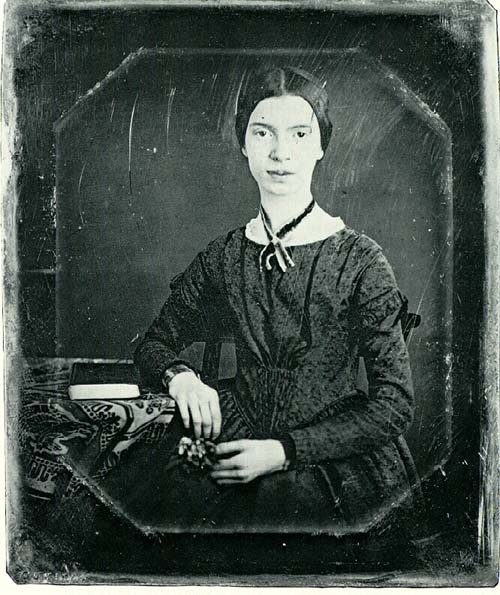
A daguerreotype of Emily Dickinson, taken at Mount Holyoke Seminary.
We’re really land-hopping here at the pub – just when folks were getting used to the snowy landscapes of Russia, now we’re going to go and yank you all across the glittering Pacific to the U.S.A. But while last week’s festivities took us to a poet forcibly mired in the horrors of a literary winter, this week’s journey takes us to a poet renowned for her solitude.
Emily Dickinson was something of an anomaly, in all senses of the term. Though she wrote nearly 1800 – yes, 1800 – poems over the course of her lifetime, fewer than a dozen saw publication before her death, and these significantly altered versions of her work could scarcely be called hers by the time the publishers’ ink dried. But of course, Dickinson liked it that way. The obscurity – probably not the manipulation of her craft. Though there is often great yearning within her words, she was an introvert – the majority of her relationships being carried out by correspondence alone.
And yet, one can scarcely think of American poetry today without drifting to the topic of the recluse wonder. Today, she is considered one of the great American poets, her work – much of it only after her death discovered by her sister! – considered a treasure trove of language, thought, and style.
Though difficult to settle on but one of her pieces for the show tonight, in the end I bring to you “Because I could not stop for Death” – a fine sampling of her skills, and her tendencies, as readers of Dickinson will quickly find the themes of death and time cornerstones of much of her work…
Because I could not stop for Death
Because I could not stop for Death –
He kindly stopped for me –
The Carriage held but just Ourselves –
And Immortality.
We slowly drove – He knew no haste
And I had put away
My labor and my leisure too,
For His Civility –
We passed the School, where Children strove
At Recess – in the Ring –
We passed the Fields of Gazing Grain –
We passed the Setting Sun –
Or rather – He passed us –
The Dews drew quivering and chill –
For only Gossamer, my Gown –
My Tippet – only Tulle –
We paused before a House that seemed
A Swelling of the Ground –
The Roof was scarcely visible –
The Cornice – in the Ground –
Since then – ’tis Centuries – and yet
Feels shorter than the Day
I first surmised the Horses’ Heads
Were toward Eternity –
~Emily Dickinson
 dVerse
Thanks for sharing this, Chris. Emily Dickinson is one of my favorite poets!
I’m so glad you posted this, Chris. As often as I’ve read her, somehow I never noticed her use of upper case in the body of her poem. (That may have been discussed when I studied it in school but that’s so long ago and I just was that “into it” way back then…) I tend to think she was a bit agoraphobic…or close to it. Do you have a biography of her you would recommend?
Should read “wasn’t” that into it.
A biography…hm, I’ll have to get back to you on that one. The bookshelves possess a great deal of her poetry, but I must confess they’re sorely lacking of in regards to her life’s chronicles.
Chris…a fantastic offering for our poetic pallets! I am one who desires solitude, and much prefer the company of my online friends…but it comes and goes! You’ve picked one of my favorites…mind you I’m a reader and not a student, so all I can really offer is how much pleasure I get from reading her work.
I’m the same way… I prefer my online friends and solitude.
When solitude is one’s inclination, it makes it hard to flow adequately through the waters of family, bathing spouse and children in the poet’s presence and attention.
Fortunately – that’s all one can ask, Natasha. Glad you enjoyed this week’s spotlight!
I love Dickinson. She always brings such inspiration in writing. Thank you for sharing :-]
Lovely to see it as she wrote it. Those dashes which editors altered are perfectly placed, if you read it aloud using them as pauses
As so many of us labor on unpublished, but busy creating anyway, it is refreshing to be reminded that in Emily’s case. notoriety was not her main impetus; the work was. With all the cyber outlets available today to the modern poet, web sites, blogs, Facebook, Twitter, Chapbooks, we manage to put our work out there regardless. And as poet Bobby Byrd said, “It is a good time to be a poet, but the pay is still shitty.” We can’t all be Billy Collins, right?
Billy Collins, the anomaly, and such a good anomaly he is.
Thank Deus for Anomalies!
Tragically, I think the pay will always be shitty…but hey, we manage.
Great post: you’ve given me the shove to read more Dickinson. Thank you.
Yes, to answer Glenn, the work’s the thing. Maybe if she had been feted and widely published, the work might have taken a different direction, and been devalued as a result.
Thanks for this Chris.
A truly excellent choice of poem from my very favorite poet and mentor, Emily.
I must confess…she’s one of those that grew on me with time. I actually wasn’t her biggest fan in younger days. Yet as far as mentors go – she’s certainly a wild breath of creativity.
this is a lovely choice chris…a poem that i find quite stirring…and emily has a story i think many can relate to as well…
My favorite (always) E.D. poem. Has been since Jr. High. She’s a major influence in my poetry. Strange woman; great poet.
Oh, we’re all a little strange…quirky, even. I hope it’s part of the appeal!
The stranger, the more artistic, don’t you think? Hopefully, anyway. 🙂 I find such an embrace here, as we all grow into an acceptance of and appreciation for our own personal and collective strangeness, feeling less estranged from the circle of unified poetry day by day, word by word.
Agree Shawna..Thanks and to you Chris for bringing us such fine work each week!
Love Emily Dickinson. Thank you for this.
Thank you Chris, a posting well done.
Thanks, Chris. She’s so great–so precise and yet kind of zany/particular. I love the poem you posted. Also “I felt a funeral in my brain,” and the one about “a certain slant of light winter afternoons.” Thanks for bringing her back to mind. K.
I’m now deep into Dickinson, with flies buzzing on a freckled pane and anguish anguish (God) and anguish. Wow.
“Though she wrote nearly 1800 – yes, 1800 – poems over the course of her lifetime, fewer than a dozen saw publication before her death” … Wow! I didn’t realize.
“the recluse wonder” … I like that. 🙂
From the poem, these are my favorite lines:
“And I had put away
My labor and my leisure too,
For His Civility”
One of her easier ones to follow–sometimes she loses me and in so few words! Then I sit and stare at them until I go cross-eyed–and when the penny drops it all seems so obvious. Sign of a great poet I think. Excellent choice, as always, Chris. (And I’m late to the party again, as always. )