Tags
Blaise Pascal, Fibonacci, FormForAll, Mathematical Series, poetry prompt, Tony Maude, Triangular Numbers
Good morning/afternoon/evening poets. My name is Tony Maude and it is my pleasure to once again welcome you to Form for All.
By now I expect that you’ll have noticed the word Mathematical in the title of this post and some of you will likely have broken out in a cold sweat. Fear not, brave poets. While there will be some Math(s) in the post, to rise to today’s poetry challenge you really don’t need to know any Math(s) at all … smiles.
The idea of using a mathematical series as the basis for poetry forms seems to be a fairly recent development. The way the idea works is simple; you take a mathematical series and use each successive number in the series to determine the length of each successive line in your poem, usually counting either syllables or words. The most popularly used series is the Fibonacci series – we’ll come to that later – but there are others that could also be used.
One, two, buckle my shoe …
The simplest mathematical series is the first one that each of us learned, usually quite early in our childhood, when we learned to count. That’s right – the sequence 1, 2, 3, 4, 5, 6 etc is a mathematical series, with each member of the series being greater than its predecessor by 1. This series can, of course, be used as the basis for a poetry form with each line being one syllable or word longer than the one before it … see, I told you that you didn’t need to know any Math(s) … smiles.
We might not be mathematicians, but we are poets, aren’t we? Of course we are, and that means that we are interested in things like rhyme, rhythm and meter. Last week, Gay reminded us about metrical feet … iambs, trochees, anapests, dactyls etc … and it seems to me that, rather than simply counting words and/or syllables, we might try to write our lines with the appropriate number of metrical feet instead. (Having laid that challenge out, I now feel honour-bound to try it myself … gulps.)
The Fibonacci Series
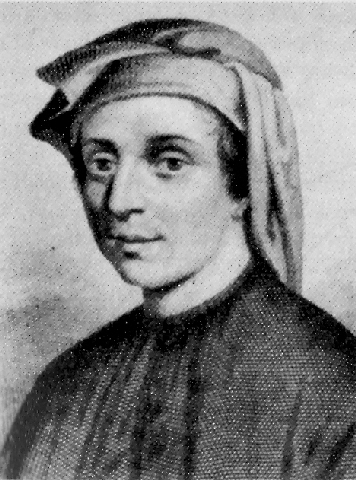 Leonardo Pisano Bigollo (c. 1170 – c. 1250) aka Fibonacci
Image via Wikimedia Commons
In mathematics the Fibonacci series are the numbers in the following integer sequence: 0, 1, 1, 2, 3, 5, 8, 13, 21 etc. Each number in the sequence is the sum of the 2 numbers that precede it (2 = 1 + 1; 3 = 2 + 1). Apparently Fibonacci came up with his sequence while thinking about breeding rabbits – as you do – but it is found throughout nature. (More information about the prevalence of the Fibonacci series in nature, as well as the Golden Number and the Golden Section that are derived from the Fibonacci series can be found here.)
For our purposes we can ignore the first term in the series – a line containing 0 words isn’t going to be all that interesting … smiles – so the first two lines of a Fibonacci poem contain 1 syllable or word, the third line has 2 words/syllables, then 3, 5, 8, 13 … and most people stop there, especially if they are counting words. As with the counting sequence above, it seems to me that, as poets, we might want to count metrical feet, rather than words or syllables, when we write our own poems based on this series.
Pascal’s Triangle, Triangular Numbers and The Powers of 2

Blaise Pascal (19 June 1623 – 19 August 1662)
French mathematician, inventor, physicist and philosopher, Blaise Pascal was a truly remarkable man who achieved more in his 39 years of life than most of us can even dream about. Some of us will know his name because Pascals are the official IUPAC unit of pressure.
More of us will know about Pascal’s Wager – if a man gambles that God exists and lives his life accordingly, only to find that there is no God, then he has lost nothing. Conversely, if he gambles that there is no God, lives accordingly and then finds that God does exist, he has lost everything.
I doubt that few, if any, of us have not come across Pascal’s Triangle at some point in our lives. For those who have forgotten it, here it is in part:
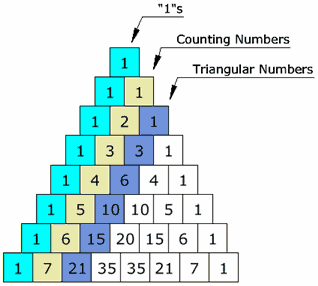
Pascal’s Triangle
Image via Maths is Fun
I’d like to draw your attention to the dark blue line of numbers, labelled Triangular Numbers in the picture above, because it seems to me that this series could also form the basis for a poetry form with 1, 3, 6, 10, 15 etc words/syllables/metrical feet in successive lines. I’ve not yet come across any examples of poems written to this form; this is your chance to change that … smiles.
Finally … “At last,” you say … if you add up the numbers in each horizontal row of Pascal’s Triangle, you will find that the sum of each line is twice that of the line before. To save you the bother let me show you that:
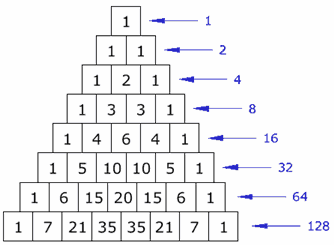
Image via Maths is Fun
The mathematicians amongst us will recognise the sequence 1, 2, 4, 8, 16, 32 etc as the powers of 2 – and the computer scientists should recognise it too … smiles. I believe that we could use this sequence to form the basis for a poetic form with 1, 2, 4, 8 etc syllables/words/metrical feet in successive lines. (I think 16 words or metrical feet in a line might be a stretch; 32 syllables might be too … smiles.) Again, I haven’t found any examples of this yet; maybe yours could be the first!
Conclusion
I hope I’ve managed to convince you that the various mathematical series presented here – the counting series, Fibonacci numbers, triangular numbers and power series – offer great potential as the basis for poetry forms; I’ll be really happy if I’ve managed to persuade you to try writing a poem using one of the series as the basis for its form.
As you write, don’t forget all the other tools in your poet’s toolbox: rhythm, end rhyme, internal rhyme, enjambment etc. Also, if you are writing by counting syllables, try to end each line with a strong word (a noun or a verb, perhaps an adjective, but not definite or indefinite articles, conjunctions etc). It’s probably better not to divide words across lines to meet the syllable count either – unless it’s done for deliberate effect.
You might want to try writing a multiple stanza poem using your chosen series, or perhaps you could write the second (fourth, sixth … is that a bit too ambitious?) stanza as a mirror of the first (third, fifth …) by working backwards through the series of numbers you are using. Or maybe you could …
there are almost limitless possibilities.
So What Now?
• Write your poem and post it to your blog. You might want to include a note to let readers know which mathematical series you’ve used – and to point people to the dVerse Poets’ Pub … smiles.
• Add a link to your poem via the ‘Mr Linky’ below.
• This opens a new screen where you’ll enter your information, and where you also choose links to read. Once you have pasted your poem’s blog URL and entered your name, click Submit. Don’t worry if you don’t see your name right away.
• Read and comment on other people’s work to let them know it’s being read.
• Share your work and that of your fellow poets via your favourite social media platforms.
• Above all – have fun!
PS: You can write and link more than one poem if you wish. It’s only on Open Link Night that we insist on 1 link per person.
 dVerse
ha – mathematical poetry – gives me shivers… smiles…. but i tried…went for the Fibonacci… i just want to mention – i have a first line with 0 words… believe it or not…smiles… happy thursday everyone – cool prompt tony and looking forward to what you all come up with – i have my calculator next to me…smiles
Really enjoyed your poem, Claudia. You can put the calculator away, I’ve done all the sums for you … smiles
thank you…smiles
Happy Thursday everyone … smiles
ok, while i am teaching math this year i took the easy route with this one…counting words is so much easier…haha….
Counting words is definitely the easier option. Of course, while antidisestablishmentarianism is long, if you were really wanting to have fun with a single word, you could have gone with pneumonoultramicroscopicsilicovolcanoconiosis … although it’s not a very nice word, seeing as it’s a lung disease.
oh dang…your words longer than mine…ha….
45 letters….wow… think that’s the longest word i ever read in my life..
Oh Claudia, that can’t be true. You Germans have some delightfully long words … smiles
ha – that’s true…. the longest german word should be Rindfleischetikettierungsüberwachungsaufgabenübertragungsgesetz
which means… beeflabelingmonitoringtasktransferlaw… ha…smiles
wow, those are really long words : – 0
Have you seen Henning Wehn telling us how to pronounce it and what it means? It’s here http://www.bbc.co.uk/languages/german/comedy/long_words.shtml for anyone who is interested.
alright…soon as i get home i am on it….cant do video from school…
haha…so good….think we’re kinda crazy with putting words together…smiles
There was me thinking that Pfeffermintpastillenschachtel was the longest word I would ever come across, but that seems kids’ stuff now.
You know Math is not my thing, but I still love your prompt, Tony… thanks! Maybe I can get my mathematical genius into poetry.
hey that would be cool….
Thanks Laurie. It’s not really about the Maths though, it’s about looking in different places to find patterns for (new) poetry forms.
Well, Tony, you don’t pull any punches, do you?
I’m reeling.
I am giving you the basics and will now start thinking about doing it in stresses, or is it feet?
I had a go at feet, but my iambs and trochees got a bit mixed up, so I ended up with stresses … smiles
Happy Thursday to you, Tony. I enjoyed your prompt. I do like having a reason to write a fibonacci poem now and then!
Before preparing for today, I’d only written one Fibonacci poem – now I have three … smiles
I am doing math all day at work Tony so I took the easier route ~ I must admit the form stifled my creativity so maybe I should try again, smiles ~
I will be returning visits once I get home ~ I am having a hard time commenting with my laptop (specially blogger) ~ Happy day everyone ~
It’s interesting that you found the form restrictive, Grace; for me part of the fun is trying to say what I want within the strictures of the form. Maybe I just like puzzles too much … smiles
Strangely enough, I was busy counting syllables for a poem I was working on today – although maybe not quite in the way you envisaged. I was also trying to make it rhyme, which is too much for my poor head (goes to lie down in darkened room with wet flannel on her forehead). I may post the sorry result tomorrow morning, but it’s certainly not good to go tonight!
For my second one today, I seem to have managed to include some internal and end rhymes, but I wasn’t really concentrating on that at all … smiles. I’ll look out for your poem when you post it, Marina.
post it! i want to see it….smiles.
Your wish is my command … smiles
Tony, awesome challenge — I love math!
Some people love Maths, others hate it. Me, I loved it … right up to the time that my brain could take no more … smiles
Tony, Thanks for the lesson. I wrote a short, simple one, but I might be back to write another later tonight. 🙂 Peace, Linda
Short and simple suits me, Linda … smiles. Peace to you too.
Tony you said Math and I shuddered. Then I remembered I LIKE to do shape poetry, and that means math! ha ha
Working on something for this…hoping it adds up to a success 😉
looking forward to it shanyn….
and again, great job last saturday
Thank you very much. I had a grand time behind the bar! 🙂
Like I said, you really don’t need to know any maths – it’s the patterns that we’re interested in … smiles
I hope you like my patterns, they are there, some more subtle than others!
looking forward to read what you come up with shanyn… and i echo bri… great job last saturday
Thanks Claudia! I took this to a fun place, hope Tony doesn’t mind! 🙂 And I had a great time tending bar. Looking forward to coming back for another shot!
Argh…WordPress is busy eating my line breaks! Will try to get them to stick, if not will have to try something else!
Hey Tony. Great article. Love the detail involved. I was married to an engineer. Wish he would return from the other side to help me think about this. While life has settled a little for me, I’m always busier than I anticipate being the only one to keep things going in a much larger place; so, the poem I hoped to have ready for today is still germinating. HOPEFULLY I will be able to compose it by day’s end even roughly in draft form.
Thank you for linking to my article. I will try to write mine in metrical feet but likely without rhyme – I’m not sure I’m up for that much mental gymnastics. Really like all of these ideas and think we can all return to them regularly. After my last poem, I probably should try to make order out of chaos (smiles). See you guys later! Have a round on me.
Trying to get everything in is probably a bit of a stretch. I have linked to a Fibonacci poem written with the appropriate number of stresses in each line. While there is some rhyme in it, I think I tripped over my feet a few times … smiles
can’t wait to read your poem gay…
looking forward to it gay….let it germinate…when its ready let it go…smiles.
Oh….used to hate maths, but love poems so much…so had to try it out. Not sure how it tuned out 😮 ..would love feedbacks 😀
you know what i just realized…you shape mirrored the plane ride too…
I must say I’m a math guy and love what you can do with it. Symmetry etc makes this so much fun. I’m still traveling but will do my tour commenting.
smiles…symmetry freaks me out… wishing you safe travels björn
You took a very creative turn with this, Björn. Safe travels.
so are you still in the states bjorn…
OK folks, it’s time for your Scottish host to hit the sack. I’ll be back out on the trail tomorrow – and I’m really looking forward to reading your work … smiles
sleep well man…
Thanks for this inspirational prompt Tony. Oh I so love maths – although much of the more complex stuff has disappeared from my memory banks as I age…
Anna :o]
Yours was wonderful!
I remember one of my maths teachers having the following on a poster on his classroom wall:
Education is what you have left when the facts are all gone.
I know exactly what that means now … smiles
I did a small triangle but then made it a palindrome. Am so impressed with myself. lol Thanks for this challenge and for Bjorn’s palindrome reminder and inspiration. But he did the F word one.
It turned out great! I did numbers but stayed away from my usual shapes 🙂 A deviant from start to finish I am! LOL
you both did very well….
I think you are right 😉 we did!
alright eyes crossing…bed….
so you in the morning….
ha
Sleep well, boss.
Hi Tony, you have me running scared 🙂 maths was/is not my strong suit, even trying to work our the calculations is making my head spin..will I attempt…heaven only knows – but very interesting indeed.
Don’t focus on the maths, think about the patterns … that’s what I did and it seems to have turned out OK … smiles
trying to do one now – could well be a disaster 🙂
Just back from your place, and I didn’t see a disaster at all … smiles
Appreciated Tony. *smiles back*
Tony, goodmorning. I was too tired last night to follow the links you gave us, but now, bright and early, I had a read: fascinating. You must have had fun researching.
Thank you for bringing numbers and maths into our poetrywith such enthusiasm.
Most of this stuff was lurking in a forgotten recess in my memory … but it was fun to remind myself of things I used to know.
Guess what I did in university – Computer Math! In our family we love mathematics, something we inherited from my Mum. In fact my daughter Inas shares this quote all the time
Love math, and math will love you back.
So, I might be late to the linky, yet again, Tony but I will give this a try.
Hhmmmm, what are those words and sentences that read the same backwards? Are those mathematically inclined too?
Those would be palindromes, Ninot.
Looking forward to what you come up with
Wow …Wonderful prompt! Inspirational. Thank you Tony. I am sick in bed with flu and high temperature…perfect conditions conducive to surreal mathematical poetry! Here I go ..nothing will stop me..Woohoo:)
Hope the flu leaves soon and you return to normal. Meanwhile, have at it with the surrealness … smiles
so, drinking poets doing math. fiend you are, I must say. Nice one, Tony. : )
I think that’s a compliment?
Of course it is! Fun prompt and reading all the posts.
OK – coffee made, I’m back out on the trail …
coffeee……..
black, please…haha
good morning.
I’m afraid it was hard enough getting the syllable count right, and trying not to be banal in the expression of the sentiments — I didn’t even try for rhyme or metre. I went for Pascale’s Triangle, as I have written Fibonacci already.
I found your poem moving; it made me think of people I loved who are no longer alive.
I’m thrown off kilter when Math is flung my way, which–despite its rich vocabulary–overthrows all language by the use of numbers and signs. But once, long ago, I longed to ride its waves across the universe. This ceased in high school when a teacher tangled me in trigonometry. I entered your prompt through the outskirts of math and art.
That works … sneak up on it and trry to convince it to change its identity … smiles
BTW, I merely counted words, trying to make them count.
nice….
ok…made my round..now too tired to keep my eyes open for one more minute…smiles… good night…
I made it back with another one – this one’s kind of silly, but fun. Hope everyone has a great weekend! Peace, Linda
There’s poetry everywhere – even in traffic jams.
just getting back in and had a bit of catching up to do…we had a football game tonight….
…i try… thanks Tony… smiles…
You gave us an excellent example to close out the Linky. Thank you
Time to clear up around here – you know, mop down the bar, refresh the sawdust on the floor etc and get the keys delivered to Mary – it’ll have to be Express Mail to get them there on time.
here is a late one i found this morning from mlm…
Thank you Brian I did realize you had done this but I was getting responses and I thought everyone had just become psychic lol
I missed Mr Linky because I was travelling for 30 hours but will post here.
http://roslynrosssmallstones.blogspot.com.au/2013/08/numbers.html
link expired, here is my response:http://clementsgeoff.com/2013/08/19/poetical-form-fibronacci-series/