Tags
Hello everyone and happy Saturday.
Today I want us to consider fables. I think we have all read fables as kids and maybe later too, and are aware of the characters and perhaps an odd idiom every now and then. Consider the sly fox or the proud lion, or maybe idioms like “sour grapes”.
So what is really a fable? First of all objects and animals are given human qualities, they are anthropomorphized, and secondly the fable should teach us a moral lesson. Sometimes the moral is summarized at the end in a pithy maxim. To me it brings some of the elements of a haibun. An author of fables is called a fabulist.
The most well-known fabulist is probably Aesop, whose existence is somewhat clouded in myths. According to legends he was a slave in ancient Greece, and he is mentioned in many different sources, so I prefer to assume that he once lived. The fables are available throughout the internet, so there should be no problem in finding them.
Consider this one for instance
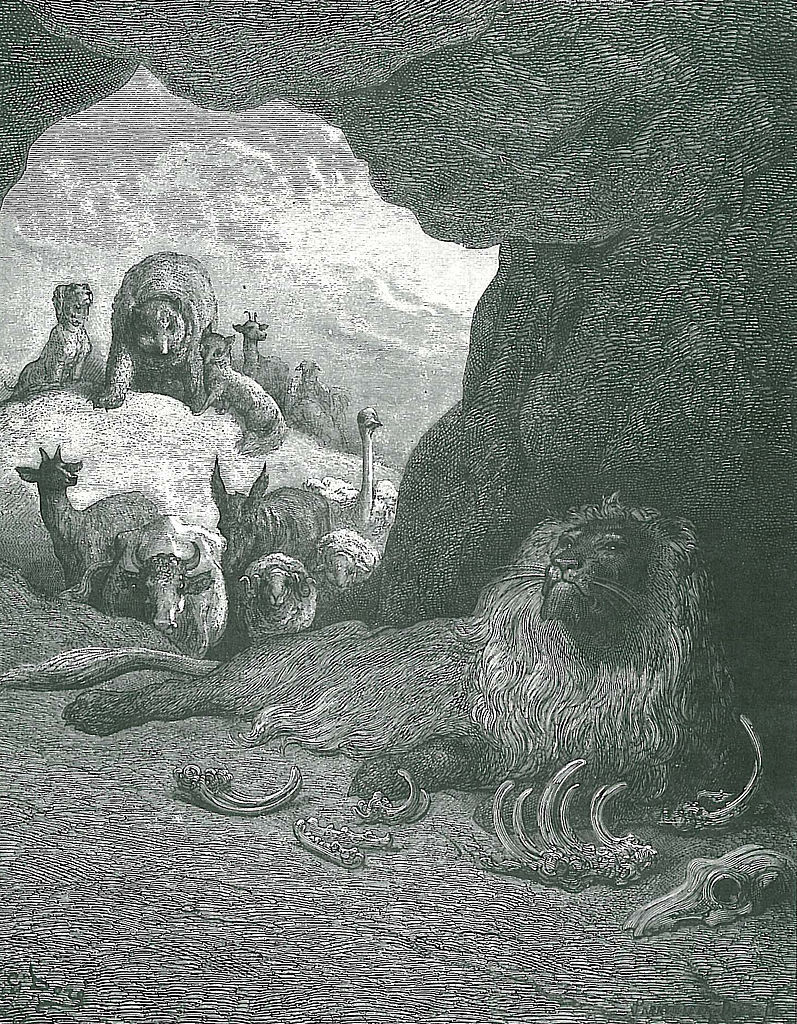
The Sick Lion
A LION, unable from old age and infirmities to provide himself with food by force, resolved to do so by artifice. He returned to his den, and lying down there, pretended to be sick, taking care that his sickness should be publicly known. The beasts expressed their sorrow, and came one by one to his den, where the Lion devoured them. After many of the beasts had thus disappeared, the Fox discovered the trick and presenting himself to the Lion, stood on the outside of the cave, at a respectful distance, and asked him how he was. “I am very middling,” replied the Lion, “but why do you stand without? Pray enter within to talk with me.” “No, thank you,” said the Fox. “I notice that there are many prints of feet entering your cave, but I see no trace of any returning.”
He is wise who is warned by the misfortunes of others.
Indeed, that’s a wise choice, and I’m sure that could be an inspiration for a fable.
The world is full of other well other known fabulists, we have La Fontaine, Hans-Christian Andersen, and Vishnu Sharma. Not to mention all the forgotten fabulists that created stories now only existing as oral traditions. I’m sure that you have a favorite on your personal list.
So for today’s challenge I would like you to either
- take an existing fable and create a poem out of it, maybe moving the anthropomorphism back to real humans.
- or, tell your own fable in the form of your preference. I think a world of foxes, lions and scorpions still exists, and can be used to create a poem.
- or simply rewrite you fable of choice in poetic words, many of the fables were actually poems to start with so you are in great company with the original fabulist.
- Write a poem and post it to your webpage.
- Enter a link directly to your poem and your name by clicking Mr Linky below
- There you will find links to other poets, and more will join
- Read and comment on other poet’s work, we all go here to have our poems read
- Promote your site and poetry you like on social media of your choice
- Promote your site and poetry you like on social media of your choice
And if you use a fable and not just the characters, please include a reference to that fable. I would love to learn how your world of fables look like.
 dVerse
Hello everyone — happy saturday.. today we had clear blue skies and a feeling of spring… we were out walking by the sea for hours. This challenge was much more difficult than I had anticipated.. managed to get something together finally.
Blue skies today here too but so cold and colder next week ~
Fabulous title, I like, smiles ~
Hi Björn
The browser ate a couple of my attempts at commenting already.
This is the first time I’ve had a go with dverse so it’s taken me a little while to work it all out.
Will just say thanks for fabulous prompt.
:))
Poesie
sorry,
first time you comment you go into the folder until approved
you should be good to go now.
cool response.
can’t comment per se on tumblr
but sent you a message through the ‘submit’ button
Poesie – really enjoyed your response –
Sorry, but I don’t have a tumblr account –
Happy Saturday to you, Bjorn. What an excellent theme for today’s Poetics! We hav clear weather at the moment, but this week we are again going to be influenced by the Polar Vortex and go DEEP into freeze mode. Wouldn’t be walking anywhere for hours outside where I live. LOL. Looking forward to seeing what everyone comes up with.
Me too.. this is maybe not the easiest prompt we have had 🙂
No, it was not easy…but it was interesting and a challenge. No harm in that! Smiles.
they were originally saying we were going to get another dip into the polar vortex but our weather people were backing off of it yesterday…will have to check again and see….
I fine prompt, sir, a terrific challenge, soaking us in anthropomorphic mist, guiding us to new flights of imagination. It felt hard at first, wanting to create my own fable, but once I got started, the tale took on life & energy, & helped write itself.
Loved your take.. it had all a real fable needs… a little bit more Hans-Christian Andersen than Aesop I think… 🙂
fantastic response glenn…you did make your own..and while grisly…it carries a poignant message….
My poem is the mythical side of fabulous fabulism: part 2 of the poem you liked last week. Succinct, as required, but no pity maxim yet, until part 4 next week at the earliest 🙂
Thanks for the prompt, and for the word ‘fabulist’.
I love your story developing… can’t wait for more.
cool tat you are going to continue to develop this…did not see this before i read and commented…so you already are granting my wish for more…
that should read “pithy”. Wish WordPress had a ‘preview’ option.
A pity indeed 🙂
Hey Bjorn! I am trying to get my novel things together today (and dealing with a touch of food poisoning–agh) so will probably not get something up for this prompt, but it is very clever, and rich. Glad you have blue skies–us too! k.
Karin, keep it in mind for later… I will probably try to reuse it.. I just spotted the possibility to write haibun fables — maybe with a haiku-maxim at the end…
Ah–very cool! K .
Great idea Bjorn – I love it and will take some time to write one for sure.
I am glad that you mention Vishnu Sharma here. When I was a boy, I found his book at home and started reading. No one had referred the book to me and it was great learning. Sadly I don’t remember any of the stories now.
Ah.. I would love to see it related… check out https://archive.org/details/panchatantraaco01hertgoog … would be wonderful to have reference to a hindu fable… I think I have read a few..
Wow, many thanks for this Bjorn 🙂 .
nice…look forward to seeing what you bring abhra
and will check out that link of bjorns so i can be familiar….
I did some reading of the book but to write something based on it would take more reading – for the prompt I wrote one from what I remembered 🙂
Hi Bjorn ~ A very challenging prompt but it got me reading Aesop fables again ~
I’m hitting the trail now ~ Wishing you all Happy Saturday ~
Happy Saturday back.. yes it was more challenging than I thought… a few years ago we brought Aesops fables when we were out camping and read aloud before going to sleep… so hope Abra will do some Hindu fables..
spent a bit of time reading fables last night as well
i remembered reading many to my boys
and remembered many that were read
to me a child as i was going through them…
Well its based on a fable…and…ahem…it’s a prose poem. Yes a prose poem.
Ha.. I just read it.. what a great idea. And the moral is ?… better chill and leach than work and preach 🙂
Hmm..just a coincidence..but i think..what i wrote as a kind of 24th anniversary present to my wife ..might fit sorta..under the category of fable..
My own interpretation..of another fable perhaps..might better describe..but YNOT..i linked and will be back later to read some poetry and comment..as OH HOW I DO LOVE..MYTHOLOGY ..OF ALL type.s.:)and an original..take..is always the best…
Ha. yes.. we are fans of the fables and stories.. I got the idea while referring to Peter and the Wolf
happy anniversary man…cool that you wrote for her…i hope you have a wonderful evening together….
Thanks Brian!
yep. did you do anything special?
I think this was a quite difficult prompt.. But now it’s almost time for me to head to bed. I will be back tomorrow and check out your poetry.
Sleep well Bjorn & see you tomorrow ~
heya bjorn,
missed you already…smiles…sorry i am so late…had a last second opportunity to do something special for my son and flew out the door around lunchtime and just getting home…
i was given courtside seats to the UVA – Notre Dame basketball game…we had a great time…ready to settle in and read some poetry.
thanks for a great prompt b…and to those that came by in my absence…
No problem.. I think many a poet are trying to come up with something… Took me quite some time myself.
I love this, especially since I grew with Hans-Christian Andersen as many Scandinavians do. I think I’ll write my OMN poem using this prompt. I don’t think that’s illegal. After all, I didn’t get in trouble for doing Claudia’s sketchbook form two weeks ago…
Detta är ett väldigt fint förslag att leka med…
Tina @ Life is Good
haha.. smiles… not illegal at all… looking forward to read what you come up with tina
not at all…that is why it is there…and we have several each week that do…
Hej, hoppas du kommer upp med nått bra.
We look forward to what you come up with
good evening….. sorry i’m way late… just coming back from a birthday party…. a fantastic prompt björn…. loving fables and had fun writing mine… i will catch up tomorrow morning with you as it’s almost 1am over here and i’m way too tired to start reading…oy… was a cool evening…met a lot of friends i haven’t seen in a bit… see you tomorrow morning… smiles
get some rest c….glad you had a good time this eve….
Hello, glad you have a good time 😉
it is interesting the different spins on the grasshopper and ant fable tonight…there is at least 3…and maybe 4 out there…each a bit different perspective…
might be a cool idea to all take a similar story sometime and try different spins on the same story…that would be very interesting…
It seems to be the favorite fable, smiles ~
yes it does…and is even the basis of ‘A Bug’s life’…ha.
There are so many fables out there… A great idea, a prompt that’s a story… 😉
Hola Bjorn, fun prompt. Have a great weekend ~
Hello, fun and challenging 😉
good night.
Good nigh Brian… Here it’s morning .. Time to go through the night’s harvest.
Good night, Brian. Was out of town all day but had to join in anyway…it’s 12:30AM! Need to get to bed myself… Loved fables as a young girl…
Hi, look forward to your reading you entry. 😉
smiles… rest well… just about to start my reading round… good morning..
Good morning Claudia, I just did the rounds.. 🙂 happy reading…
good morrow gayle….smiles…
and bjorn
and claudia…
Good morrow, Brian…smiles.
kustrim,
left a message at your place, there was not a post addressing the prompt, or any written less than 3 days ago. if you write to the prompt, feel free to link back in with a direct URL.
What can the sunday have brought us… I have been out all day… congrats to all my Canadian friends for the Hockey gold… lets get back to the real news…
Yoohooo ~ Smiles ~ Happy golden Sunday to all ~
smiles… yes…congrats… good job…
was out all day as well – beautiful sunny day over here… now catching up and watching the olympics farewell party
Bjorn I am working on a fable for you. Not sure how to herd my thoughts together nbut I am working on it. And yes I did get up to watch the Olympic hockey game. Did you?
I didn’t actually.. and I guess it was just as good.
It was well played by both teams.
Dear Brian,
Please, remove my link, I miss linked it.
Thank you and best regards,
Marlon O.
Absolutely.
smiles… a beautiful love poem…you should link it up on tuesday for oln
I think so too 🙂
Dear Bjorn, I don’t know how but something went wrong when I was posting my link and my previous post for dVerse, “The Raven’s Curse” got linked. Could you please help me out and remove that link? My actual submission is linked just after the wrong one, its called “Clytie’s Folly”.
Much thanks
Sam
dont worry…i caught it earlier and fixed it sam
your comment got caught in the filter as well…
happy sunday to you
Thank you Brian 🙂
Dear Bjorn,thank you so much for this fun and creative challenge-you were right,I enjoyed this very much:-) i hope I have been able to do justice to the challenge. Will come by later to read at least some of the submissions,thanks again 🙂
You did fine .. Loved your story
:-)Thanks a ton my friend
I gave it a shot. Probably not my strongest work, but I had fun with it!
nice….be over in a few barry….