My interest in erasure stems from my work as an artist. I am involved in work that deletes various texts, and am excited by the subtle play that erasure seems to create when executed in certain ways. My work is not about the suppression of text, or the negation of what the text represents, but is about obscuring the words in order to create a different relationship between the text and the viewer. – Richard Galpin, from ERASURE IN ART: Destruction, Deconstruction, and Palimpsest
Hello dVersians! Welcome back after the holidays break. This is Li(sa) and it is my pleasure to host Haibun Monday today. To celebrate the incrementally lengthening days as we begin 2025, please give your hostess (me) requests for drinks/eats from the fully stocked beverages cabinet and the magic cupboard.
While looking for something different but still within the parameters of haibun, I came across a form called, burning haibun, discussed here in, “Writing from the Ashes: On the Burning Haibun,” written by Torrin A. Greathouse:
The burning haibun is an alteration of the traditional haibun—a Japanese haikai form originally popularized by Matsuo Bashō in the seventeenth century [that is] composed of a prose poem and a haiku [senryu] that functions as a kind of capstone or postscript, either amplifying or complicating the prose portion’s contents but employing greater segmentation. I was originally drawn to this form by the duality of its nature, defined both by the expansiveness of the prose poem and the terse compression of the haiku [senryu], allowing me to marry my competing maximalist and minimalist aesthetic impulses.
Making two key interventions upon the haibun, the burning haibun integrates erasure to fundamentally alter the form’s structural potential. Rather than the poem’s haiku [senryu] existing exterior to the initial text, the haiku [senryu] is derived, through a series of erasures, from the initial text itself. The haiku [senryu] is a kind of hidden message, a moment of stark truth concealed beneath the lyricism of the initial text. The second intervention is that, unlike traditional haibun, which often exist as travelog[ue]s or meditations upon an external landscape, the burning haibun’s focus is upon the interior landscape of memory—an environment often rendered fragmentary by trauma.
Tonee Mae Moll describes burning haibun as a poetic form that “begins with a haibun that documents an interior journey, then undergoes two rounds of erasure until what remains is a haiku [senryu].” Tonee gives her example, with Burning Haibun as Portrait: 9 months on HRT, Georgia on MS Word. In another post, Torrin gives an alternate way to create one by using a favorite song’s lyrics to inspire prose and distill it down to the lyrics.
Googling for examples, I found many excellent choices, but because they are rather lengthy am not including them in this post. I would encourage you to google like I did to check them out. Here is one I wrote today:
Hold Tight
A struggle in 2024, a struggle since 1993, when I stopped smoking cigarettes and stopped starving myself. Letting go of a pack a day and fasting left a vacuum that filled with food. Hikes and bike rides, step aerobics and Lake Michigan body surfing, couldn’t – and can’t – keep up with calories.
Like coats of paint on an old house, layers of poundage coat this corpus. Weighed down, worn down, my moving parts are tested. Knees groan, ankles throb, orthopedics strain, teeth chew to dust.
Heaviness enshrouds like blanket of gray January. Martinet intellect screams, “It’s time to get this fat ass in gear!” Drowning chorus of a thousand voiced cruelties pounds me into dilemmic inertia; mindlessly chewing another slice.
Limbo suckles, dark, forever-hungry presence that season cannot transcend. Holding tight until spring, may it bless with burbling fount for silence in songs of returning birds.
struggle when letting go
vacuum filled layers worn
moving parts chew dust
enshrouded blanket screams
drowning cruelties slice
limbo suckles
holding tight may bless
for silence in songs
letting go, filled
worn parts enshroud cruelty
hold tight for silence
Now it has come to the place where I lay out your choices to inspire you today.  Please choose one (or more) of these options:

1:  Write a burning haibun based on an interior journey you’ve taken.
2:  Write a burning haibun using the lyrics from a favorite song to inspire you.

If you choose #1 or #2, please show all of the incarnations, from original prose, to first erasure (or bolding words, as done above) to the second erasure verse using the chosen bolded words, to the final haiku or senryu (aka personalized haiku)

If you’re not feeling adventurous, please choose #3:

3:  Write a haibun on any topic you choose.

Burning haibun is a brand new form for me and in the world of poetry in general.  Let’s try to have fun with it and do a little soul searching at the same time.

• Pen a burning haibun poem choosing one or more of the given options to guide you.
• Post your piece on your blog and link back to this post.
• Place the link to your actual post (not your blog url) on the Mister Linky page.
• Don’t forget to check the little box to accept use/privacy policy.
• Please visit other blogs and comment on their posts!
• Have fun (but only if you want to!)
PROMPT ENDS SATURDAY AT 3PM NYT
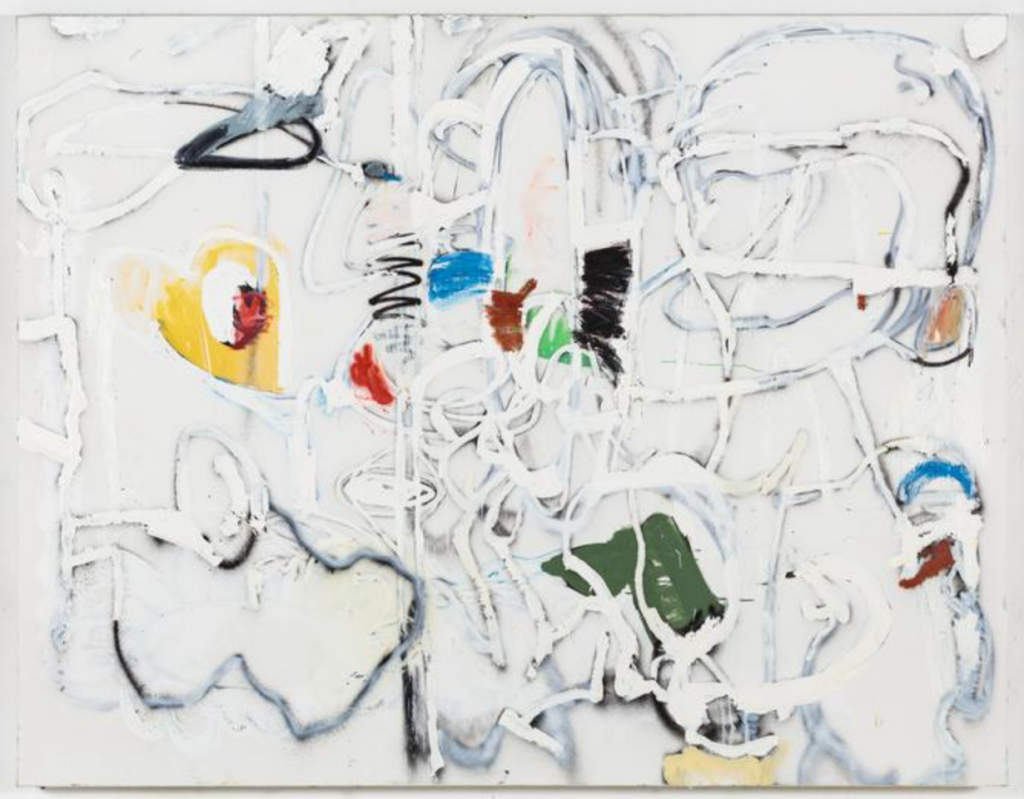
top image: One of Eddie Martinez’ White Outs
 dVerse
Welcome Back!
Thank you for the warm welcome to all our poets for 2025! Cheers!
Welcome, Grace. It’s my pleasure. Cheers ❤
Good evening poets, happy New Year, and thank you for hosting our first prompt of the year, Lisa! I’m afraid I won’t be able to stay around for long this evening, but will be back tomorrow to read and comment. There was one thing that worried me about my haibun, and that was including the lyrics of ‘Blue’. Maybe I should delete that section of the burning haibun. What do you think?
Welcome, Kim. Sorry you can’t stay tonight but happy you will be back tomorrow. As far as song lyrics, just like with the Prosery prompts, I think attribution of the lyrics in your post should be fine.
Hi Li and everyone! What an exciting and challenging way to start the dVerse new year, Li, and I can tell you I was challenged. Your poetic example was my star and my guide. It’s snowing here in the DC area and I would love a hot cocoa with marshmallows and cream if you please.
Welcome, Dora! I’m glad you found the prompt challenging and you met the challenge admirably! Thank you so much for the kind words. Hot cocoa with marshmallows coming right up. Making two, one for you and one for me. Cheers!
Oops just reading through and saw I missed the cream. One portion of cream in a small pouring cup to add to your hot cocoa. Double Cheers!
Good evening Lisa and all! Happy New Year 😀 it is soo good to be back with the poetry community again.
I was feeling adventurous and chose to write a burning haibun inspired by song. Hope you like it! Hot chocolate for me please 🩷🩷
Welcome, Sanaa! Happy New Year! And yes, it’s good to be back. I loved what you did with your Burning Haibun. Hot chocolate coming right up. Cheers!
Thank you! Cheers! 🥰🥰
Wow! you came on strong with this prompt, Lisa. I will have to chew on it awhile to get it figured out! Your burning haibun resonates with me along with the struggles you face(ed). How about some hot chocolate on the ,cold January day!
Welcome, Dwight. I know it seems complicated but once you get your prose part done, the rest will fall into place. Or… just write a regular haibun and call it good 🙂
Hot chocolate coming right up. Cheers!
:>) I will see what I can do!
Hello and welcome to 2025, all, and a special mention to Lisa whose brief (which isn’t) sent me scrabbling for the dictionary to find out how ‘martinet’ is defined.
Ha, I have one of ’em bossy intellects too… and my friend calls hers ‘Top Dog’, the hyper-critical critter.
I’ll be back later in the week as a read-only dVerser this time round, to ssee what you skilled word-burners have to share… meanwhile I’m wanting a trans-Atlantic hot-spout to deliver a top-up of my cold tea…
And a jelly baby, a strawberry one, please.
Welcome, Kathy. LOL on martinet, something we and your friend have in common. May as well admit it and then tell it to f— off 😉
OK on read-only, happy you dropped in and will be reading “skilled word-burners” (great term) along the way. One trans-Atlantic hot-spout and a strawberry jelly baby (dang sounds good) coming right up. Cheers!
Good evening darling Li, and all the other darlings too…!
I am afraid the Burning Haibun was a quantum leap in the mechanics for me, so I chose no. 3….apologies…
I have recently discovered the joys of iced coffee…so if you could just leave it outside a while, while I indulge in the reading of, I am sure, some lovely Burning Haibun…
Welcome, Dear Ain. I enjoyed what you did and feel a kindred druidic spirit within you. I’m glad the old tree is still standing. One Iced Coffee coming right up. I’ll leave it in the snowback over there. Cheers!
Cheers, lovely Li ❤
happy new year you wonderful people.
apple pie and custard please.
this burning haibun was a challenge, but one I enjoyed.
I needed to stretch the old poetry legs.
thhanks rog
Rog, just about forgot to get you your apple pie and custard. Sounds so yummy! Cheers, my friend.
Happy New Year all.
bi Lisa i’ll have scotch on the rocks from the magic bar 🙂
much♡love
Welcome, Gillena. Scotch on the rocks coming right up. Cheers!
You’ve outdone yourself, Lisa! This challenge is making me nervous, which isn’t always a bad thing. I wonder if I can rise to this particular task? We’ll soon find out!
I’d love an iced cappy, decaf, less ice, whole milk and 2 Sweet N Low, please. Thank you!
Oh, how much time do I have to complete my personal Odyssey?
Welcome, Nancy! I’m sure you will rise to the occasion. Can’t wait to see what you come up with.
One iced cappy, decaf, less ice, whole milk and 2 Sweet N Low, coming right up. No caffeine or sugar? What’s the point 😉 Cheers, my friend!
Grazie! I know…..I’m weird that way!
❤ It's a good weird 🙂
Oh dear! Now I’m even more confused than before. Is this a quadrille or a haibun……or both?
It’s a haibun. I did a typo on my poem at my blog that is now changed after you caught my boo-boo. You can follow the instructions in the post here or use mine as a model. Basically write a prose piece about an internal struggle, pick out some words (bold them) and make a poem, then bold some from that poem to make your haiku/senryu. Or… you can write a regular haibun.
Gotcha! Thanks Lisa!
I am miserably sick now, so a half-burning haiku was the best I could pull off. The rest is ice. Li, can you pour me some hot tea?
Welcome, Nolcha! One cup of hot tea, with a little honey and lemon on the side for your illness, coming right up. Cheers and Get Well Soon!
Thanks, Li – I’m working on it!
You’re welcome ❤
Greetings! Lisa, this is a doozy of a challenge to launch 2025! Can’t wait to dive in. Since it’s [sort of] “still the Season” may I have a large eggnog with rum? A few sprinkles of nutmeg?
Welcome, Helen. Good to see you. I just finished reading your wonderful offering. A large eggnog with rum and a few sprinkles of nutmeg coming right up. Sounds yummy, I will pour two, one for you and one for me. Cheers!
Yesterday was the end of Christmas Holidays here in Sweden so I did not get into writing… let me see if I can come up with anything.
Welcome, Bjorn, happy you linked up.
Hi Li and others. Wishing you all a happy new year!
Li, I am not too good at prose writing but your “burning haibun” is too challenging to miss. Your haibun made it look doable (just love it!), so I am diving right in and hope to post later today.
Punam, welcome! Thank you for joining in on the challenge. This form comes naturally to you.
My pleasure, Li, and thanks for your encouragement. 😊
❤
Hi, Lisa! With TankaTuesday being retired, I’m looking for a new home for my creativity. I’m going to give this a try.
Yvette M Calleiro 🙂
http://yvettemcalleiro.blogspot.com
Welcome, Yvette. So sorry TankaTuesday retired. Very happy to see you giving dVerse a try ❤
Pingback: Deconstructed – K.
What a fabulous way to start the year Li, many thanks for this cathartic opportunity. I would love a double whiskey 🙂 Cheers and – happy New Year.
Welcome, Paul. Happy you like the prompt. Pouring just one double whiskey today as I’m headed out on the road to Grand Rapids in a few minutes. Happy New Year and Cheers!
Very late here. Just back from hospital. Pleased to post. 🙂
Rob were you staying in the hospital or an emergency visit? Hope everything is ok??
p.s. Welcome! Can I get you a hot toddy?
Hello, all I’m new here and haven’t populated my blood yet. This task looks terrifying but exciting. Is there a deadline to post? This may be beyond my capabilities anyway!
Welcome, Lesa. Please give it a try and don’t sell yourself short. Exciting is your motivator 😉
p.s. The prompt will be open until Saturday at 3pm.
This was not only a fun challenge, but a revealing one too. Thank you so much for this site!
Welcome, Sheila. I just finished reading your poem and making comment. Thank you for writing to the challenge and happy you appreciate dVerse Poets Pub ❤
Had a busy week so didn’t get the time to write, just submitted my haibun, great prompt, Lisa! happy new year
Welcome, Jay! Nice to see you. Glad you made some time to join in on the prompt. Happy New Year to You.
Pingback: Who Am I? – The Scribbletorium