
Tags
***ANNOUNCEMENT***
Call for Poetry Submissions: Krisis: Poetry at the Crossroads // Be a part of an upcoming dVerse anthology in celebration of our 15th anniversary! Find more information here!
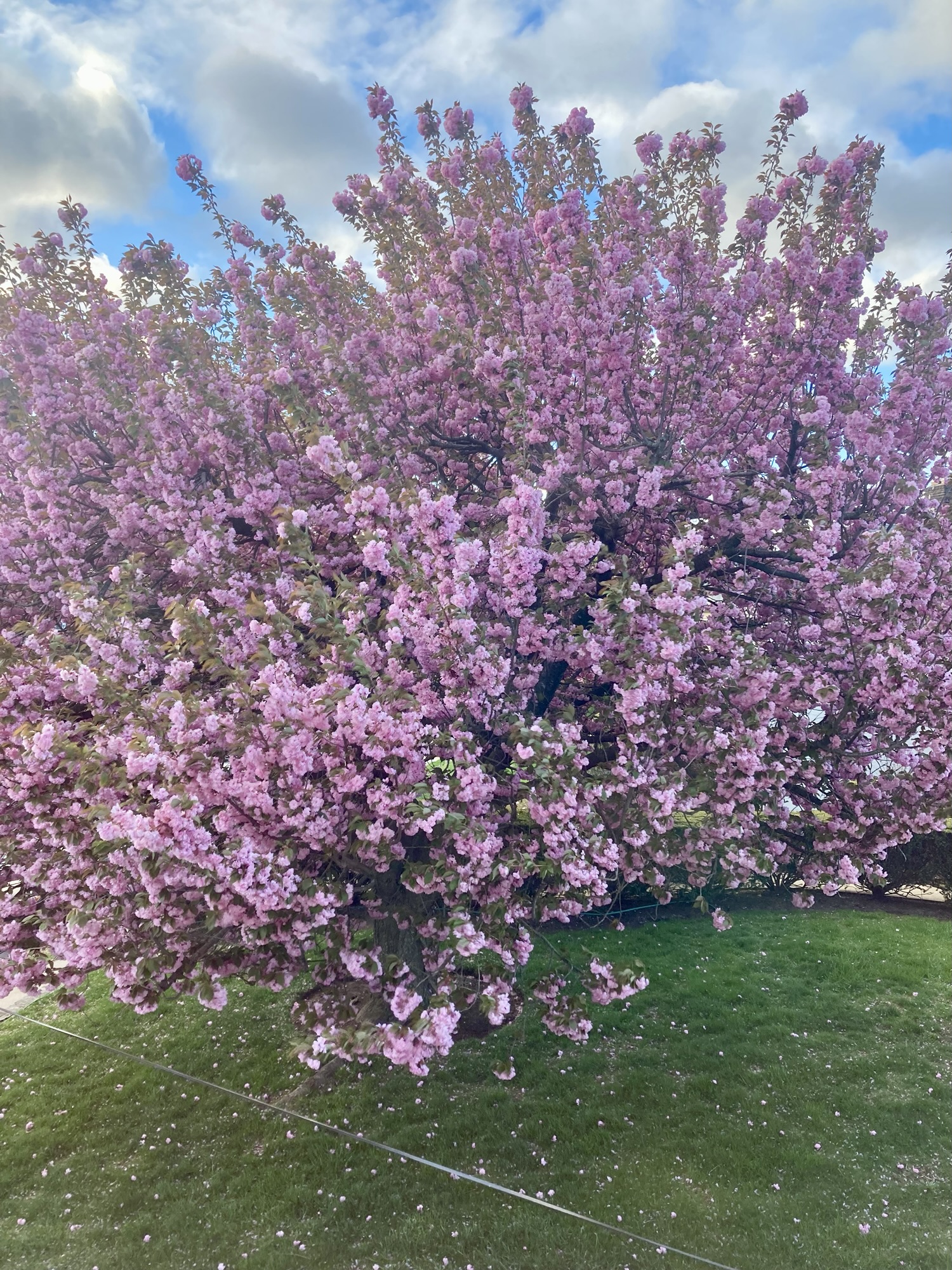
Sometimes, we need to wake up later. What’s true for us is true for some Cherry Trees, too. Welcome to another Haibun Monday, poets! Frank J. Tassone here, and today, we again write haibun, that blend of prose-poetry and haiku. On this last Monday of April, 2025, let’s embrace a traditional Spring kigo: late cherry blossoms!
As I said three years ago:
Blooming from mid-March to late April, Cherry trees produce an array of beautiful flowers, whose colors embody Spring. Viewing the Cherry Blossoms (hanami) evolved as an important cultural ritual in Japan. Poets from the Heian era wrote many waka (tanka) that alluded to the blossoms. Basho continued this tradition in both his haiku and haibun writing, and other haiku poets followed his lead. Viewing Cherry Blossoms remains popular today, both in Japan and throughout the world. The United State’s National Cherry Blossom festival, for example, is an annual celebration in the nation’s capital.
The Cherry tree next to my home just bloomed this past week. Bright pink blossoms now adorn every branch like a garlanded Christmas Tree. When I looked at its bare branches before vacationing the week before last, I wondered if I’d ever see its blossoms. Now that they’re here, I sigh as Sunday’s strong winds already blow some of them to the ground.
Again, as I said three years ago:
No wonder cherry blossoms inspired some haiku masters themselves:
without regret
they fall and scatter…
cherry blossoms
(Issa)
How many, many things
They call to mind
These cherry-blossoms!
(Basho)
Sakura, sakura
they fall in the dreams
of sleeping beauty
(Buson)
from “Haiku Poetry about Cherry Blossoms,” Alicia Joy, Culture Trips
Today, let’s write haibun that allude to late cherry blossoms!
New to haibun? The form consists of one to a few paragraphs of prose—usually written in the present tense—that evoke an experience and are often non-fictional/autobiographical. They may be preceded or followed by one or more haiku—nature-based, using a seasonal image—that complement without directly repeating what the prose stated.
New to dVerse? Here is what you do:
- Write a haibun that alludes to late cherry blossoms.
- Post it on your personal site/blog.
- Include a link back to dVerse in your post.
- Copy your link onto the Mr. Linky.
- Remember to click the small checkbox about data protection.
- Read and comment on some of your fellow poets’ work.
- Like and leave a comment below if you choose to do so.
- Have fun!
 dVerse
Pingback: Slipping | Björn Rudbergs writings
Good evening… a glass of sparkling sake would be great to celebrate the sakura I think.
One sake coming up!
Good afternoon, poets! The Pub is open!
Pingback: dVerse — Haibun Monday — Late (for) Cherry Blossoms – Tao Talk
Hello Bjorn, Frank, and All. I enjoyed writing to this prompt and am definitely enjoying the warmer weather. Dandelions officially in bloom!
Love it, Li! Happy you made it! 😀
Thanks, Frank.
I may have to take a slightly different tack. We are entering winter and blossoms of any kind are scarce! I’m hosting a bunch of bees at the moment it is so bad out there. If there’s any whisky in the cupboard, I’ll have a single as is please. Or do I need a double?
petru, where in the world are you? I’m in nj, usa
South Africa, thankfully.
ah super. Thanks
Who doesn’t need a double? Here you go!
Thanks!
Hi Frank! Can you pour me a glass of cherry soda?
Coming right up!
Pingback: I’m an Introvert | petrujviljoen
Gilles lovely about the pour trees
*gillena*. And “poui” trees!
Hello Frank! Thanks for this challenge. It’s been awhile since I’ve written to this and it was fun to do so. Mine is based on a sakura tree we lost many years ago in a storm. Happy Monday, all~
Glad you could join in, Jennifer!
That’s all for me, tonight. Last one out, get the lights! See you on the trail tomorrow!
Hello, Frank, thanks for hosting. I love writing a haibun and the topic was great too.
Pingback: Holding Back Time – Haibun by Paul Vincent Cannon | parallax
Many thanks Frank, it’s amazing what stirs when prompted 🙂
Pingback: Fleeting Blossoms | What Rhymes with Stanza?
Thanks for the lovely prompt, Frank. It was definitely timely as we visited these beauties just the other day. Cheers!
Pingback: Spring Ritual | thoughts and entanglements
Pingback: May 2025 Late Cherry Blossoms | method two madness
Pingback: Cherry pink – Keep it alive