
It’s Tuesday and the dVerse Poets Pub is open with cold drinks, spicy dips, carrot and celery sticks, pitta bread and the usual bar snacks, as well as a selection of delicious poetry. I’m Kim from writinginnorthnorfolk.com, your host for this week’s Poetics.
I return again and again to the war poets, particularly Rupert Chawner Brooke, an English poet born on 3rd August 1887, son of a housemaster at Rugby School, which he entered at the age of fourteen. A lover of poetry since he was nine years old, he won the school poetry prize in 1905. A year later, Brooke attended King’s College, Cambridge and became president of the Fabian Society. He published his first poems in 1909 and his first collection, Poems was published in1911.
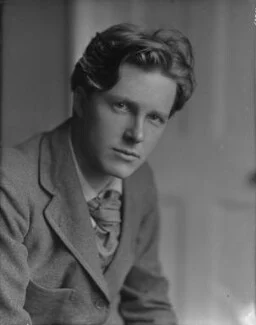
Popular in both literary and political circles, Brooke befriended Winston Churchill, Henry James, and members of the Bloomsbury Group, including Virginia Woolf. Although he was popular, Brooke had a troubled love life. Between 1908 and 1912 he fell in love with three women; however, none of the relationships lasted and, in 1912, after his third romance failed, Brooke left England to travel in France and Germany for several months.
He returned to England and, in 1912, he compiled an anthology entitled Georgian Poetry, 1911–12, with arts patron and translator Edward Marsh. Although most critics found Brooke’s poetry sentimental and lacking depth, they considered his work a reflection of the mood in England during the years leading up to World War I.
After experiencing a mental breakdown in 1913, Brooke travelled again, spending several months in the U.S., Canada, and the South Seas. While in the South Seas, he wrote some of his best poems, including ‘The Great Lover’.
Brooke returned to England at the outbreak of the First World War and enlisted in the Royal Naval Division. His most famous work, the sonnet sequence 1914 and Other Poems (Sidgwick & Jackson, Limited), appeared in 1915.
On April 23, 1915, after taking part in the Antwerp Expedition, Brooke died of blood poisoning from a mosquito bite. Following his death, he became a symbol of the tragic loss of talented youth during the war.
Read the following lines from the second stanza of ‘The Great Lover’ by Rupert Brooke:
“These I have loved:
White plates and cups, clean-gleaming,
Ringed with blue lines; and feathery, faery dust;
Wet roofs, beneath the lamp-light; the strong crust
Of friendly bread; and many-tasting food;
Rainbows; and the blue bitter smoke of wood;
Radiant raindrops couching in cool flowers;
And flowers themselves, that sway through sunny hours,
Dreaming of moths that drink them under the moon;
Then, the cool kindliness of sheets, that soon
Smooth away trouble; and the rough male kiss
Of blankets; grainy wood; live hair that is
Shining and free; blue-massing clouds; the keen
Unpassioned beauty of a great machine;
The benison of hot water; furs to touch;
The good smell of old clothes; and other such—
The comfortable smell of friendly fingers,
Hair’s fragrance, and the musty reek that lingers
About dead leaves and last year’s ferns. . . . “
You can read the full poem here.
The second stanza is a long stanza, consisting of forty-seven lines, comprising a list of everything the speaker (Brooke) loved. In lines 1-9 he includes “white plates and cups” and “many-tasting food”, the “radiant raindrops couching the cool flowers” as well as the “flowers themselves, that sway through sunny hours”. These choices show both his care for the world and the way he sees it.
In the following lines (10-19), the list continues with the love the speaker feels for “the cool kindliness of sheets, that soon / Smooth away trouble” and the “rough male kiss / Of blankets”, “furs to touch”, the “good smell of old clothes” and the “comfortable smell of friendly fingers”. Here Brooke engages the reader by appealing to the senses.
Your challenge:
Re-read Brooke’s poem as inspiration and, if you wish, springboard off one or more lines that appeal to you from this stanza, or you may like other lines from the complete poem, for example “Sweet water’s dimpling laugh from tap or spring”, “the little dulling edge of foam / That browns and dwindles as the wave goes home” or “brown horse-chestnuts, glossy-new” .
Now write a list poem that begins ‘These I have loved:…’ of the everyday things that are important or precious to you. Be specific, picking out tiny details, and don’t stop until you get to the bottom of the page.
Finish with ‘All these have been my loves’. Leave yourself time to refine your draft and then follow the usual instructions:
- Write a poem in response to the challenge.
- Enter a link directly to your poem and your name by clicking Mr Linky below.
- There you will find links to other poets, and more will join, so check back for their poems.
- Read and comment on other poets’ work – we all come here to have our poems appreciated.
- Please link back to dVerse from your site/blog.
- Mister Linky will close on Saturday at 3 p.m. EST.
- Comment and participate in our discussion below, if you like. We are a friendly bunch of poets.
- Have fun.


Good evening, poets! I hope you’re all in fine fettle and have been enjoying the summer. After a week away, I’m glad to be home, and hosting Poetics is an added bonus. I look forward to reading your poems, In the meantime, enjoy a drink and a snack, and I’ll be round to read shortly.
Hello, this is a prompt i enjoyed writing to… still summer here, to enjoy and walk in.
I’m pleased you enjoyed the prompt, Björn, and really enjoyed your poem.
I think we all could go on and on about our loves…so many! Thanks, Kim, for hosting here 🙂
Always a pleasure, Lynn. As I said to another poet, we’re only scratching the surface.
What a lovely, wonderful prompt! I’m retired now and thought I’d have more time for poetry (including learning along with writing) but I find myself with two rambunctious grandboys this week (ages 3 & 5) and will likely be answering this prompt for an upcoming Open Link Night. List poems are soooo fun, and the Brooke prompt is wonderful. I LOVE his work. I look forward to reading all the wonderful poems that come into Mr. Linky in response to this prompt. Thanks, Kim!!!
I’ve just spent a week with my two grandsons, 8 and 3, also rambunctious, Kim, and couldn’t find a minute to myself, let alone to write poetry, although the older boy asked me to help him write a poem for his teacher. I look forward to reading yours whenever you find the time. Enjoy your week!
You get it!!!! 8 is probably easier than 3, but the distance between them probably makes it hard to pick activities. Hire cool that you got to provide guidance for a school poem. That’s a grandparent’s dream!
Great prompt Kim one of my favourite poets 💕
Thanks Ange. Rupert Brooke and Wilfred Owen are my favourite war poets.
Yes and Robert Graves 🩷
This is a great prompt, Kim. It should be very interesting to read each other’s posts.
Thank you, Dwight. I’m only just up this morning, but I’ll be making the rounds soon and look forward to reading everyone’s poems.
Hello, Kim! Great prompt. I absolutely adored this poem.
Hello, Jay! I’m glad you enjoyed poem and prompt, and I look forward to reading your poem.
Pingback: These I have loved – Denise DeVries – Author
Greetings All ~ Kim, your poetic challenge is one of the most challenging in the best possible way ~~ thought provoking, deeply personal ~~ I am pondering, examining, remembering. Cheers!
Thank you, Helen. I look forward to reading your poem. You have plenty of time – until Saturday afternoon.
I always enjoy some Rupert Brooke, and I do love a list poem, so double bonus, many thanks for this prompt Kim.
Cheers Paul!
Hi Kim!
I LOVE this prompt! We’ve just gotten back home after a week in Chicago with family….delayed flights last night etc. And before that, guests staying with us for a week so I’m a bit exhausted with laundry to do, errands to run etc. So not sure when I’ll get to this. If not before Mr. Linky closes, will definitely use it for an OLN. Truly a wonderful prompt! Happy Wednesday, my friend.
Happy Wednesday, Lill! I got back on Monday afternoon and I’m still catching up. I look forward to reading your poem. No pressure.
Pingback: These Have I Loved | What Rhymes with Stanza?
List poems are always such fun, and I really like Brooke’s. Thank you for the challenge.
Welcome to the Pub’s Poetics, Josie. I’m delighted you like the challenge.
Very tardy – I had to wait till my working week was over, and I’m not sure its what you had ain mind, but its a list and of thing I love…- great prompt, Kim…
Thank you, and you’re not so tardy, Andrew; you have until Saturday. I look forward to reading your list poem.
I love this poem – thank you for the great prompt! Here is my response:
I’m so glad you love the poem and the prompt. Will be over to read and comment shortly.
Hi all. Unfortunately, I screwed up and missed the cut off to link up. If you’re interested in reading my poem, here it is. Thanks!
https://theelephantstrunk.org/2026/07/26/in-my-life-in-my-heart/
Never too late, Nancy. I’ll be over to read after breakfast.
Oh, great! Thanks, Kim.