In my last appearance here with Pretzels & Bullfights, I led us into the Romantic Period with William Wordsworth and his celebrations of the powers of nature and the spirit. Today, we move a few steps forward in time and honor William Blake.
The Romantic Period in literature and arts was a time of the rejection of social and political norms, an era where exploring all emotions fueled creativity and the picturesque qualities of nature captivated imagination. Romanticism freed artists and writers to express their personal feelings in their creations. Originality was an essential element during the Romantic period as it should be today. Perhaps as a result of personal experience and the examination of their own feelings, Romantics distrusted the human world. They chose to believe strongly in their connection with nature to strengthen individual moral and mental health.
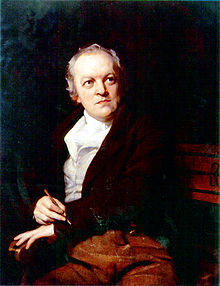
William Blake by Thomas Phillips
William Blake was born in Soho, London in 1757. He attended school until he was 10 years old, then continued his studies at home with his mother. Although he is now considered a major figure in the histories of poetry and visual arts, his works were unrecognized during his lifetime. His contemporaries often scoffed his idiosyncratic views and considered him mad, he was most likely more advanced than his critics in thought and talent. William Rossetti, 19th century scholar, regarded Blake as a “glorious luminary” and “a man not forestalled by predecessors, nor to be classed with contemporaries, nor to be replaced by known or readily surmisable successors”. In essence, Blake personified the foundation of Romantic beliefs.
William Blake was a gifted poet and painter. He was also a printmaker, painstakingly printing copies of his own poetry for distribution. He etched each poem by hand along with his original illustrations on copper plates. The plates were then inked for print. Once printed, he colored the illustrations by hand with paint. This expensive and time consuming method pays homage to the blending of his two great loves, poetry and visual
arts. Blake believed they were inseparable although looking at each today, both appear to have the strength to stand on their own but together, they create a deeper impression to the reader.
Blake’s Songs of Innocence and Experience (1794) present the innocence of childhood in contrast to the adult world, pastoral next to corruption and repression, dark next to virtue. This collection offers two very different views of the same world. “The Lamb” represents a humble and docile virtue from the perspective of innocence while the poem that pairs with it, “The Tyger”, gives evidence of opposing darkness.
Little Lamb who made thee
Dost thou know who made thee
Gave thee life & bid thee feed.
By the stream & o’er the mead;
Gave thee clothing of delight,
Softest clothing wooly bright;
Gave thee such a tender voice,
Making all the vales rejoice!
Little Lamb who made thee
Dost thou know who made thee
Little Lamb I’ll tell thee,
Little Lamb I’ll tell thee!
He is called by thy name,
For he calls himself a Lamb:
He is meek & he is mild,
He became a little child:
I a child & thou a lamb,
We are called by his name.
Little Lamb God bless thee.
Little Lamb God bless thee.
Tyger Tyger, burning bright,
In the forests of the night;
What immortal hand or eye,
Could frame thy fearful symmetry?
In what distant deeps or skies.
Burnt the fire of thine eyes?
On what wings dare he aspire?
What the hand, dare seize the fire?
And what shoulder, & what art,
Could twist the sinews of thy heart?
And when thy heart began to beat,
What dread hand? & what dread feet?
What the hammer? what the chain,
In what furnace was thy brain?
What the anvil? what dread grasp,
Dare its deadly terrors clasp!
When the stars threw down their spears
And water’d heaven with their tears:
Did he smile his work to see?
Did he who made the Lamb make thee?
Tyger Tyger burning bright,
In the forests of the night:
What immortal hand or eye,
Dare frame thy fearful symmetry?
In “The Lamb”, the speaker is childlike, asking the lamb about its creator. With its gentle tone, the poem ends with a blessing for the lamb.
In contrast to the innocent wonder, the speaker in “The Tyger” knows fear and wonders what kind of being could create such terror to roam among the weak and wonders if that same being could possibly have created the lamb.
These are two examples from William Blake’s Songs of Innocence and Experience. When reading this collection, it is important to remember that most poems are contrasting pairs, each a different view of the same situation.
The story of William Blake’s death is one of a romantic artist. His wife of nearly 45 years, Catherine Sophia (Kate) was at his bedside. Blake recognized her sorrow and proportedly asked “Stay Kate! Keep just as you are – I will draw your portrait – for you have ever been an angel to me.” When he completed her portrait, he began singing hymns and verses, then promised his wife that he would be with her always before taking his final breath. Kate professed that Blake visited her frequently from beyond the grave and spoke to him from her own deathbed a few years later. They were buried at Dissenter’s burial ground in Bunhill Fields. Unfortunately, the precise location their grave is lost. In 1965, the markers were removed from the old cemetery to create a lawn. A memorial stone stands for both William and his wife in Westminster Abbey.
Thank you for joining me for Pretzels & Bullfights. As usual, I could only scratch the surface of information about this talented poet and artist. I hope I have inspired you to read more of his work. I am currently traveling on personal business but will monitor comments when I have internet access.
References:
Romanticism – Wikipedia
Gutenberg.org
Sparknotes
Online Literature
Blake, William and Rossetti, William Michael. The Poetical Works of William Blake: Lyrical and Miscellaneous. 1890, p. xi.
 dVerse
I enjoy Blake’s poetry and much appreciated learning more about him. It amazes me how many “masters” of their craft weren’t recognized during their own lifetime. Perhaps this should encourage us.
Hi Victoria 🙂 I think there is hope. I’d prefer to reap rewards if I can. Lol
Well, I must either have scheduled the post incorrectly or my sense of time zones is out of whack. I didn’t think this was to post for another hour. I will respond to comments via cell phone. I hope you enjoy this post.
Blake is one of those poets that I read very differently when I was young (he appealed to me with his love for animals and often very simple language) and then when I grew up. A delight to read and reread, thank you for reminding me of him.
Ah, beautiful Blake! A unique genius. I loved the deathbed story, thank you.
smiles…i think it is pretty cool that he was not accepted during his time, and thought mad….that gives me hope eh? smiles…pretty cool on revisiting his wife as well…that makes me smile…that there is love that lasts beyond…smiles.
Love his paintings almost as much his poems. Some of them seem even more before his time. His Illustation of Dante are hellishly magnificent 😉
Thank you for reminding me of one of my earliest poetic enthusiasms. Tyger Tyger was the subject I used for the calligraphy part of my O level an awrul long time ago.
Fun to read Lamb and Tyger today. My favorite of his works is “The Marriage of Heaven and Hell.” I love the death story you tell.
I hadn’t heard that story of his death, but love it – that kind of love… makes me shiver a bit.
Interestingly (given this is one of the poems you quote in its entirety, Beth), my choir is slated to sing “The Lamb” (Blake’s poem set to music by John Tavener) at our Christmas concert this year… It isn’t one of the poems I was that familiar with previously.
And I’m with Bjorn in thinking Blake\s paintings magnificent… even on a par with his writings.
This was moving, especially about the time he died with his wife by his side. Thank you for shedding some light on Blake’s art and life.
Lila
Thanks Beth for the insight into William. An interesting read and yes how sad that poets – possibly unlike other ‘writers’ are known after they pass. Love does last beyond I am sure of it (referring to Brian’s comment) I think that is why I can do what I do…as I know it is not the end of their journey ~ smiles
Give me the classics any day. Poetry should be poetic and often in this age, it is not.
I have been travelling for the past week but have just realised that Dverse notifications have not been appearing in my inbox. I wonder if others had the same.
the story of Blake’s death is so touching .. so poetic. Inspired me to read more of his work.
Love Blake. Thanks for this. 🙂